
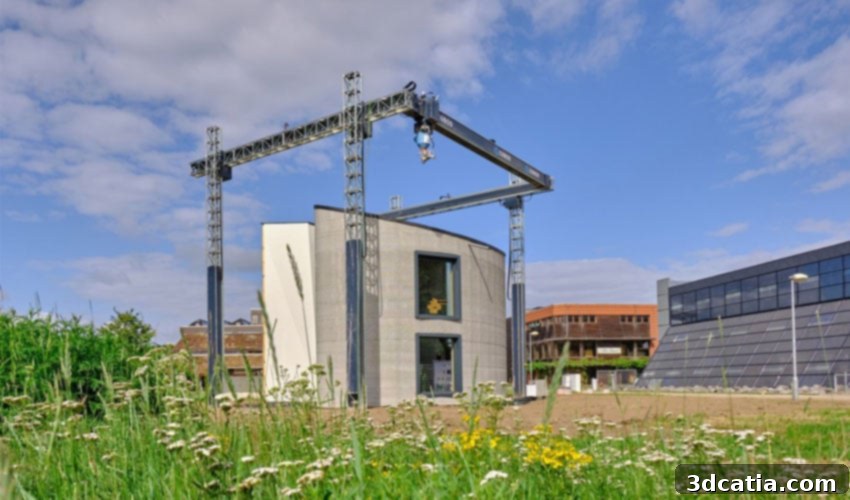
Belgium’s Two-Storey 3D Printed House: A Landmark in Sustainable Construction
In a monumental stride for the global construction industry, Belgium has proudly introduced its inaugural two-storey house, brought to life entirely through the advanced techniques of additive manufacturing. This groundbreaking residential structure is the result of an innovative collaboration between Kamp C, a prominent Belgian center for sustainability and innovation in construction, and COBOD, a world-renowned leader in construction 3D printing technology. Leveraging COBOD’s state-of-the-art BOD2 concrete 3D printer, Kamp C masterfully constructed the 90-square-meter dwelling in an astonishingly swift period of just three weeks. What makes this project particularly revolutionary is its unique construction method: the entire house was printed in a single, continuous block. This eliminates the conventional, often laborious, on-site assembly steps typically associated with modular or pre-fabricated construction, significantly streamlining the building process. While not yet inhabited, this impressive structure serves as a visionary model house, meticulously designed to showcase the full, untapped potential and transformative capabilities of additive manufacturing within the demanding construction sector. It stands as a beacon for a new era of building, emphasizing speed, efficiency, and sustainability.
The contemporary construction industry is navigating a complex landscape fraught with significant challenges. These encompass the excessive consumption of traditional, often polluting materials like concrete and steel, high energy demands throughout the entire building lifecycle, and the pressing global imperative to drastically reduce CO2 emissions to mitigate climate change. Simultaneously, there’s an escalating demand for housing solutions that are not only affordable but also maintain high standards of quality and durability. Furthermore, the sector contends with issues such as skilled labor shortages, lengthy project timelines, and considerable material waste, all of which contribute to rising costs and hinder the timely completion of essential infrastructure. These multifaceted constraints frequently impede project progress, inflate budgets, and create widespread frustration among stakeholders. It is precisely within this challenging environment that additive manufacturing emerges as a compelling and potent solution, poised to redefine our approaches to design, development, and construction. Kathleen Helsen, MPP for Housing and President of Kamp C, powerfully articulates this potential, stating: “New technologies, such as 3D printing of concrete, can help provide an answer. 3D printing in construction is growing worldwide. A number of possibilities, including the printing of temporary dwellings and even complete apartments, are already being implemented, but this technology is still very new in Flanders.” Kamp C’s visionary project, this pioneering 3D printed house, is therefore much more than just a building; it is a live demonstration, meticulously engineered to unveil the profound possibilities and practical applications offered by additive manufacturing technology for shaping the future of sustainable and efficient construction.
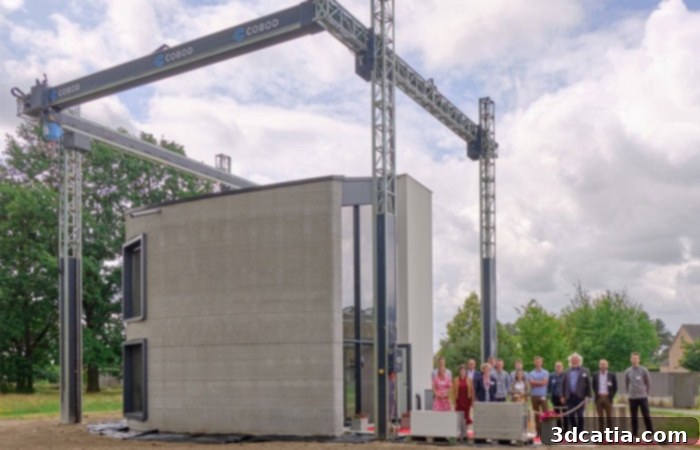
The impressive two-storey 3D printed house alongside the cutting-edge COBOD 3D printer, a testament to modern construction innovation. (Photo credits: Kamp C)
The Kamp C team deliberately designed the 3D printed structure with an open-ended utility, thereby emphasizing its remarkable versatility and adaptability. This allows the building to function seamlessly as a comfortable family home, a dynamic modern office space, or even a flexible commercial unit, depending on future needs. Regardless of its eventual designation, the inherent benefits of employing 3D printing technology in this context are unequivocally substantial and far-reaching. The project yielded impressive savings across multiple fronts, demonstrating a reduction of 70% in material consumption, overall costs, and construction time when compared to conventional building methodologies. The initial three-week timeframe to erect the entire two-storey structure represents a significant acceleration in construction speed. Furthermore, the Kamp C team is actively pursuing optimization, with an ambitious goal to reduce similar construction projects to a matter of mere days, promising an even greater revolution in project delivery. Beyond sheer speed and efficiency, material innovation formed a cornerstone of this project. To significantly enhance the structural integrity, durability, and resilience of the final structure, carbon fibers were ingeniously incorporated into the concrete mixture. Marijke Aerts, project manager at Kamp C, proudly highlighted the superior performance of this advanced composite material: “The compressive strength of the material is three times higher than that of conventional building bricks.” This translates to a 3D printed house that is substantially stronger and more robust than structures built using traditional techniques, offering enhanced longevity and safety. Moreover, the inherent design freedom facilitated by 3D printing technology allowed for the creation of unique, atypical, and architecturally striking shapes and complex geometries that would be exceptionally difficult or prohibitively expensive to achieve through conventional construction methods. This project also championed a deep commitment to environmental responsibility, adopting a “greener” construction philosophy. The house incorporates state-of-the-art features engineered for ultra-low energy consumption, integrates efficient solar panels for sustainable energy generation, and utilizes a highly effective floor and ceiling heating system, all contributing to a significantly reduced environmental footprint and fostering sustainable living practices for the future.
Perhaps the most truly revolutionary aspect of the advanced technique meticulously developed in partnership with COBOD lies in its unparalleled ability to 3D print the entire exterior envelope of the house in one seamless, continuous process, spanning both floors simultaneously. This monumental achievement—a two-storey house fabricated in a single, monolithic block—stands as an unprecedented global first for the entire construction industry. Traditionally, even with the adoption of construction 3D printing, different structural components are typically printed separately, either off-site as modules or as distinct sections, which are then transported and laboriously assembled on the construction site. This pioneering single-block approach fundamentally redefines the construction paradigm, offering a multitude of unparalleled benefits in terms of structural integrity, dramatically increased speed of construction, and a substantial reduction in the need for extensive on-site labor. By printing the entire structure as an integrated whole, potential weak points often found at conventional joints and seams are minimized, leading to a significantly more robust, cohesive, and structurally sound building. Furthermore, the accelerated timeline means that entire construction projects can transition from conceptualization to completion far more rapidly, directly addressing urgent housing demands and significantly reducing overall project durations and associated risks. The economic implications of this innovative method are equally profound, promising substantial savings on labor costs, transportation logistics, and complex material handling. This methodology showcases a highly scalable, incredibly efficient, and environmentally conscious path forward for constructing not only residential buildings but also diverse commercial spaces, vital temporary shelters, and bespoke architectural marvels. The spirit of innovation championed by Kamp C and COBOD is not merely about the mechanical process of printing a house; it’s about pioneering a fundamentally new, more integrated, and environmentally responsible method of building that possesses the power to redefine urban development strategies and housing solutions across the globe. This forward-thinking project firmly establishes Belgium’s position at the vanguard of additive manufacturing in construction, undoubtedly inspiring similar advancements and technological breakthroughs worldwide.
This landmark achievement in Belgium serves as a powerful and undeniable testament to the transformative potential of additive manufacturing in confronting and resolving some of the most critical and pressing issues facing the global construction sector today. From championing environmental sustainability through reduced waste and emissions to addressing the urgent societal need for affordable, high-quality, and rapidly deployable housing, 3D printing offers a compelling and comprehensive suite of solutions. The Kamp C project, distinguished by its unwavering focus on operational efficiency, groundbreaking material innovation, and integrated sustainable design, provides a tangible and replicable blueprint for future urban and rural developments. It conclusively demonstrates that advanced robotic construction techniques can deliver structures that are not only considerably faster and more cost-effective to build but are also inherently stronger, more durable, and significantly more environmentally friendly than their traditionally constructed counterparts. The newfound ability to create complex, customized, and aesthetically unique architectural forms without incurring exorbitant costs further unlocks unprecedented avenues for creative and functional design, allowing architects and builders to push boundaries previously deemed impossible. This pioneering spirit is absolutely vital for consistently driving innovation, fostering technological adoption, and encouraging the wider integration of these nascent but rapidly maturing technologies into mainstream construction practices. The implications of this project extend far beyond a single demonstration house, promising a future where construction is inherently more agile, dramatically less wasteful, and profoundly more adaptable to the dynamic and evolving needs and challenges of a growing global population. Those interested in personally witnessing this architectural marvel and gaining deeper insights into its sophisticated construction are cordially invited to visit the house. Public visits commenced in September 2020 and are available by appointment only. Further comprehensive details and precise scheduling information can be readily accessed on the official website of Kamp C, where you can explore the project’s ambitious vision and intricate technological specifics in greater depth. This project stands as a shining beacon for a new and progressive era in construction, warmly inviting professionals, forward-thinking policymakers, and the curious public alike to actively explore and embrace the boundless possibilities of building better, smarter, and greener for generations to come.
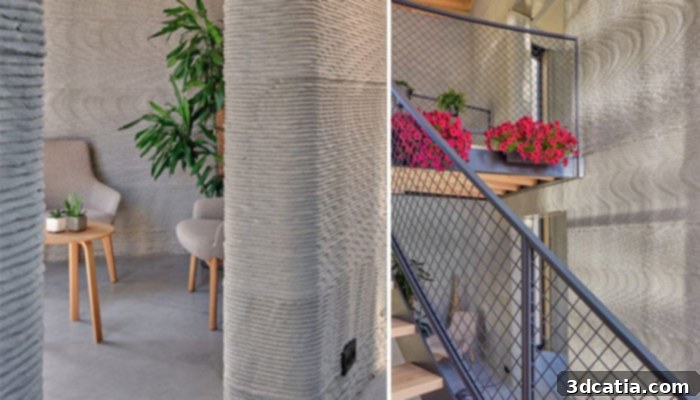
An exclusive glimpse into the modern and functional interior details of the groundbreaking 3D printed house, showcasing the versatility and aesthetic potential of this innovative construction method.
The revolutionary single-block 3D printed house by Kamp C and COBOD is far more than just a mere structure; it is a profound statement about the imminent future of construction and a tangible blueprint for innovation. What are your insightful thoughts on this incredible engineering achievement and the vast potential of a house 3D printed in a single, seamless, monolithic block? We warmly invite you to share your perspectives, opinions, and predictions for the evolution of building technologies in the comments section below. Engage in the conversation and connect with us on our vibrant social media channels – you can find us easily on our Facebook and Twitter pages! To stay comprehensively informed about all the latest advancements, cutting-edge innovations, and breaking news in the dynamic and rapidly evolving world of 3D printing, be sure to sign up for our completely free weekly Newsletter. Get exclusive, cutting-edge updates delivered directly to your inbox every week and actively become a vital part of the ongoing additive manufacturing revolution!