
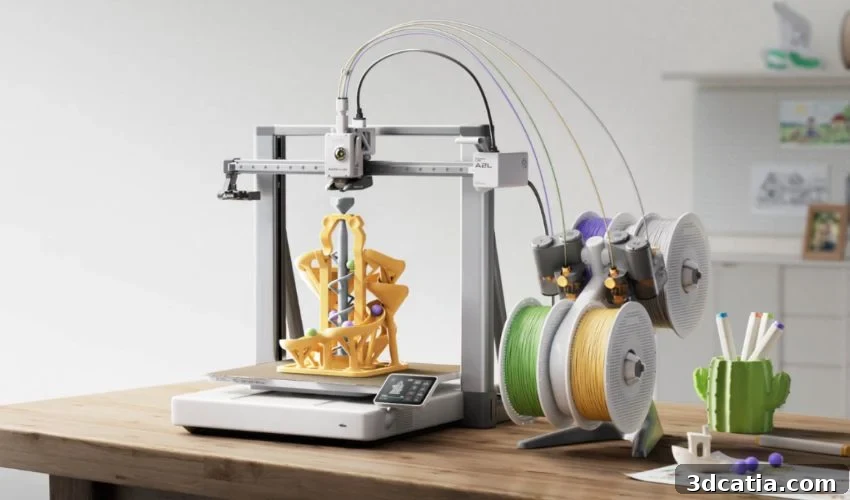
Today Bambu Lab launches the A2L, a large-format 3D printer the company calls the “Creative Playground.” Built for ambitious creative projects that once required splitting large models into multiple pieces, the A2L brings professional-tier capabilities to a more accessible price while preserving the user-friendly experience of the A-Series. With a 330 × 320 × 325 mm build volume, the A2L offers 105% more printable area than typical 256 mm-class machines, making it well suited for oversized cosplay props, high-volume lifestyle items, and RC model work.
Beyond sheer size, the A2L embraces modularity. The printer is compatible with accessory modules such as a blade-cutting unit and a pen-drawing module, allowing users to swap components and turn the machine into multiple tools. That flexibility underscores Bambu Lab’s focus on creative users who want a single platform capable of many functions.
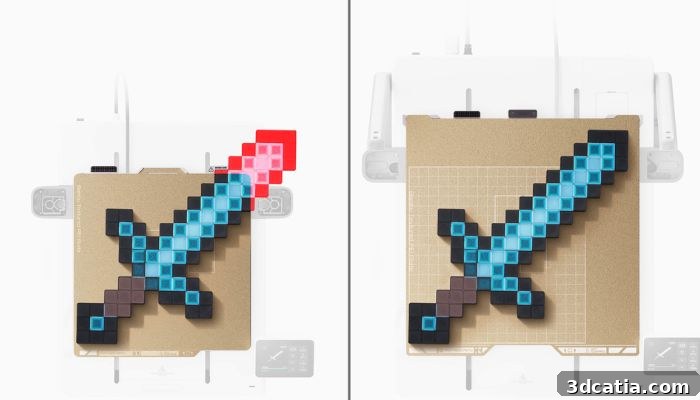
The A2L has 105% larger build volume than the A1.
What’s Different about the A2L?
While the larger build volume and modular approach headline the A2L, several additional design choices distinguish it from previous models:
- Extrusion System Upgrade: The A2L uses a PMSM closed-loop servo extruder for stable power delivery at high speeds and active monitoring of extrusion anomalies. This improves extrusion precision and reduces filament buildup. The printer also retains the A1 series’ detection suite, including Filament Run-out, Nozzle Clogging (Air Printing), and Tangled Spool detection.
- Adaptive Vibration Compensation: An adaptive algorithm with multi-point calibration and load-adapting reduces ghosting and ringing on large or tall prints, improving surface quality across extended builds.
- Physical Resonance Suppression: Two particle dampers are integrated into the frame to absorb resonance, sharpening fine details and enhancing overall print fidelity.
The A2L includes intelligent monitoring that enables hands-off printing and operates quietly in silent mode at around 49 dB; in Standard Mode peak noise reaches approximately 52 dB. The system can support up to four AMS units plus one AMS lite in series, enabling multi-material and multi-color workflows of up to 19 colors.
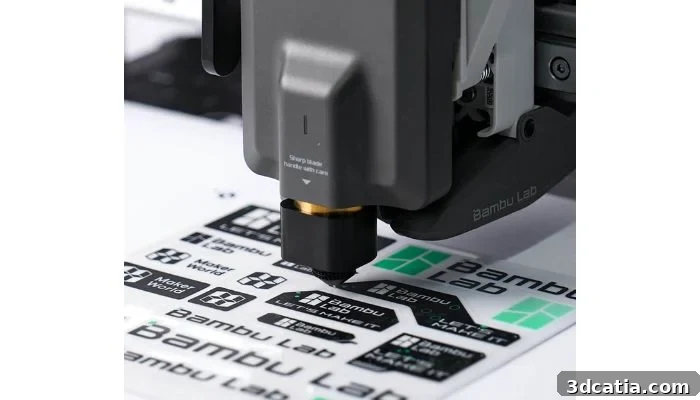
The A2L is compatible with blade cutting modules.
What the A2L Does Not Include — and Why
Some features commonly found on other machines are intentionally omitted from the A2L to preserve simplicity and reliability. The printer does not offer dual-nozzle or multi-toolhead setups; Bambu Lab positioned the A2L as an easy-to-use large-format device and prioritized core performance—build volume, surface quality, and dependable operation. Users who need advanced dual-nozzle capabilities may prefer the X2D model.
Another point is the maximum bed temperature, which is lower than the A1’s. As an open-frame printer, the A2L targets non-engineering filaments such as PLA and PETG that require modest bed temperatures. Raising the bed temperature across a significantly larger surface would increase energy consumption and could strain home electrical circuits. For that reason, Bambu Lab set the bed maximum at 80°C, which supports mainstream filaments while keeping power use reasonable.
Safety and alignment considerations influenced other exclusions. The A2L supports blade-cutting modules but not laser modules because the open-frame design raises safety concerns for laser operation. The printer also omits the BirdsEye camera, so it cannot perform the fully automatic Live Spatial Alignment available on the H2 series Laser models. Users can achieve photo-assisted alignment using the Bambu Handy smartphone app. Bambu Lab notes that a Print-then-Cut feature is under development and may arrive in a future OTA firmware update.
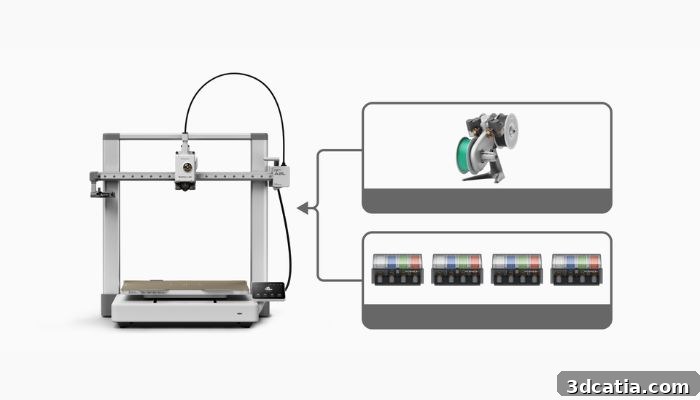
The A2L can print up to 19 colors at once, with four AMS units and one AMS lite connected.
The A2L will be available globally starting June 1, 2026, at a MSRP of $469 / €379. This model positions itself as a versatile, large-format option for makers and creators who want expanded build size, modular tooling, and reliable everyday performance without the complexity of multi-head systems.
*All Photo Credits: Bambu Lab