

Backflip: Pioneering the Future of 3D Design and Manufacturing with Advanced AI – An Interview with Co-founder Greg Mark
The world of additive manufacturing and 3D design is experiencing a profound transformation, spearheaded by innovators who continuously push the boundaries of what’s possible. Among these trailblazers are Greg Mark and David Benhaim, the visionary co-founders behind Markforged, a company that revolutionized 3D printing with its groundbreaking metal and carbon-fiber technologies, now operating across all seven continents. Their latest venture, Backflip, has already captured significant attention, launching last December with a remarkable $30 million in Series A funding. Backflip is an artificial intelligence design tool meticulously engineered to generate high-quality, manufacturable 3D models – a crucial differentiator in a market often lacking production-ready outputs. While other AI 3D model generators exist, they frequently fall short of producing models suitable for 3D printing without extensive post-processing and editing. Backflip, leveraging years of deep experience in the additive manufacturing field, prioritizes high functionality and printability, aiming to bridge the gap between imagination and physical reality. We recently had the opportunity to speak with Greg Mark, CEO of Backflip, to delve into the startup’s origins, its unique value proposition, and its ambitious trajectory.
Introducing Backflip: Bridging Imagination and Reality Through AI
Greg Mark enthusiastically introduced Backflip as a pioneering platform designed to build 3D AI models specifically for the physical world. The core mission is to empower designers and engineers, providing them with advanced tools that dramatically simplify the process of translating creative ideas into tangible products. He elaborated on their initial product, a highly intuitive web application that allows users to convert an idea—whether it’s a simple drawing, a sketch, a photograph, or even just text—into a highly detailed 3D model with a single click, in approximately one minute. This rapid generation capability is a game-changer, fostering unprecedented acceleration in how design ideas are communicated, iterated upon, and ultimately prepared for manufacturing, particularly via 3D printing.

Greg Mark, Founder and CEO of Backflip
Reflecting on his prior experience, Mark drew a clear distinction between his work at Markforged and his current endeavors with Backflip. At Markforged, the focus was firmly on the “downstream” aspects of manufacturing innovation. The company dedicated its efforts to developing cutting-edge 3D printing technology capable of producing robust and durable parts faster, utilizing advanced materials like carbon fiber and metal. He expressed immense pride in the technological advancements and the successful business infrastructure they built at Markforged, which fundamentally altered manufacturing processes in critical, resource-constrained environments such as the International Space Station or nuclear submarines, in addition to serving thousands of traditional and advanced manufacturing companies globally.
The genesis of Backflip emerged after a period of introspection following his time at Markforged. Greg Mark spent time recharging and deeply considering the evolution of manufacturing technology and the burgeoning ecosystem of service providers in both additive manufacturing and traditional CNC machining. A crucial realization dawned upon him: 3D design itself had become the most significant bottleneck, hindering wider access for individuals to create physical parts and products. Backflip was conceived to dismantle this barrier, accelerating and simplifying the entry of more people into the intricate world of 3D design. Consequently, Backflip zeroes in on the “upstream” phase of creating physical objects—the design process—aiming to revolutionize the journey from initial idea to final design and ultimately, to reality.
Backflip’s Overwhelming Reception and Investor Confidence
The enthusiastic response to Backflip has been palpable, evidenced by its substantial $30 million Series A funding and a rapidly growing waitlist for platform access. Greg Mark expressed profound gratitude for the support from their world-class venture firms, NEA and Andreessen Horowitz, emphasizing that their contribution goes far beyond mere capital. These firms, renowned for their expertise in deep tech innovation and as sector-specific authorities in AI, possess a unique understanding of Backflip’s vision and its transformative potential, offering invaluable strategic guidance and support. Their confidence underscores the significant impact Backflip is poised to make in the AI and manufacturing sectors.
Regarding the product’s public launch, Mark admitted that while they were prepared for a surge in traffic and optimistic about its appeal to the creative community, the exponential daily traffic growth for two consecutive weeks was beyond their initial expectations. He acknowledged the immense outpouring of interest, highlighting it as a primary focus for the company. Scaling their infrastructure to meet this surging demand has been a daily priority since the beginning of the year. He confirmed that Backflip has successfully begun inviting users off the waitlist, gradually opening up access to the platform, signifying a significant milestone in their journey to democratize 3D design.
Distinguishing Backflip: High Functionality for Manufacturable 3D Models
When discussing what truly differentiates Backflip from other 3D generators, Greg Mark articulated a clear, impact-driven philosophy. For him and his co-founder, the sole metric of their success lies in their positive impact on the world. “Did we actually make it easier for our users to turn their imagination into reality? Are we making their lives and jobs easier? Are we actually unlocking the future we want to live in?” These questions guide their development process, ensuring that the technology serves a meaningful purpose beyond novelty.
Mark emphasized that simply generating a 3D model is insufficient. For Backflip to be a true solution, the models must possess sufficient detail, quality, and functionality to meet the rigorous demands of users who intend to manufacture real physical parts. He noted the proliferation of AI models in the market, including Backflip’s contributions, but stressed their unwavering focus on building “high-quality, highly functional tools” rather than just demonstrating possibilities. An AI model can show what’s feasible, but a tool is something used daily to generate tangible value for the user. Mark made it clear: “We will have failed if all we do is help someone make a pretty model (although we’ve designed our tools to also create aesthetically beautiful parts too).” This perspective underscores Backflip’s commitment to utility and real-world application.
With this deep-seated philosophy, Backflip meticulously engineered a system specifically designed to produce detailed, high-quality 3D models. Crucially, this system also offers users an unprecedented degree of control and editability, empowering them to customize and refine designs to perfectly meet their unique challenges. The team leveraged their collective insights from decades in design and engineering to forge an AI-powered design process that is not only intuitive but also highly effective for professionals engaged in building real-world products and structures.
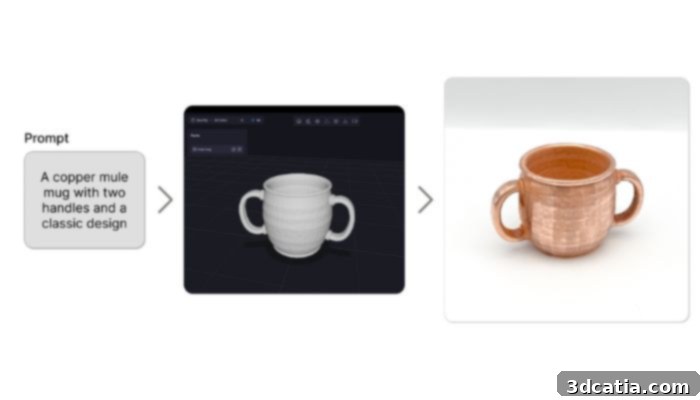
A prompt generates a 3D model, which is then 3D printed.
From a technological standpoint, the founders’ combined decades of experience in the 3D printing and manufacturing space provide Backflip with an intimate understanding of the characteristics that make parts truly manufacturable. This invaluable know-how has been strategically leveraged to construct the world’s largest synthetic dataset, specifically curated to train Backflip’s AI model in translating 2D images and textual prompts into robust 3D models. This dataset is continuously expanding and refining. A critical aspect of this training involves equipping the AI model and developing tools to generate 3D models with properties inherently conducive to 3D printing. A prime example is the creation of “manifold meshes”—geometries without any holes or discontinuities in the mesh surface—which are essential for successful and high-quality 3D prints. This deep integration of manufacturing expertise directly into the AI generation process is a fundamental aspect of Backflip’s competitive advantage.
Backflip’s Broad Target Audience and Diverse Use Cases
Greg Mark framed Backflip’s target audience expansively, envisioning the platform as a catalyst for humanity’s accelerated progress into the future. He articulated a profound belief: everyone possesses an imagination, yet a significantly smaller portion of the population possesses the tools or skills to manifest that imagination into physical reality. At Backflip, the objective is to build a platform for every inventor, designer, artist, engineer, or creator who harbors a desire to design their own future, democratizing the creation of physical objects.
Delving into specifics, Mark highlighted the widespread enthusiasm among users across a broad spectrum of creative fields. This includes established manufacturers seeking to streamline their design processes, designers crafting props, costumes, and special effects (SFX) for Hollywood productions, major toy manufacturers, consumer packaged goods (CPG) companies, interior designers, and even video game developers. The application of Backflip’s tools is remarkably diverse and industry-dependent. For many users lacking the specialized skillset typically required for existing, complex 3D design software, Backflip’s intuitive app provides an accessible pathway to create end products in 3D for the very first time. Meanwhile, for seasoned professionals with extensive design experience, Backflip is proving invaluable for early ideation, rapid design iteration, and efficient design communication, serving as a powerful front-end tool before they transition to their more traditional, detailed design software.
A recurring theme emerging from user feedback underscores Backflip’s utility in scenarios where clients or customers approach designers with only vague ideas of what they desire. Mark provided a vivid example from Hollywood’s SFX and props industry, where producers frequently request custom props without providing clear artwork or design direction. In such situations, Backflip empowers SFX and costume houses with a tool to quickly workshop various design concepts with their clients. This rapid prototyping and visualization capability allows for swift agreement on a design direction, significantly reducing the expenditure of time and energy on speculative work before a paid job is officially secured. This efficiency not only saves resources but also enhances client satisfaction by bringing ideas to life faster and more collaboratively.
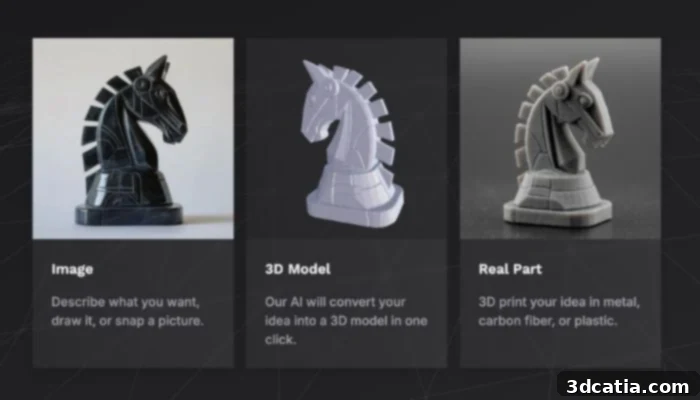
Backflip helps users make their imagination a tangible reality.
Navigating Challenges and Addressing Environmental Impact
The development of a universal 3D design tool presents unique challenges, as Greg Mark highlighted. One of the inherent complexities in 3D design is the sheer diversity of processes, even within a single industry. When considering the divergent design workflows and tool preferences of industrial designers, digital sculptors, mechanical engineers, and technical individuals with no prior 3D design experience, it becomes clear that “what works best” is highly subjective and varied. Backflip has actively sought to strike a delicate balance by creating highly flexible tools that offer users a wide array of options for how they prefer to create. This commitment to adaptability remains a major area of focus and continuous development for the company throughout the current year, ensuring the platform caters to a diverse user base effectively.
Addressing the critical concern of artificial intelligence’s environmental footprint, Greg Mark was transparent and pragmatic. He clarified that while he doesn’t want to “greenwash” the issue, Backflip’s technological approach is inherently more efficient in computing resources compared to Large Language Models (LLMs). This translates to substantially lower computational costs and a drastically reduced environmental impact. The key lies in Backflip’s “convergent versus divergent” technological process; unlike LLMs that make educated guesses in a vast, open-ended generative space, Backflip’s AI is purpose-built with a clear understanding of the desired output, making its computations far more focused and efficient. This targeted approach allows the AI to arrive at the solution more directly, minimizing wasted processing power.
Furthermore, Backflip has pioneered a novel neural representation that fundamentally teaches AI to “think” in 3D, thereby unlocking an entirely new category of models. This groundbreaking development yields remarkable efficiency gains: training is 60 times more efficient, inference (the process of generating a model) is 10 times faster, and the spatial resolution achieved is 100 times greater than existing state-of-the-art methods. Mark assured that the company is relentless in its pursuit of further improvements, continuously working to optimize its infrastructure and enhance these impressive metrics over time, solidifying its commitment to both performance and sustainability.
The Future is Now: Backflip’s Vision and Call to Innovators
Greg Mark concluded the discussion by emphasizing that while Backflip has already launched with a product that is immediately transformative in a “zero-to-one” sense—creating something entirely new and impactful—this is merely the beginning of their journey. The team is diligently working, actively listening to user feedback, and developing a host of new features and capabilities. By the end of the year, Backflip expects to have added a tremendous amount of new functionality, further solidifying its position as a leading innovator in AI-powered 3D design. He extended an open invitation to anyone passionate about building the future: “If anyone reading wants to get in touch to help build the future, we’re hiring talented and driven folks to join us and would love for them to reach out—you can find our careers info on our website here.”
Backflip stands poised to redefine how we conceive, design, and manufacture physical products, making advanced 3D creation accessible to a broader audience than ever before. Its unique blend of AI innovation, deep manufacturing expertise, and a user-centric approach promises to empower a new generation of creators to turn their imaginations into tangible realities. What are your thoughts on Backflip and its potential impact on 3D design and manufacturing? Let us know in a comment below or on our LinkedIn, Facebook, and Twitter pages! Don’t forget to sign up for our free weekly Newsletter here, the latest 3D printing news straight to your inbox! You can also find all our videos on our YouTube channel.
*Cover image: A mug designed with AI assistance in Backflip and then 3D printed in copper, exemplifying the seamless transition from digital concept to physical form. (All photo credits: Backflip)