
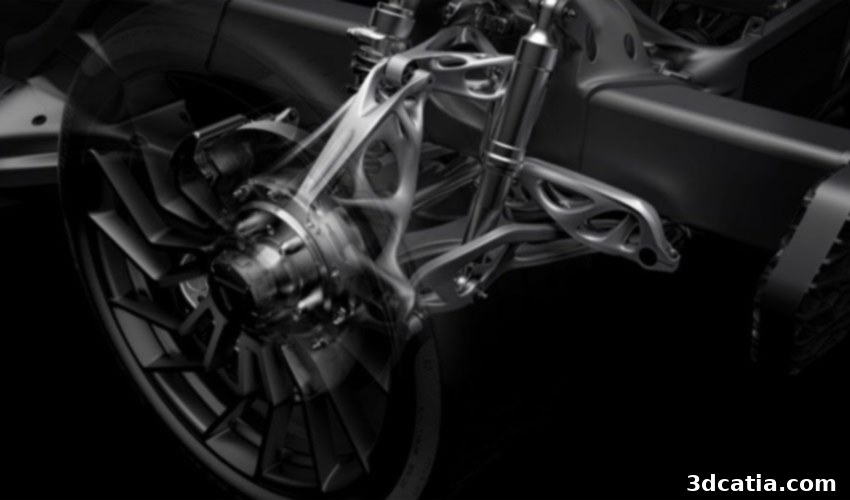
Additive Manufacturing’s Transformative Impact on the Automotive Sector: A Deep Dive into Growth and Production
The automotive industry is on the cusp of a profound transformation, largely driven by the accelerating adoption of additive manufacturing, commonly known as 3D printing. A recent comprehensive report from US research firm SmarTech Publishing sheds light on this monumental shift, projecting an extraordinary growth trajectory for additive manufacturing within the automotive sector. The study forecasts that this market, encompassing various 3D technologies for designing parts, functional prototypes, and tools, will achieve a revenue of $5.3 billion by 2023. Looking further ahead, the momentum is expected to intensify, with revenues predicted to soar to an impressive $12.4 billion by 2028. This significant growth underscores a clear trend: an increasing number of automotive players are integrating 3D printing into their operations, moving beyond traditional manufacturing constraints. The report meticulously analyzes the primary growth drivers and revenue sources, highlighting that additive manufacturing’s future lies predominantly in direct production applications rather than solely in prototyping or tooling.
This isn’t the first time SmarTech Publishing has forecasted such robust growth. In 2015, an earlier report estimated the automotive additive manufacturing market would reach $1.1 billion by 2019, reflecting an anticipated annual growth rate of 25%. Current trends suggest that this dynamic expansion is not only being sustained but is set to accelerate over the next decade. Crucially, the fundamental source of revenue generation is shifting dramatically. While prototyping and tooling have historically dominated the application landscape, the focus is now squarely moving towards the production of finished, end-use parts. This evolution signifies a maturing market where additive technologies are becoming viable for direct component fabrication. Both metal and polymer parts manufactured through additive processes are anticipated to become major revenue streams, collectively representing a staggering $4.3 billion by 2028. This indicates a strategic pivot within the industry, signaling a broader acceptance and integration of 3D printing into the core manufacturing processes for critical vehicle components.
The automotive additive manufacturing market in 10 years
The Unstoppable Rise of Additive Manufacturing in Automotive Confirmed
The projected market growth for automotive additive manufacturing is firmly substantiated by several transformative industry trends and technological advancements. One of the most significant developments has been the strategic entry of major technology players, such as HP, into the additive manufacturing landscape. HP’s Multi Jet Fusion (MJF) technology, for instance, has revolutionized the production of complex polymer parts, offering unparalleled speed, precision, and cost-effectiveness. This capability allows automotive engineers to rapidly iterate designs, produce functional prototypes, and even manufacture end-use components with intricate geometries that would be impossible or prohibitively expensive to achieve with conventional methods. The ability of MJF to create parts quickly and efficiently has been a game-changer for accelerating development cycles and enabling bespoke solutions.
Concurrently, the metal additive manufacturing segment has witnessed its own profound disruption with the emergence of innovators like Desktop Metal and the strategic acquisition moves by industry giants such as GE Additive. These companies have not only introduced advanced metal 3D printing technologies, including binder jetting and direct metal laser sintering (DMLS) or selective laser melting (SLM), but have also pushed the boundaries of material science. Their innovations enable the production of lightweight, high-strength metal components, crucial for improving fuel efficiency, electric vehicle range, and overall vehicle performance. The capacity to create complex internal structures, optimize topology for strength-to-weight ratios, and consolidate multiple parts into a single, additively manufactured component is rapidly transforming how critical engine, chassis, and structural elements are conceived and produced. These advancements are instrumental in validating additive manufacturing’s role in high-performance automotive applications.
Beyond these newcomers, established leaders in the additive manufacturing space—such as Stratasys, 3D Systems, EOS, and EnvisionTEC—have proactively evolved their offerings to meet the automotive sector’s burgeoning demands for mass production. These companies, with their diverse portfolios of technologies including Fused Deposition Modeling (FDM), Stereolithography (SLA), Selective Laser Sintering (SLS), and Digital Light Processing (DLP), have invested heavily in developing more robust, reliable, and scalable additive manufacturing solutions. Their focus has shifted from specialized, low-volume applications to systems capable of higher throughput, greater automation, and improved cost per part. This strategic pivot involves not only enhancing printer capabilities but also developing industrial-grade materials that meet stringent automotive requirements for durability, heat resistance, and structural integrity. By collaborating closely with automotive OEMs and suppliers, these pioneers are tailoring their technologies to facilitate the seamless integration of additive processes into existing automotive production lines.
Moreover, the foundational role of software solutions cannot be overstated in this additive manufacturing revolution. Leading software providers like Autodesk, Dassault Systèmes, and Siemens are at the forefront, offering sophisticated design and simulation tools specifically optimized for additive manufacturing (DfAM). These tools enable engineers to leverage generative design, topology optimization, and lattice structure creation, allowing for the development of parts that are lighter, stronger, and more efficient than those designed using traditional methods. A prime example of this synergy is the recent partnership between General Motors and Autodesk, aimed at significantly reducing the weight of electric car components right from the initial design phase. By integrating these advanced software solutions, automotive companies can unlock the full potential of 3D printing, creating innovative designs that were previously unimaginable and directly contributing to performance enhancements and sustainability goals across their vehicle platforms.
The SmarTech Publishing report further provides valuable insights into the specific types of parts benefiting most from 3D printing within the automotive context. It suggests that a vehicle’s powertrain components are rapidly emerging as a major source of revenue for additive manufacturing. This sector, critical for vehicle performance and efficiency, benefits immensely from the ability to produce complex geometries, optimize fluid flow, and integrate cooling channels, leading to improved thermal management and reduced weight. For polymer-based applications, the report indicates that 3D printed parts will primarily be of medium size and produced in increasingly larger quantities. This includes, but is not limited to, interior trim components, air ducts, fluid reservoirs, custom housings, and various jigs and fixtures used in the manufacturing assembly process. The ability to customize these parts on demand, reduce lead times, and consolidate assembly steps makes additive manufacturing an attractive solution for both pre-production and series production. These findings collectively demonstrate that 3D printing is no longer confined to niche applications; it is steadily transitioning into a legitimate method for mass production, irrespective of the material—be it advanced polymers or high-performance metals. For a deeper dive into these transformative insights, the complete study is available for review on the SmarTech Publishing website, offering detailed analysis and forecasts.
A 3D printed part by Ford
The future of additive manufacturing in the automotive sector promises continued innovation and integration. As material science advances, print speeds increase, and post-processing steps become more streamlined, the economic viability of 3D printing for even higher volume production will grow. While challenges such as standardizing materials, ensuring consistent part quality, and establishing robust certification processes remain, the industry is actively working to overcome them. The clear benefits—including unprecedented design freedom, rapid product development, part consolidation, weight reduction, and the potential for on-demand manufacturing—are simply too compelling for automotive manufacturers to ignore. As the industry continues to evolve towards electric vehicles and autonomous driving, the flexibility and capabilities of additive manufacturing will be even more critical in creating lighter, more efficient, and highly customized components. This dynamic landscape guarantees that 3D printing will play an increasingly pivotal role in shaping the cars of tomorrow.
What are your thoughts on the future trajectory of additive manufacturing within the automotive sector? We’d love to hear your perspective and insights! Please feel free to share your comments below or engage with us on our Facebook and Twitter pages. Don’t miss out on the latest advancements and news in the world of 3D printing; remember to sign up for our free weekly Newsletter, delivered straight to your inbox with all the crucial updates!