
Automated Powder Removal: Revolutionizing Post-Processing in Additive Manufacturing for Enhanced Safety and Efficiency
Additive manufacturing, commonly known as 3D printing, has witnessed an unparalleled surge in adoption and popularity across diverse industries in recent years. This transformative technology is no longer a niche concept but a mainstream solution for rapid prototyping, complex part creation, and even serial production. The substantial investment by companies in 3D printing technologies has skyrocketed, leading to a continuous increase in the volume of 3D-printed parts. Complementing this growth, an extensive ecosystem of CAD software has emerged, and the spectrum of available 3D printing materials is constantly expanding. From widely used plastics and metals to advanced ceramics, and even novel substances like chocolate, ash, and sugar, the material possibilities are vast and continually growing. However, the journey from a digital design to a finished physical component involves more than just printing. Just as numerous as the additive manufacturing processes themselves are the subsequent steps required for post-processing. These crucial operations include support structure removal, surface finishing, polishing, and critically, the removal of excess material. As additive manufacturing continues its industrialization trajectory, particularly in powder-based methods, the efficiency and safety of powder removal are gaining paramount importance.
In the realm of powder-based metal 3D printing, once the printing process is complete, a significant amount of unbound powder remains within the build chamber, clinging to the component, and occupying its internal channels and intricate cavities. This excess powder must be meticulously removed before the object can be finalized and proceed to subsequent post-processing stages. Traditionally, the powder still adhering to the component after printing is often removed manually. This method, however, is far from ideal. Manual depowdering demands extreme care and precision; any misstep or lack of attention can lead to irreversible damage to the component, or introduce imperfections that cause serious problems in subsequent manufacturing steps. For instance, the part must be absolutely free of any residual powder before critical processes such as heat treatment can commence, as contamination can compromise the material’s properties or structural integrity. The reliance on manual depowdering for additively manufactured components, especially those with complex geometries or large dimensions, inherently carries numerous disadvantages and significant risks, which can impact both part quality and operator safety.
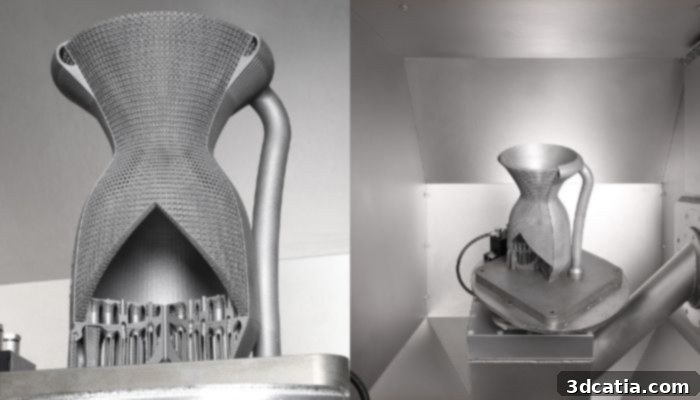
Manual powder removal quickly reaches its limits, especially with filigree structures (photo credits: Solukon Maschinenbau GmbH)
AM Experts Identify Critical Challenges with Manual Powder Removal
Solukon Maschinenbau, a pioneering company specializing in advanced systems for powder removal from components produced via metal or polymer laser powder bed fusion processes, conducted an extensive survey among experts in the additive manufacturing industry. The objective was to gain deeper insights into the limitations and bottlenecks associated with manual powder removal. The survey results unequivocally highlighted health risks as the most significant concern. Manual powder removal invariably exposes operators to fine dust particles, which, especially with certain metal alloys, can pose serious health hazards. These fine particles can be inhaled, leading to respiratory issues, or absorbed through the skin, potentially causing irritation or more severe systemic problems depending on the material’s toxicity. Furthermore, the risk of dust explosions, particularly with highly reactive metal powders like aluminum or titanium, was also frequently cited by respondents, underscoring a critical industrial safety challenge that traditional manual processes struggle to mitigate effectively. Ensuring operator safety and maintaining a healthy work environment becomes an increasingly complex and costly endeavor when relying on manual depowdering.
Another critical finding from Solukon’s survey was that a staggering 74% of the surveyed AM experts found it exceedingly difficult to achieve consistent and repeatable cleaning results through manual depowdering. The quality and thoroughness of the cleaning process are heavily dependent on the individual skill, experience, and even the momentary concentration of the operator. This inherent variability means that achieving a uniform and consistent cleaning quality across different parts or even different batches is practically impossible. Such inconsistency is a major impediment to scaling up production and ensuring robust quality control, especially in industries with stringent regulatory requirements like aerospace or medical. Without predictable and repeatable results, parts may need to be re-cleaned, undergo additional inspection, or even be scrapped, leading to increased costs, extended lead times, and reduced overall efficiency in the additive manufacturing workflow.
The challenges of manual depowdering are further compounded when considering the increasing size and complexity of modern 3D printed parts. With industrial 3D printers now capable of producing components up to a meter in height, the task of manually handling and depowdering such large and heavy objects becomes physically demanding, ergonomically challenging, and incredibly time-consuming. Delicate and intricate internal channels, which are a hallmark of advanced additive manufacturing designs, are virtually impossible to clean thoroughly by hand. This is precisely where manual depowdering methods rapidly hit their operational limits, creating a significant bottleneck in the entire AM production chain. Recognizing these growing limitations, the need for an automated solution became unequivocally clear. Andreas Hartmann, CEO and founder of Solukon, vividly recalls the pivotal moment: “We became aware of the crucial need for automated depowdering through a direct collaboration with a customer. In 2014, a prominent southern German automotive manufacturer approached us, seeking an innovative way to automatically remove powder from their components. This urgent demand spurred us into action, and in just one year, our team successfully developed the SFM-01 – the world’s inaugural automated powder removal system. A year later, Dominik Schmid and I officially founded Solukon Maschinenbau GmbH, a company dedicated entirely to advancing the science and technology of depowdering.” This rapid development and strategic focus quickly positioned Solukon as a market leader. Today, Solukon’s impressive customer base includes leading 3D printer manufacturers like EOS, SLM Solutions, and AddUp, alongside prestigious research institutes such as NASA, and several renowned American rocket building companies, all of whom trust Solukon’s automated solutions to optimize their AM post-processing.
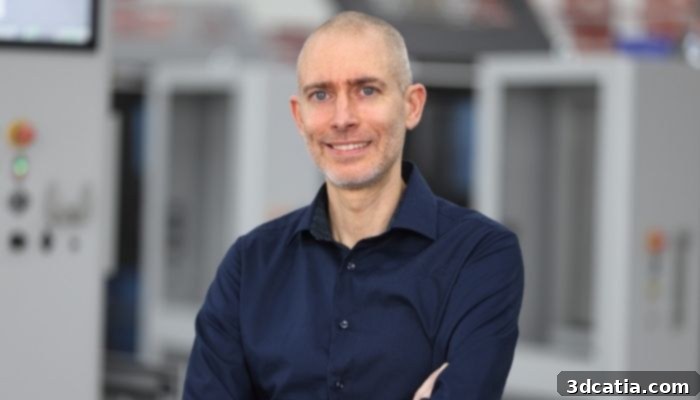
Andreas Hartmann recognized the importance of automated powder removal at an early stage (photo credits: Solukon Maschinenbau GmbH)
Automated Powder Removal: Unlocking Enormous Added Value for 3D Printing Production
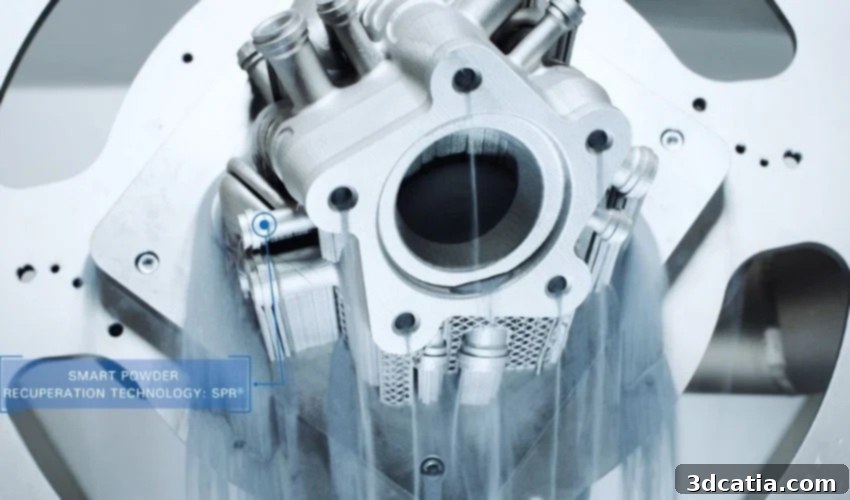
Since the groundbreaking launch of the world’s first fully automated powder removal system in 2015, Solukon has maintained its pioneering role, consistently driving innovation in the critical field of automated depowdering. At the heart of Solukon’s success lies its patented SPR® (Smart Powder Removal) technology, which offers an unparalleled solution for effectively freeing even the most complex parts from residual powder – quickly, efficiently, and entirely automatically. The core principle involves placing the 3D-printed part within a protected atmosphere, where it undergoes automated swiveling and rotation along two precisely controlled axes, combined with targeted, intelligent vibration. This dynamic movement ensures that loose powder is dislodged from all surfaces, including intricate internal geometries, which are notoriously difficult or impossible to reach manually. Automating this crucial depowdering process step delivers significant time savings, dramatically reducing the overall post-processing time. Furthermore, the ability to collect and recycle uncontaminated powder directly translates into greater cost efficiency for additive manufacturing production, reducing material waste and improving the economic viability of AM. Unlike manual processes, automated depowdering not only accelerates the entire powder removal operation but also consistently delivers precise, thorough, and highly repeatable cleaning results, essential for high-quality industrial applications.
For anyone operating within the dynamic landscape of additive manufacturing, it’s widely understood that seamlessly linking individual process steps is paramount for achieving true industrialization and efficiency. Solukon’s innovative Digital Factory Tool plays a pivotal role in enabling the complete automation and sophisticated networking of additive manufacturing workflows. This advanced tool facilitates the smooth and effortless integration of automated depowdering into the broader digital AM process chain. By employing a comprehensive sensor and interface concept, the Digital Factory Tool ensures continuous monitoring and meticulous logging of the entire depowdering operation. This level of transparency and data integrity is particularly vital for demanding industries such as aerospace and medical, which impose exceptionally high requirements for traceability, validation, and process transparency throughout every stage of the additive manufacturing process. The ability to automatically document every depowdering cycle ensures compliance, improves quality assurance, and provides invaluable data for process optimization, making it an indispensable component of an Industry 4.0-ready AM facility.
The practical efficacy and robust reliability of automated depowdering have been extensively proven in real-world industrial settings, as evidenced by countless application examples from Solukon. With more than 180 depowdering systems currently in operation globally, Solukon’s technology is a trusted solution for diverse manufacturing challenges. A prime example is AddUp, a leading French manufacturer of Additive Manufacturing systems (specializing in Powder Bed Fusion – PBF & Directed Energy Deposition – DED). AddUp has successfully integrated the Solukon SFM-AT800-S into its production line to achieve complete powder removal from highly complex parts. Medhi Offroy, Post-Processing Methods Engineer at AddUp, attests to its critical value: “Powder removal is a critical step right after the printing as the powder can be cohesive, i.e. it can get stuck in internal channels of the part. By integrating the Solukon SFM-AT800-S we’ve found the ideal depowdering system for our production plant, ensuring both efficiency and the integrity of our components.” This statement underscores the transformative impact of automated systems on production efficiency and part quality. For more detailed information on advanced powder removal techniques in 3D printing and to discover how Solukon has fundamentally revolutionized the market with its state-of-the-art SPR® technology, we invite you to click HERE.
What are your thoughts and experiences regarding automated powder removal in the rapidly evolving world of 3D printing? Do you see it as an indispensable step for the future of industrial additive manufacturing? We invite you to share your insights and opinions in a comment below, or engage with us on our LinkedIn, Facebook, and Twitter pages! Don’t miss out on the latest advancements and news in the 3D printing sector – be sure to sign up for our free weekly Newsletter here, delivering the freshest updates straight to your inbox! Additionally, you can explore all our informative videos and content on our dedicated YouTube channel.