
The Future of Driving: Automotive Additive Manufacturing Shifts to Final Part Production
The automotive industry is undergoing a profound transformation, with additive manufacturing (AM), commonly known as 3D printing, playing an increasingly critical role. A recent report from SmarTech Publishing sheds light on this evolving landscape, offering a detailed overview of the sector and identifying significant growth prospects. This year’s analysis takes a distinctive approach, zeroing in exclusively on the market for 3D printed final parts, a notable departure from previous reports that often included rapid prototyping. While prototyping remains an essential component of automotive development, given the extensive testing involved, the exclusive focus on end-use parts underscores a pivotal shift in the industry’s adoption of additive technologies. SmarTech Publishing projects that by 2029, automotive 3D printing will generate a staggering $9 billion in revenue from the production of final parts alone, a monumental leap from the $1.39 billion recorded just last year.
This burgeoning trend toward integrating 3D printing into final part production isn’t entirely new but is certainly accelerating. Last year, the American market research firm had already highlighted the growing adoption of 3D technologies for manufacturing finished components, alongside their established use for tools and prototypes. At that time, it estimated this segment of revenue would reach $4.3 billion by 2028. The latest report not only confirms this trajectory but projects an even more aggressive growth curve, driven in large part by robust sales of 3D printing equipment. This segment of equipment sales is expected to account for over a third of the total revenues generated, indicating a significant investment in the infrastructure required to scale up production. Meeting the demanding productivity requirements of the mass automotive industry necessitates a substantial deployment of industrial-grade 3D printers, presenting a lucrative opportunity for equipment manufacturers capable of delivering high-volume, reliable solutions.
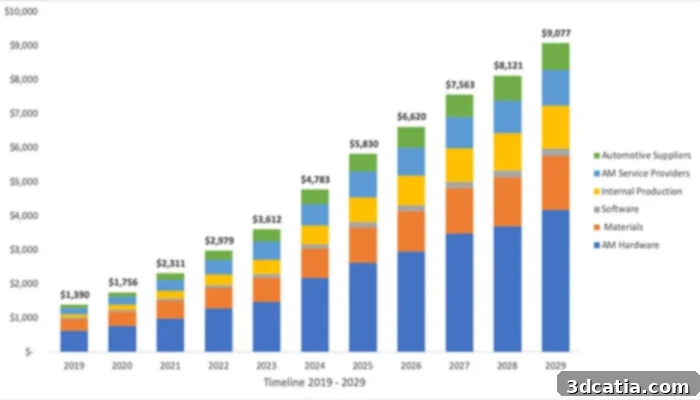
Revenues generated by automotive 3D printing, particularly from finished parts | Credits: SmarTech Publishing
The Paradigm Shift: From Prototyping to Production
The automotive sector has historically relied on 3D printing primarily for rapid prototyping, enabling designers and engineers to quickly iterate on designs, test concepts, and identify flaws before committing to expensive tooling for mass production. This application remains crucial, facilitating faster design cycles and reducing development costs. However, the shift highlighted by SmarTech Publishing towards final part production marks a more fundamental change. It signifies that additive manufacturing is moving beyond a support function to become a direct method for creating components that go into vehicles consumers purchase.
This transition is driven by several key factors. First, advancements in 3D printing technologies themselves, including improved materials, increased build speeds, enhanced accuracy, and larger build volumes, have made it feasible to produce parts that meet automotive industry standards for strength, durability, and performance. Second, the demand for lightweight components to improve fuel efficiency and reduce emissions aligns perfectly with AM’s ability to create complex, optimized geometries that are impossible or cost-prohibitive to produce with traditional manufacturing methods. Third, 3D printing enables unparalleled customization, allowing for personalized vehicle interiors or specialized components for niche models without the high costs associated with traditional tooling. Finally, it offers significant advantages in supply chain resilience, enabling on-demand production of spare parts, reducing inventory, and mitigating risks associated with global supply chain disruptions.
Driving Forces Behind the Growth in Automotive AM
The projection of $9 billion in revenue from final parts by 2029 is a testament to the confluence of technological maturity and industry demand. A significant portion of this growth, as the report indicates, will be fueled by the sale of industrial 3D printing equipment. For automotive manufacturers to integrate AM into their production lines effectively, they need robust, reliable, and scalable machinery. This includes sophisticated metal 3D printers capable of producing high-performance components, as well as advanced polymer systems for interior and exterior parts. The development of automated post-processing solutions and integrated workflows is also vital, transforming what was once a craft-based technology into an industrial process.
Furthermore, the evolution of materials specifically engineered for additive manufacturing is a critical enabler. From high-strength alloys and advanced composites to specialized polymers that meet strict automotive standards for heat resistance, UV stability, and impact absorption, material science is continually pushing the boundaries of what’s possible. Alongside hardware and materials, software advancements in design optimization, simulation, and process control are streamlining the entire additive manufacturing workflow, making it more efficient and reliable for automotive applications. These combined factors are paving the way for 3D printing to become a cornerstone of future automotive manufacturing strategies, facilitating innovation and accelerating time-to-market for new vehicle designs.
The Use of Additive Manufacturing by Automobile Manufacturers
The escalating demand for production-grade additive manufacturing solutions has been well identified by established market players such as Stratasys, EOS, and 3D Systems. These historical manufacturers are actively responding by introducing advanced automation solutions, refining their software ecosystems, and simplifying all stages of the modeling and production process. Their overarching objective is to optimize the additive manufacturing workflow from initial design to finished part, thereby enhancing efficiency and reducing costs. This proactive strategy is also aimed at effectively competing with innovative new entrants like Desktop Metal and HP, who have rapidly gained traction by focusing on high-speed, cost-effective, and scalable processes tailored for industrial production environments.
SmarTech Publishing’s report delves deeper by mapping out how major automotive manufacturers are integrating and utilizing additive manufacturing. The firm meticulously analyzed which 3D printing technologies are most commonly deployed by these industry giants and for what specific applications. It reveals that the Volkswagen Group stands out as a leading adopter of 3D printing, with a particular emphasis on metal additive manufacturing for designing both finished parts and specialized tools. For rapid prototyping purposes, stereolithography (SLA) and Fused Deposition Modeling (FDM) remain the preferred choices due to their versatility and cost-effectiveness for concept validation and functional testing. Close behind the German automotive powerhouse are BMW and Ford, both of whom have made significant strides in their additive manufacturing capabilities. Notably, BMW announced last year that it had surpassed the impressive milestone of one million 3D printed parts, underscoring the industrial scale at which these technologies are being implemented.
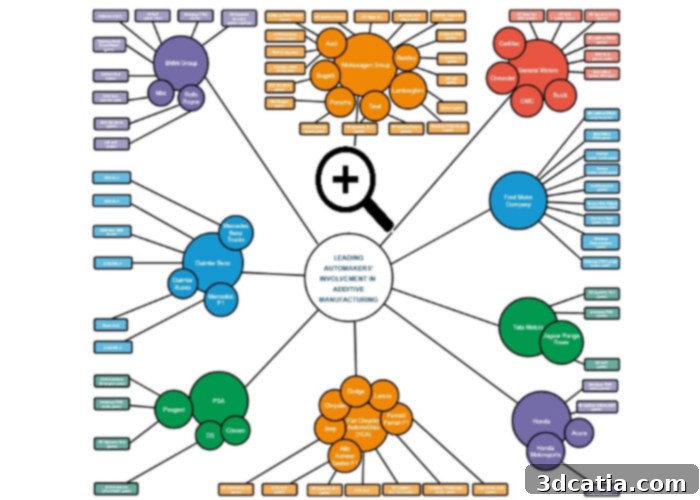
What are the 3D printing technologies used by manufacturers | Credits: SmarTech Publishings
Preferred Technologies and Industry Leaders
In terms of technology providers, the German manufacturer EOS is reported to be among the car manufacturers’ favorites, particularly for its Selective Laser Sintering (SLS) systems for polymers and its robust powder bed fusion solutions for metals. EOS’s reputation for industrial-grade quality and reliability makes it a go-to choice for critical applications. It is joined by some of the longest-standing and most influential players in the market, including Stratasys and 3D Systems. Stratasys is renowned for its FDM and PolyJet technologies, offering diverse solutions for both prototyping and end-use polymer parts, while 3D Systems boasts a broad portfolio encompassing various polymer and metal AM processes.
These established giants are, however, facing dynamic competition and innovation from newer entrants who have rapidly carved out significant market shares. Companies like HP, with its Multi Jet Fusion technology, are making waves in high-volume polymer part production, offering speed and cost-efficiency. Carbon, with its Digital Light Synthesis (DLS) technology, is gaining traction for its ability to produce highly elastic and durable parts with speed, ideal for applications requiring specific mechanical properties. Desktop Metal is aggressively expanding its presence in metal additive manufacturing, particularly with its binder jetting technology aimed at mass production of metal components. The comprehensive study from SmarTech Publishing offers an in-depth look into these dynamics, providing invaluable insights into market share, technological preferences, and future trajectories. You can find the entire study HERE for a detailed analysis.
The future of automotive manufacturing is undeniably intertwined with additive manufacturing. As technologies mature, materials expand, and industry players continue to innovate, 3D printing will move even further into the heart of vehicle production, enabling lighter, more customized, and more efficiently produced cars for the road ahead. The shift to final part production is not just a trend; it’s a testament to the growing maturity and indispensable value of additive manufacturing in one of the world’s most demanding industries.
What are your thoughts on the evolving role of automotive 3D printing, especially its shift towards final part production? We invite you to share your insights in a comment below or join the conversation on our Facebook and Twitter pages! Don’t forget to sign up for our free weekly Newsletter to receive all the latest news in 3D printing directly in your inbox!