
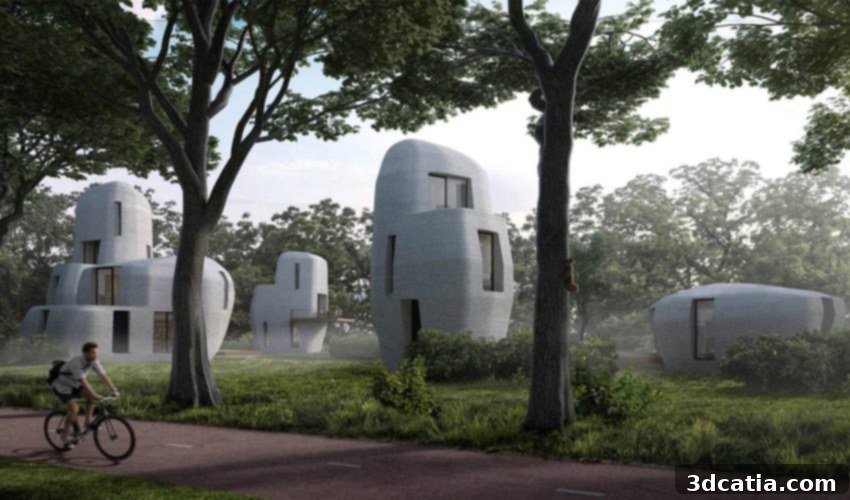
Eindhoven Pioneers 3D Printed Homes: Project Milestone Set to Revolutionize Construction
The landscape of modern construction is on the cusp of a groundbreaking transformation, and the city of Eindhoven in the Netherlands is leading the charge. Exciting news reveals that the first tenants could be moving into innovative 3D printed houses as early as mid-2019. This ambitious undertaking, known as Project Milestone, stands as a testament to the myriad benefits of additive manufacturing over conventional building techniques. This initiative is a collaborative effort, spearheaded by the prestigious Eindhoven University of Technology, and involves a consortium of key players, including the renowned French construction materials group, Saint Gobain, underscoring the broad industrial interest in this emerging technology.
Eindhoven is no stranger to pioneering additive manufacturing in urban infrastructure. The city recently made headlines with the inauguration of a fully 3D printed concrete bridge designed for cyclists, a project that showcased the practical application and structural integrity of this advanced method. That landmark bridge was also a product of the same visionary university, in partnership with BAM Infra, demonstrating a consistent commitment to exploring the frontiers of construction. Now, the focus shifts from public infrastructure to residential living, promising to open new chapters in housing development.
The concrete 3D printer at Eindhoven University, a key instrument in the Project Milestone initiative.
Project Milestone: Crafting Five Future-Forward 3D Printed Houses
Project Milestone is not just about building a single experimental home; it’s a comprehensive research and development venture involving the construction of five distinct 3D printed houses. The journey begins with a single-floor dwelling, anticipated to be completed and ready for occupancy in the near future. Following this initial prototype, the project will scale up, with the subsequent four houses featuring multiple floors, progressively challenging the boundaries of multi-story 3D printed architecture. These concrete structures are meticulously engineered to adhere to all standard industry requirements and rigorous building codes, ensuring their structural soundness and safety. Furthermore, they are designed with a keen eye on occupant satisfaction, promising optimal levels of comfort, thoughtful layouts, superior quality finishes, and competitive pricing, aiming to make advanced housing accessible.
The architectural vision for these groundbreaking homes comes from the innovative minds of Houben and Van Mierlo. They sought to move away from conventional blocky designs, instead embracing more organic and irregular structures. The resulting homes boast captivating rounded and asymmetrical shapes, a design freedom that would be prohibitively complex and expensive with traditional construction methods. Concrete 3D printing is the enabler of this artistic expression, allowing for the precise, layer-by-layer creation of intricate geometries, thus unlocking unprecedented architectural possibilities. This ability to print complex forms not only enhances aesthetic appeal but also opens avenues for optimizing structural efficiency and material usage.
The Genesis of Innovation: From Concept to Concrete Reality
The roots of Project Milestone trace back approximately two years prior to its public announcement, blossoming during the acclaimed Dutch Design Week. Theo Salet, the esteemed Head of 3D Concrete Printing at Eindhoven University of Technology, recounts the project’s inception: “The idea came about two years ago during the Dutch Design Week. But we needed partners to realize such an idea.” His statement highlights the crucial role of collaboration in bringing ambitious technological visions to fruition. Salet further elaborated on their progress and aspirations, stating, “We have managed to control the printing technique and now we want to know what it is like to live in it; we are still learning, and we hope that our team will print buildings in the future.” This reflects a pragmatic yet forward-thinking approach, combining scientific mastery with a genuine desire to understand the human experience within these novel structures. The project, therefore, is not merely about construction, but about liveability and continuous improvement.
Learning and Iteration: The Path to Scalable 3D Printed Construction
The sequential printing of five houses is a deliberate strategy designed to foster continuous learning and refinement. By undertaking multiple builds, the diverse team of partners and researchers can analyze each stage of the printing process, identify efficiencies, pinpoint challenges, and implement improvements iteratively. This methodical approach ensures that lessons learned from the first house are immediately applied to the second, and so forth, culminating in an optimized and highly efficient construction workflow by the fifth dwelling. Initially, the early structural elements of the houses will be 3D printed within the controlled environment of the university campus. This allows for precise calibration and troubleshooting away from the complexities of a live construction site. However, the ultimate objective is to transition all construction activities directly to the building site, a crucial step towards demonstrating the true scalability and practicality of 3D concrete printing for mainstream housing development. The culmination of this learning curve will be the fifth and final house, which is planned to be entirely 3D printed on site, showcasing the technology’s full potential for autonomous, in-situ construction.
Eindhoven: A Beacon for Additive Manufacturing in Construction
Eindhoven’s repeated ventures into 3D printed construction projects are cementing its reputation as a global leader in additive manufacturing innovation. This forward-thinking approach is not just about adopting new technologies; it’s about actively shaping the future of how we build. From the early success of the 3D printed bridge for cyclists, which demonstrated the technology’s viability for public infrastructure, to the ambitious Project Milestone, Eindhoven is continuously pushing the boundaries. These projects are a testament to the city’s robust ecosystem of research institutions, innovative companies, and supportive local government, all converging to foster a fertile ground for technological advancements. The university’s role, particularly in 3D concrete printing, positions it at the forefront of architectural and engineering evolution, attracting talent and investment from around the world.
The Transformative Potential of 3D Concrete Printing
Beyond the immediate innovations seen in Eindhoven, 3D concrete printing promises to revolutionize several aspects of the construction industry globally. One of its most compelling advantages is the unprecedented geometric freedom it offers. Architects and designers are no longer constrained by the limitations of traditional formwork and labor-intensive processes. This enables the creation of organic, curvilinear, and structurally optimized designs that are both aesthetically pleasing and inherently efficient. Moreover, the automation inherent in 3D printing significantly reduces material waste, as concrete is deposited only where needed, leading to more sustainable construction practices. The potential for rapid construction, reduced labor costs, and enhanced safety on construction sites further underscores its appeal. As technology advances, we can anticipate even greater efficiencies and broader applications, from disaster relief housing to personalized residential complexes.
Addressing Global Housing Challenges with Advanced Technology
The global housing crisis is a complex issue, characterized by rapidly growing urban populations, increasing demand for affordable homes, and the environmental impact of conventional construction. 3D printed houses, like those in Project Milestone, offer a promising solution. Their ability to be built quickly, cost-effectively, and with reduced environmental footprint makes them an attractive option for addressing housing shortages in various contexts. The localized nature of 3D printing, especially when construction moves entirely on-site, can also empower communities and create new local economies. As these technologies mature, they have the potential to democratize homeownership and provide durable, comfortable, and aesthetically pleasing homes to a wider demographic, truly embodying a sustainable future for residential development.
For those interested in delving deeper into the specifics of this groundbreaking initiative, further details are available on the Eindhoven University of Technology’s official website. This project marks a significant step towards understanding not just the technical capabilities of 3D printed construction, but also the practicalities and experiences of living in such homes. What are your thoughts on these innovative 3D printed houses emerging from the Netherlands? We invite you to share your perspectives in the comments section below or join the conversation on our Facebook and Twitter pages! Stay informed about the latest advancements in additive manufacturing by signing up for our free weekly Newsletter, delivering all the essential 3D printing news directly to your inbox!