

AML3D and Boeing Forge Deeper Partnership for Advanced Metal 3D Printing in Aerospace
Australian metal additive manufacturing specialist, AML3D, has announced a significant expansion and renewal of its strategic partnership with global aircraft manufacturing giant, Boeing. This renewed collaboration marks a pivotal moment in the integration of cutting-edge 3D printing technologies into the aerospace supply chain, underscoring Boeing’s commitment to innovation and AML3D’s growing capabilities.
Earlier this year, the initial phase of their engagement saw Boeing commission AML3D to 3D print prototype aluminum aircraft components. These critical parts were subject to rigorous testing, demanding adherence to the stringent AS9100D quality assurance requirements – a global standard for aerospace quality management systems applicable to “flying” components. This intensive validation process ensured that AML3D consistently delivered products and services that not only met but exceeded the high demands of the aerospace sector, affirming the reliability and precision of their proprietary technology. The foundational partnership between these two industry leaders was established in 2021 when AML3D secured its first contract with Boeing, and it has steadily expanded in scope and importance ever since.
Expanding Horizons: From Prototypes to Strategic Supply Chain Integration
The recently renewed contract signifies a substantial deepening of this relationship. Under the terms of the expanded agreement, AML3D will broaden its engagement with Boeing, moving beyond initial prototypes to supply a wider array of 3D printed parts. This strategic initiative is designed to significantly increase the volume and value of business that the Australian manufacturer conducts with Boeing, cementing its position as a key supplier within the aerospace ecosystem.
Andrew Sales, Managing Director of AML3D, highlighted the strategic importance of this development: “AML3D has already demonstrated to Boeing that our proprietary Wire Additive Manufacturing (WAAM) metal 3D printing technology produces high-quality parts on time and according to the specification. The extended purchase agreement is strategically vital as it allows AML3D to become a integral part of Boeing’s advanced manufacturing supply chain. This aligns perfectly with achieving our ambitious growth objectives within the demanding aerospace industry.” This statement underscores not only the technical validation of AML3D’s technology but also its ambition to play a foundational role in modernizing aerospace manufacturing through additive processes.
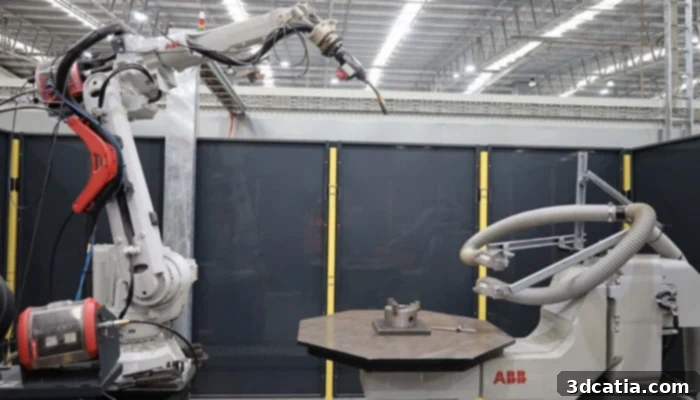
AML3D’s Arcemy printer (Photo credits: AML3D)
AML3D and Boeing: A Partnership to Develop 3D Printing in Aeronautics
Boeing’s decision to leverage AML3D’s metal 3D printing solution is a testament to the transformative potential of additive manufacturing. AML3D has pioneered a sophisticated 3D printing system that merges advanced welding techniques, precision robotics, innovative materials engineering, and intelligent software to create complex, high-performance shapes. At the heart of this capability is the Arcemy printer, the machine specifically selected by AML3D to produce the parts required by Boeing.
The Arcemy printer utilizes Wire Additive Manufacturing, or WAM®, AML3D’s patented technology. This groundbreaking process is built upon the Directed Energy Deposition (DED) principle, where a focused energy source, typically a laser or electron beam, is used to melt material as it is deposited, layer by layer, onto a substrate. A distinctive feature of AML3D’s Arcemy system is its use of inert gas shielding, which allows the machine to operate effectively in open-air environments. This eliminates the need for expensive, specialized vacuum chambers often required by other metal additive manufacturing processes, significantly reducing operational complexities and costs. As a result, the Arcemy system offers unparalleled advantages, capable of manufacturing large-scale, intricate parts at approximately 70% less cost compared to conventional manufacturing techniques, while simultaneously generating up to 85% less material waste. These efficiencies are crucial for aerospace manufacturers seeking to optimize production, reduce lead times, and enhance sustainability.
The Broader Landscape of Additive Manufacturing in Aerospace
AML3D is now firmly established among a growing cohort of advanced 3D printing companies collaborating with the world’s leading aerospace manufacturers. These collaborations are essential for pushing the boundaries of what is possible, from developing rapid prototypes to producing critical end-use parts that meet the highest safety and performance standards. The aerospace sector is uniquely positioned to benefit from additive manufacturing due to its inherent demands for lightweighting, complex geometries, and highly optimized components that traditional manufacturing methods struggle to achieve efficiently or at all.
This burgeoning ecosystem includes other notable players such as EOS and Materialise, both of whom have achieved significant milestones, including receiving certification from Airbus for their aviation-grade materials and processes. Such certifications are vital, as they validate the reliability and consistency of additive manufacturing for flight-critical applications. Furthermore, organizations like Aitiip are actively pursuing initiatives to improve energy efficiency within aerospace production through the strategic application of additive manufacturing. These efforts collectively demonstrate a global commitment to harnessing 3D printing for more sustainable, efficient, and innovative aircraft production.
The advantages of metal 3D printing for aerospace extend beyond just cost and waste reduction. It enables unprecedented design freedom, allowing engineers to create topologically optimized structures that are significantly lighter yet stronger than traditionally manufactured parts. This lightweighting directly translates to reduced fuel consumption, lower emissions, and increased payload capacity for aircraft. Moreover, additive manufacturing can consolidate multiple components into a single, integrated part, simplifying assembly, reducing part count, and enhancing overall system reliability. For more in-depth applications of additive manufacturing within the aerospace industry, you can explore further insights by clicking HERE.
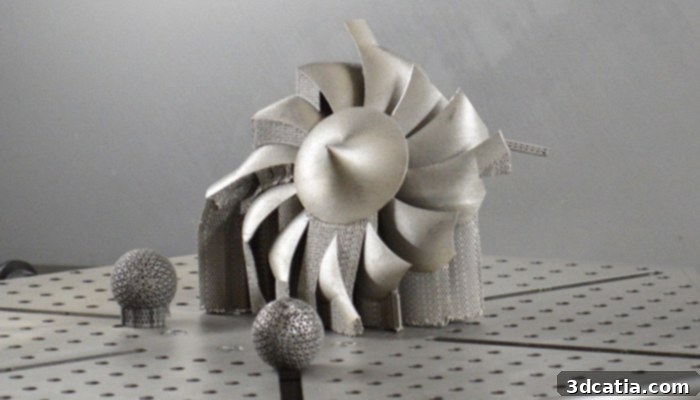
Photo credits : 3Dnatives
Looking Ahead: The Future of Metal AM in Aviation
The extended partnership between AML3D and Boeing is more than just a commercial agreement; it represents a significant step forward in the industrialization of metal additive manufacturing for one of the most demanding sectors globally. By integrating AML3D’s innovative WAAM technology into its supply chain, Boeing is not only enhancing its manufacturing capabilities but also driving the adoption of sustainable and efficient production methods. This collaboration will likely pave the way for broader applications of metal 3D printing in future aircraft designs, fostering continued innovation, and solidifying the competitive advantage for both companies. As the aerospace industry continues its trajectory towards advanced materials and manufacturing processes, partnerships like this will be instrumental in defining the next generation of air travel.
What are your thoughts on the expanding role of 3D printing within the aeronautical industry? We invite you to share your insights in a comment below or join the conversation on ourLinkedIn,Facebook, andTwitter pages! Don’t miss out on the latest advancements – sign up for our free weeklyNewsletter here, delivering the freshest 3D printing news directly to your inbox! You can also find all our compelling videos on ourYouTube channel.
*Cover photo credits: Boeing