
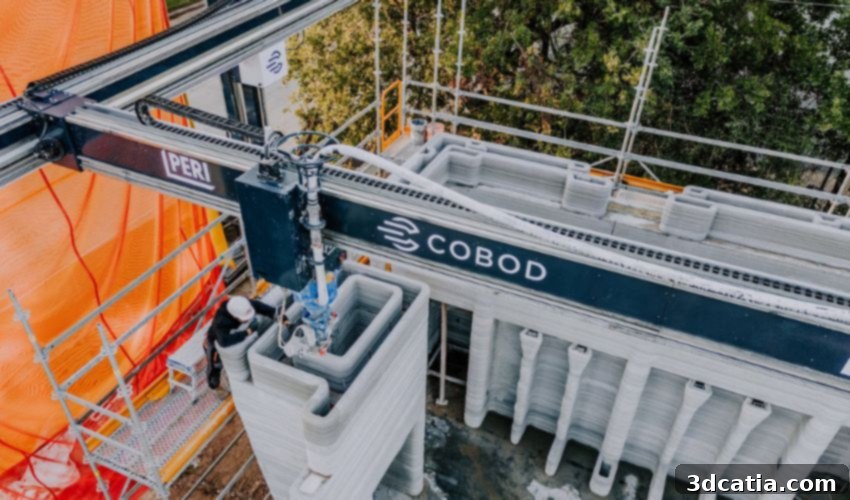
Revolutionizing Housing: The Rise of Multi-Story 3D Printed Buildings in the US
The global landscape is currently grappling with a pressing issue: a widespread housing shortage, exacerbated by rapidly increasing population densities and the ever-escalating cost of living. Traditional construction methods often struggle to keep pace with demand, leading to inflated prices, prolonged building times, and limited architectural innovation. However, a revolutionary technological advancement is now poised to breathe new life into the housing market, offering a sustainable and affordable solution to these modern challenges: 3D printing in construction. This innovative approach promises not just to build structures faster and more efficiently, but also to redefine the very concept of accessible and customizable housing.
In a groundbreaking development that underscores the immense potential of this technology, a collaborative effort has recently culminated in the construction of the largest residential 3D printed building project in the United States. This impressive feat is the result of a synergistic partnership between the visionary architecture firm HANNAH Design Office, the advanced printing expertise of PERI Ltd., and the robust construction capabilities of civil engineering firm CIVE. Spanning an impressive 4,000 square feet, this pioneering structure stands as a tangible and compelling example of how additive manufacturing is being leveraged for domestic development, moving beyond experimental prototypes to practical, livable spaces.
While 3D printing technology has been successfully employed in the US to construct numerous single-story buildings in recent years, this particular project marks a significant milestone. It proudly holds the distinction of being the country’s first two-story 3D printed building, a feat that has already been accomplished by nidus3D Inc. in neighboring Canada. What truly sets this latest construction apart is its practical application; it is not merely an artistic endeavor or a demonstration of technological prowess. Instead, it is a fully functional residence, signaling a crucial step towards the widespread creation of multi-story family homes. This project transcends the realm of ambitious designs and hobbyist pursuits, positioning 3D printed housing as a genuine and viable future for affordable and sustainable residential development.
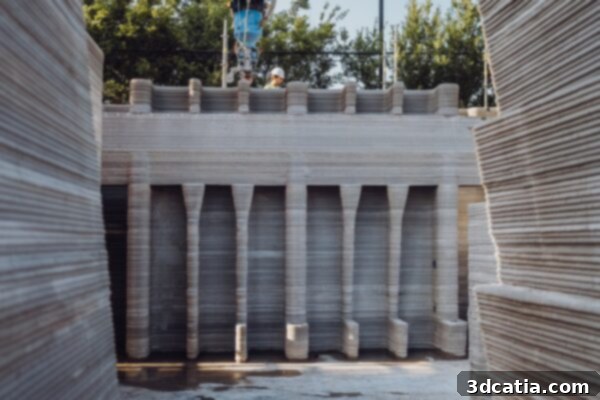
Construction of COBOD’s 3D printed home, showcasing its innovative and functional spaces. (photo credits: hannah-office.org)
The Transformative Power of Construction 3D Printing
The president of CIVE, Hachem Domloj, articulated the profound significance of this project, not only for his team but for the entire construction industry. He stated, “Having the opportunity to be the engineers and general contractor for the first multistory 3D printed structure in the U.S. has been an honor. We can see how this technology and our team’s approach is providing the scalability to larger commercial developments. Collectively, we’re changing the way our country builds, and paving the way for more affordable housing, higher structural integrity, and faster building capabilities. The possibilities of 3D printing are endless!” His words encapsulate the core advantages that make 3D printed construction a game-changer for addressing contemporary housing challenges.
One of the most compelling benefits of 3D printing in construction is its potential to drastically improve **affordability**. By automating much of the building process, it significantly reduces labor costs, which are often a major component of traditional construction budgets. Furthermore, the precision of additive manufacturing minimizes material waste, allowing for more efficient use of resources and subsequently lower material expenses. This efficiency, combined with faster construction timelines, translates directly into more cost-effective housing solutions for individuals and families.
Beyond affordability, **speed and efficiency** are hallmarks of 3D printed construction. Unlike conventional methods that require intricate scaffolding, extensive formwork, and multiple stages of manual labor, 3D printers can rapidly extrude walls layer by layer, erecting the basic structure of a home in a matter of days or even hours. This accelerated pace not only addresses urgent housing needs more effectively but also reduces overall project durations, leading to quicker occupancy and faster returns on investment for developers. The ability to build rapidly and precisely fundamentally alters project timelines.
Moreover, 3D printing offers substantial advantages in terms of **sustainability**. The precise nature of the printing process means that materials are used exactly where needed, leading to significantly less waste compared to traditional building practices where offcuts and excess materials are common. Many 3D printing systems can utilize locally sourced or recycled materials, reducing the environmental impact associated with transportation. The design freedom offered by 3D printing also allows for the creation of optimized structures with improved thermal performance, potentially leading to lower energy consumption for heating and cooling once occupied, thus contributing to greener, more eco-friendly homes.
**Design freedom and customization** are also key aspects. Architects and designers are no longer constrained by the limitations of conventional building techniques. 3D printing allows for complex geometries, curved walls, and integrated features that would be prohibitively expensive or impossible with traditional construction. This opens up possibilities for highly personalized homes, innovative aesthetic designs, and structures that are perfectly adapted to their environment or specific functional requirements, pushing the boundaries of architectural creativity.
Finally, the point about **higher structural integrity** made by Hachem Domloj is crucial. While often associated with novelty, 3D printed concrete structures can be incredibly robust. The continuous layering process can create monolithic walls that are inherently stronger and more resistant to certain stresses than segmented block or frame constructions. The ability to reinforce structures precisely within the printing process further enhances their durability and resilience, offering a new standard for quality and safety in residential buildings.
Technical Design and the Role of the COBOD BOD2 Gantry Printer
For this pioneering two-story structure, engineers innovatively combined traditional wood framing with advanced 3D printed concrete blocks. These concrete elements were meticulously created using the renowned COBOD BOD2 gantry printer. A gantry printer operates by moving its print head along a fixed frame, allowing it to build large structures directly on site with exceptional precision. This hybrid approach allowed for the strategic integration of the 3D printed concrete, forming the load-bearing walls and creating visible spaces within the structure that are perfectly suited for integrating features like stairwells and other essential functional areas. The modularity inherent in this design means that projects can be easily scaled up or down in size, providing unparalleled flexibility in producing homes that precisely meet individual needs and spatial requirements. Theoretically, this same robust technology could be applied to construct even a three-story home, significantly increasing housing capacity under a single roof and further addressing the density challenges in urban areas.
Philip Lund-Nielsen, co-founder of COBOD and head of its Americas division, expressed immense pride in the instrumental role the BOD2 printer played in this landmark project. He commented, “We are proud to see more and more buildings being 3D printed with our BOD2 printer in North America as a consequence of our leading position in the market and the many 3D construction printers that we sold here. Our superior technology and leading position is documented by COBOD being the only supplier that has delivered 3D printers for construction of multi-story projects.” His statement highlights COBOD’s commitment to pushing the boundaries of additive construction and its proven track record in delivering reliable and high-performance solutions for multi-story residential and commercial applications. The BOD2’s capability to print complex structures efficiently and reliably positions it as a key enabler for the future of construction.
Challenges and the Future Outlook for 3D Printed Homes
Despite its immense promise and the exciting breakthroughs demonstrated by projects like the US’s largest multi-story 3D printed building, construction 3D printing is not without its limitations and ongoing challenges. Like any burgeoning technology, it faces hurdles that need to be addressed for widespread adoption. One significant concern is the often substantial initial cost of the advanced machinery itself. While the long-term savings in labor and materials can offset this investment, the upfront capital expenditure can be a barrier for smaller construction firms or developing regions. Furthermore, questions surrounding the consistent meeting of established regulatory standards and building codes are critical. As the technology is relatively new, integrating it into existing legal frameworks and ensuring universal acceptance by regulatory bodies requires ongoing collaboration between innovators and policymakers.
It is crucial to remember that this impressive project, while monumental, still represents a single home within the broader construction landscape. In many parts of the world, 3D printing in construction remains the exception rather than the norm. However, this pioneering example, alongside numerous other global initiatives, strongly indicates that this status is rapidly changing. The industry is witnessing a steady progression from experimental prototypes to practical, scalable solutions. Overcoming challenges related to material standardization, developing a specialized skilled workforce, and increasing public and regulatory confidence will pave the way for 3D printing to become a standard, accepted method for building not just residential homes, but also commercial structures and infrastructure.
The future of 3D printed housing is incredibly promising. Beyond addressing urban housing shortages, this technology holds potential for rapid deployment in disaster-stricken areas, offering quick and resilient shelter. It could also revolutionize construction in remote or challenging environments, or even for extraterrestrial habitats. As material science advances and printing processes become even more refined, we can expect to see an even wider range of sustainable, high-performance materials being utilized. This ongoing evolution will undoubtedly lead to even more efficient, adaptable, and environmentally friendly construction practices, making 3D printed homes a cornerstone of future communities and a key component in the smart cities of tomorrow.
For those interested in a deeper dive into the specific technologies and architectural philosophies that underpin this project, an extended interview with Philip Lund-Nielsen and Zaid Marmash, head of Architecture and Construction, offers invaluable insights. This interview, available below, provides further context on the current state of the 3D printing construction industry, detailed information about their BOD2 printer, and underscores the pivotal role of thoughtful architecture in successfully integrating this advanced technology into livable spaces.
What are your thoughts on 3D-printed housing? Do you believe it represents the future of modern communities and affordable living? Share your opinions and insights by leaving a comment below, or engage with us on ourLinkedIn,Facebook, andTwitter pages! To stay informed about the latest advancements and news in the world of 3D printing, don’t forget to sign up for our free weeklyNewsletter here, delivered straight to your inbox! You can also explore all our engaging video content on our dedicatedYouTube channel.
*Cover Photo Credits: COBOD