
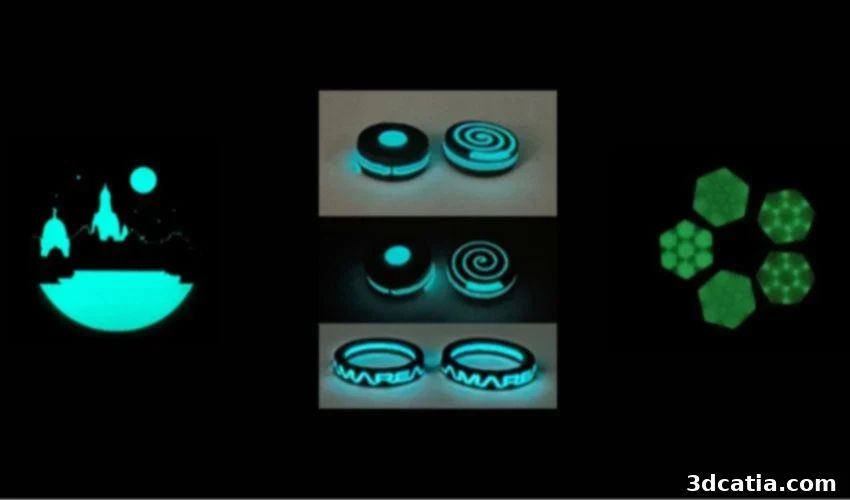
Unlocking New Possibilities: AMAREA Technology Pioneers Industrial Multi-Material 3D Printing with MMJ
The additive manufacturing (AM) market is undeniably dynamic, characterized by relentless innovation and a constant influx of companies striving to establish their unique position. These innovators are dedicated to developing high-performance hardware and sophisticated software solutions designed to tackle the most pressing challenges in AM. This vigorous pursuit has led to an expansive array of cutting-edge technologies and a vast spectrum of specialized AM materials, collectively opening doors to an ever-growing number of applications across diverse industrial sectors. As 3D printing continues its professionalization and penetrates high-performance industries, the demands placed upon it are escalating. Consequently, the call for reliable and advanced multi-material solutions has grown significantly louder. Amidst this evolving landscape, AMAREA Technology emerges as a key player. This German start-up is singularly focused on developing industrial 3D printers capable of simultaneously processing multiple materials, alongside crafting the appropriate specialized printing materials. Through its groundbreaking Multi Material Jetting (MMJ) technology, AMAREA Technology aims to captivate both existing additive manufacturing users and new entrants, inspiring them to embrace multi-material production. The company’s overarching mission is to collaborate with its customers to enhance resource efficiency, thereby actively shaping the future of manufacturing towards a more sustainable and innovative paradigm. We recently had the opportunity to speak with the founders, delving into the origins of the company, their motivations, the intricacies of Multi Material Jetting technology, and its profound benefits for the industry.
3DN: Could you briefly introduce yourself and tell us how you got into 3D printing?
AMAREA Technology operates as a system developer and manufacturer specializing in additive manufacturing machines tailored for demanding industrial applications. Our innovative systems are engineered to process a wide range of high-performance materials, including technical ceramics, metals, composites, and various polymers. Crucially, our technology excels at combining these diverse materials within a single printing process, thus pioneering advancements in the relatively nascent field of multi-material 3D printing. The company was founded by three dedicated partners: Steven Weingarten, who serves as CEO, Lutz Gollmer, our COO, and Robert Johne, the CTO. Both Steven Weingarten and Robert Johne bring a robust background in materials science to the team, while Mr. Gollmer contributes invaluable expertise in business administration. Our collective journey into additive manufacturing, particularly multi-material 3D printing, began in the realm of applied research. All three founders dedicated years to their work at the prestigious Fraunhofer Institute for Ceramic Technologies and Systems (IKTS). It was within this innovative environment, starting in 2014, that Steven Weingarten spearheaded the development of the foundational **Multi Material Jetting** technology. This groundbreaking work was subsequently commercialized, receiving crucial support from the EXIST research transfer program, an initiative generously backed by the German Federal Ministry of Economics and Climate Action (BMWK), commencing in 2021.
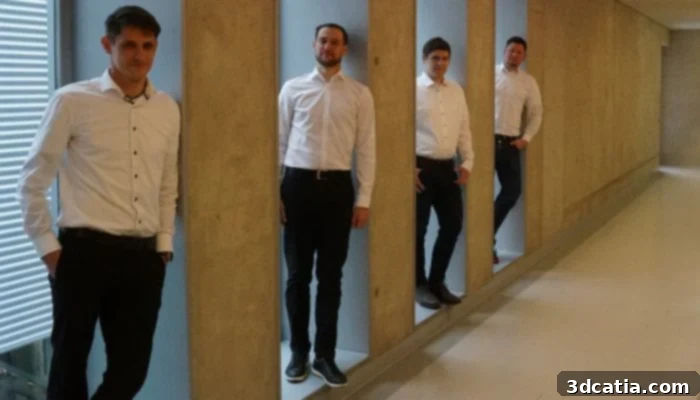
The AMAREA Technology team from left to right: Steven Weingarten (co-founder, CEO & Managing Partner), Robert Johne (co-founder + CTO), Philipp Horn (employee), Lutz Gollmer (co-founder, COO & Managing Partner)
Our unique path to multi-material 3D printing truly commenced at Fraunhofer IKTS in 2014. At that time, Steven Weingarten, then a student, faced a significant challenge: how to effectively combine disparate technical ceramics and, simultaneously, achieve a level of geometric freedom that conventional manufacturing processes, such as ceramic injection molding, simply could not offer. The most expedient, and at the time quite unconventional, solution was to embark on the development of an entirely new, proprietary technology. This pioneering effort was initially launched under the name “Thermoplastic 3D Printing – T3DP,” primarily because there was no commercially viable multi-material printing technology available on the market that could address these specific needs. Following successful initial trials with oxide ceramics, and later the ambitious combination of stainless steel with zirconium oxide, a robust system concept emerged. This concept was built upon advanced microdispensing systems, significantly expanding the possibilities for complex material integration. Further advancement came through the EU project CerAMfacturing, which profoundly deepened our understanding of materials and processes critical for this nascent technology. By 2017, we had achieved a remarkable milestone, successfully manufacturing components composed of up to four distinct materials for the very first time. This breakthrough enabled the creation of sintered glass parts infused with luminescent particles of various colors, designed to glow when exposed to light, as well as near-net-shape tool blanks crafted from carbide, whose mechanical properties were fully comparable to, if not superior to, conventionally manufactured components. These early successes underscored the immense potential of our developing multi-material approach.
3DN: How did AMAREA come about, and what are your goals?
The extraordinary success of those initial experiments, combined with a profound fascination for this nascent technology, particularly its inherent potential to directly integrate advanced functionality into components and facilitate their miniaturization, spurred us to broaden the scope of the technology and transition it from a research concept into a tangible, real-world application. At Fraunhofer, such transitions typically occur through established mechanisms of technology utilization. Thus, the technology, now refined and known as **Multi Material Jetting (MMJ)**, had two primary pathways to market: either through licensing or outright sale to established companies, or via the formation of a spin-off. The latter option would empower a carefully selected team from Fraunhofer IKTS to take the commercialization of the technology into their own hands. The successful acquisition of funding from the BMWK’s prestigious EXIST research transfer program, coupled with positive evaluations during the transfer phase and the successful negotiation of licenses with the Fraunhofer-Gesellschaft, marked the true beginning of our journey. This enabled us to establish a start-up, independent of Fraunhofer, to advance the MMJ technology. The overwhelmingly positive response from the industrial sector to the MMJ technology strongly encouraged the founders to take this bold step towards independence right from the outset. Consequently, AMAREA Technology GmbH was officially founded in Dresden on February 3, 2023, embarking on its mission to redefine additive manufacturing.
As a young and agile company, AMAREA Technology not only infuses the market with fresh perspectives and innovative energy but also proudly positions itself as a technology-driven innovation partner, extending far beyond the conventional role of a mere hardware supplier. Our core objective is to elevate additive manufacturing to an unprecedented level through the strategic application of multi-material technologies. To achieve this ambitious goal, we offer a comprehensive and holistic system that encompasses state-of-the-art 3D printers, precisely customized materials, and a full suite of accompanying services. These services span the entire value chain, from initial feasibility analyses and expert material selection to sophisticated design development and seamless process integration. This ensures our clients receive end-to-end support, maximizing the potential of MMJ technology.
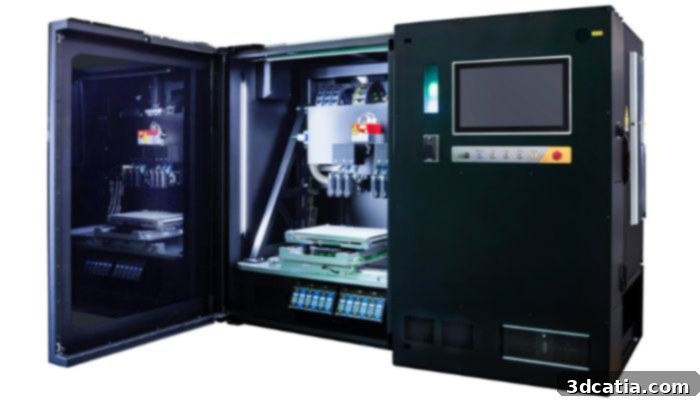
The MMJ ProX6L multi-material 3D printer processes up to six different materials in one printing process.
With our proprietary Multi Material Jetting (MMJ) technology, we empower industrial users to achieve the precision 3D printing of highly functional components crafted from up to six distinct materials – all within a single, fully automated printing process. This unparalleled capability allows for the precise and intentional combination of mechanical, electrical, thermal, or optical properties within a single integrated component, eliminating the need for complex assembly steps. This transformative approach unlocks entirely new frontiers of application across a myriad of sectors, including advanced electronics, critical aerospace components, and cutting-edge energy technology. Our fundamental vision is to play a pivotal role in establishing 3D printing as a primary driver of innovation, ushering in a new generation of technical products that are smarter and more efficient. We are committed to providing manufacturers, designers, and particularly developers with an indispensable tool that enables the creation of sustainable, intelligent, and exceptionally high-performance components, extending to complex assemblies. These are products that are currently considered either impossible to produce or can only be achieved with considerable additional effort and prohibitive costs through traditional methods. By doing so, AMAREA Technology contributes significantly to truly sustainable industrial production worldwide, fostering a future where advanced functionality is intrinsically linked with responsible manufacturing.
3DN: How does MMJ technology work?
MMJ is a cutting-edge additive manufacturing technology positioned at the forefront of future industrial applications, primarily leveraging thermoplastic materials. Conceptually, it complements established manufacturing processes like injection molding but vastly surpasses them in terms of design freedom and, crucially, material combination flexibility. Unlike injection molding, which forces material into intricate molds, MMJ operates on principles similar to an inkjet printer. However, instead of ink, it precisely dispenses high-precision, particle-filled droplets, meticulously controlled within the nanoliter range. These specialized droplets are composed of thermoplastic polymers, which serve as binders, intricately filled with functional materials in powder form. This functional material portfolio is exceptionally broad, including advanced ceramics, various metals, specialized glasses, or sophisticated composite materials. The process begins with the material in a solid state, housed within a dedicated material reservoir. Here, it is locally melted and then selectively deposited as individual droplets via highly advanced print heads. As these droplets are “jetted” onto the build platform, they immediately fuse together upon contact and solidify within milliseconds, forming precise layers. The distinguishing feature of MMJ is its unparalleled ability: by depositing material drop by drop, materials from profoundly different classes can be precisely and selectively placed and combined within complex geometries. This allows for components to be either structurally separated, where distinct materials occupy specific zones, or functionally graded, where material properties transition smoothly and intentionally across a volume.
The remarkable outcome of this process is the production of multifunctional components endowed with perfectly tailored properties, all manufactured in a single, streamlined production step. This approach embodies superior resource efficiency, as only the exact amount of material functionally required is deposited, minimizing waste and optimizing material usage. MMJ technology offers exceptional control, allowing precise parameterization of critical process variables such as droplet diameter and height. Droplet diameters can be adjusted from 200 to over 1000 µm, and layer heights can range from 80 to 500 µm, with the flexibility for individual adjustments—even dynamically during the printing process itself. This granular control facilitates geometry- and function-specific material dosing, enabling unprecedented design possibilities. Once printed, the green parts can be removed directly from the build platform and are then subjected to further thermal processing, typically involving debinding to remove the polymer binder, followed by sintering to consolidate the functional material particles. This results in robust components with their final desired technical properties. In essence, MMJ seamlessly integrates material, function, and form into a single, digitally controlled process – making it exceptionally efficient, highly scalable, and fully ready for advanced industrial deployment.
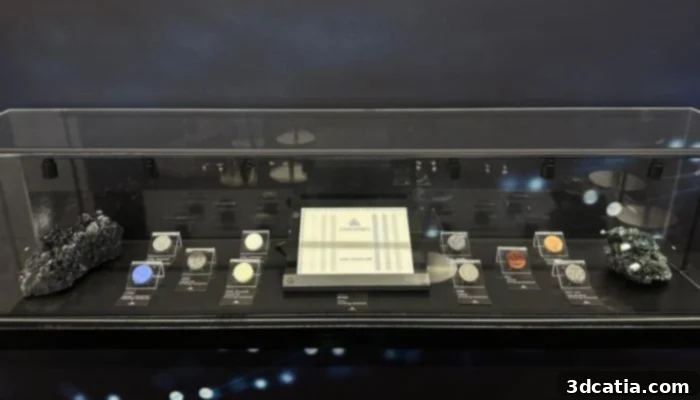
The material portfolio of AMAREA Technology. From oxide, nitride and carbide ceramics to sintered glasses, glass ceramics, hard metals and cermets to metals, polymers and particle-filled polymers – the range of processable materials is broad.
3DN: What are the biggest advantages of the technology? Who benefits most from it?
The significant advantages offered by AMAREA Technology’s Multi Material Jetting (MMJ) are multifaceted and transformative, positioning it as a leading solution for advanced manufacturing challenges:
- Unprecedented Material Diversity & Functionality: MMJ allows for the processing of a vast array of disparate materials—including various metals, technical ceramics, and specialized glasses—all on the very same 3D printer. Furthermore, for materials that are co-sinterable, they can be precisely combined within a single, integrated printing process. This capability transcends traditional manufacturing limitations, enabling the creation of truly multifunctional components with properties meticulously customized to specific application requirements. Imagine parts that conduct electricity in one section, insulate thermally in another, and provide structural integrity simultaneously.
- Superior Precision & Resource Efficiency: The drop-by-drop material deposition method inherent to MMJ ensures maximum precision at a micro-level and unparalleled resource efficiency. Material is only deposited exactly where it is functionally needed, eliminating waste and significantly reducing raw material consumption. This not only translates to cost savings but also contributes to more sustainable manufacturing practices by minimizing environmental impact.
- Expansive Design Freedom & Geometric Complexity: MMJ technology liberates designers and engineers from conventional constraints. It enables sophisticated functionalization alongside precise miniaturization, the creation of smoothly graded material transitions, the engineering of defined porosities, and the seamless integration of different materials and colors. Complex geometries, fine internal structures, and seamless material transitions, which were previously impossible with high-performance materials, are now readily achievable with MMJ. This opens up entirely new design paradigms for innovation.
- Fully Digital & Tool-Free Production: The entire MMJ printing process is controlled digitally, offering unparalleled flexibility, rapid prototyping capabilities, and highly individualized production. This makes it an ideal solution for developing complex prototypes, producing small to medium series, and manufacturing highly functional components and assemblies tailored to specific needs. The integrated profile sensor technology further ensures continuous quality assurance throughout the manufacturing process, guaranteeing reliable results without the need for costly and time-consuming tooling.
- Highly Productive & Innovatively Driven: MMJ technology is explicitly engineered for future-oriented applications, providing high throughput and adaptability. Both mono-material and multi-material components can be produced efficiently with up to six print heads operating simultaneously, dramatically increasing productivity. The system’s design allows for a swift transition between entirely different print materials, often in less than an hour. This rapid changeover maximizes machine utilization and enables the agile exploitation of a broad, cross-material class portfolio. In cases of mono-material components or misprints, the unused or failed material can often be reused, further enhancing cost-effectiveness and sustainability.
Users who stand to benefit most profoundly from our MMJ technology are primarily research and development departments engaged in cutting-edge innovation, as well as manufacturers operating in high-tech sectors such as advanced electronics, sophisticated sensor technology, the demanding aerospace industry, the evolving automotive industry, critical medical technology, and specialized individualization applications. Furthermore, innovative start-ups and small to medium-sized enterprises (SMEs) within the high-tech arena will find MMJ invaluable. In essence, MMJ provides the decisive edge wherever innovation must be considered not solely in terms of form, but fundamentally in terms of integrated function. It excels in scenarios where conventional manufacturing processes hit their limits – be it due to limitations in material diversity, geometric complexity, desired functionality, or the imperative to significantly reduce the number of production steps. MMJ offers a transformative solution, pushing the boundaries of what’s possible in advanced manufacturing.
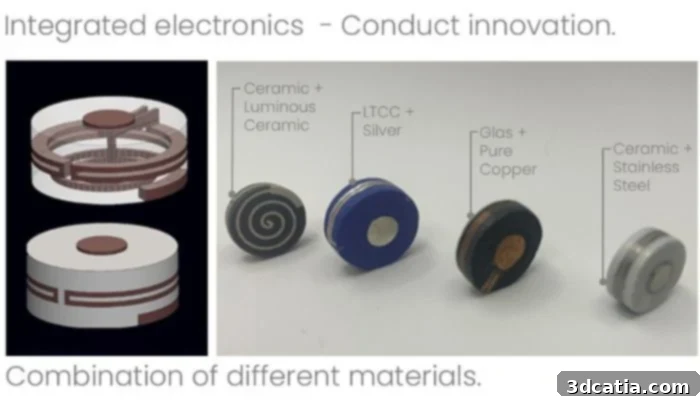
Left: This CAD graphic shows an example of a complex multi-material structure with an integrated conductor structure, e.g. for a heater or sensor layout. Right: Examples of 3D-printed components made from specifically combined materials for use in electronics (From left to right: ceramic + luminescent ceramic, LTCC + silver, glass + pure copper, ceramic + stainless steel.
3DN: What are the challenges?
As with any truly innovative and key technology, Multi Material Jetting (MMJ) faces a unique set of specific challenges that require careful navigation and expertise:
- Intricate Material Development & Compatibility: The successful interaction and precise processing of disparate high-performance materials within a single manufacturing process demand exceptionally deep and specialized material science expertise. Each material, and crucially, every material combination, presents its own distinct set of requirements concerning rheology, optimal sintering behavior, and other critical properties. AMAREA Technology is acutely aware of this complex challenge and addresses it head-on by maintaining extensive in-house expertise in advanced materials science, continuously researching and developing new material systems.
- Establishing Standardization & Scalability: Additive multi-material processes, particularly those as advanced as MMJ, are still emerging fields for many industries and research institutions. Consequently, well-established industry standards, universally accepted test methods, and standardized interfaces for seamless integration into existing production workflows are sometimes lacking. This absence can pose a barrier to broader adoption. AMAREA Technology actively addresses this by providing comprehensive consultation to our customers, guiding them through the integration process and advocating for future industry standards.
- Cultivating User Know-how & Encouraging a Rethink: The full potential of MMJ technology can only be realized if product developers adopt a “multi-material-compliant” mindset early in their design process. This often necessitates a fundamental rethink in traditional product development methodologies, moving beyond designing for single materials. It requires a new way of thinking that embraces the integrated functionality MMJ offers and calls for interdisciplinary knowledge to leverage its capabilities effectively.
- Addressing the Lack of Post-Processing Resources: The 3D printing stage is often followed by essential post-processing steps, typically including debinding to remove the binder and sintering to achieve final material density and strength. Depending on the chosen material system, further steps like surface treatment might also be necessary. The thermal processing, in particular, must be precisely adapted to the selected material system. Not every customer possesses the appropriate infrastructure, such as specialized high-temperature furnaces, when it comes to these critical thermal processing stages. To mitigate this, AMAREA Technology strategically leverages its extensive partner network, making it available to customers who may need to acquire the necessary furnace technology or utilize such services on an outsourced basis, ensuring a complete solution.
3DN: Do you have any final words for our readers?
Our overarching vision at AMAREA Technology is to see our MMJ ProX 3D printers, and their subsequent generations, firmly established as indispensable tools across a wide array of industrial sectors. We aspire to be more than just a supplier of advanced systems; we are committed to actively developing innovative solutions for the products of tomorrow, in close collaboration with our valued customers. Looking ahead five years, we envision ourselves in a position where additive manufacturing with multiple materials is no longer merely a promising innovation, but a widely accepted and indispensable industrial standard for creating truly multifunctional, intelligent, and sustainably produced components.
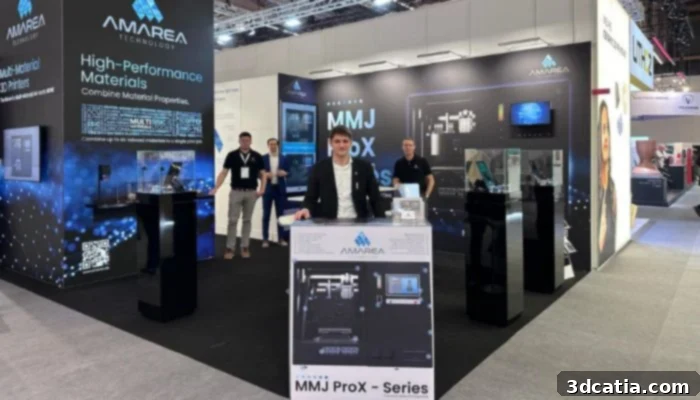
The AMAREA Technology team at Formnext.
We stand at the cusp of a profound technological revolution impacting numerous domains, from the exciting advancements in quantum computing and the transformation of future mobility to the groundbreaking progress in additive manufacturing. Specifically within the AM sector, it has become increasingly evident that it’s no longer just about the “what” and the “how” of production, but, most importantly, the fundamental “why.” With our pioneering MMJ technology, AMAREA Technology is dedicated to empowering companies and developers to engineer products that are inherently smarter, more sustainable, and possess greater functionality than anything previously conceived. To achieve this ambitious future, we recognize the critical need for curiosity, openness to new ideas, and strong, collaborative partners who are willing to invest in pioneering new frontiers. This is precisely where AMAREA Technology steps in. We extend a sincere invitation to everyone to join us in forging new paths in additive manufacturing, pushing the boundaries of what is possible. Because we firmly believe that the most impactful innovations and the future’s most advanced products are created when materials and functions are not considered in isolation, but are thoughtfully and seamlessly integrated. To learn more about our company and explore the possibilities, you can find further information HERE.
What are your thoughts on AMAREA Technology’s multi-material approach? We encourage you to share your insights in a comment below, or engage with us on our LinkedIn or Facebook pages! Additionally, don’t miss out on the latest 3D printing news by signing up for our free weekly Newsletter, delivered straight to your inbox. You can also explore all our videos and compelling content on our YouTube channel.
*Photo credits: AMAREA Technology GmbH. Cover picture: Luminous ceramics and glasses. The two rows of images on the left show 3D-printed components made of zirconium oxide in combination with a luminescent material. On the right are structured components made of luminescent glass, which can also be used for functional or aesthetic applications.