
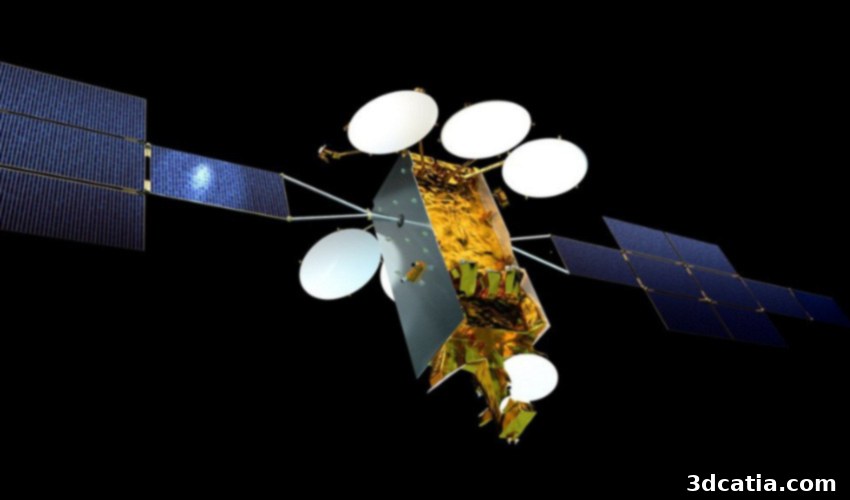
Airbus Propels Satellite Technology with Large-Scale 3D Printed RF Components for Eurostar Neo
The final frontier is becoming increasingly accessible thanks to groundbreaking advancements in manufacturing, with 3D printing leading the charge. In a significant leap forward for space technology, Airbus has leveraged Additive Layer Manufacturing (ALM), widely known as 3D printing or additive manufacturing, to create crucial radio frequency (RF) components for two state-of-the-art Eurostar Neo satellites. These innovative satellites are destined to join the operational fleet of Eutelsat, a prominent communications provider serving Europe and beyond, marking a pivotal moment for the aerospace sector.
This initiative by Airbus is a clear indicator of a rapidly accelerating trend within the aerospace industry. Companies are increasingly turning to additive manufacturing as a transformative approach to component production. The allure of AM lies in its remarkable ability to craft parts that are not only more cost-effective but also inherently stronger and more efficient. This superiority stems from the unparalleled design flexibility offered by 3D printing, allowing for the creation of complex geometries and the utilization of advanced materials previously unattainable with traditional manufacturing methods. The first communications module, featuring these advanced 3D printed components, is now complete and has been dispatched to Airbus’ defence and space facility in Toulouse, France, where the complete satellite assembly will take place. Meanwhile, the second module is poised to commence its rigorous testing phase in the near future.
The Transformative Power of Additive Manufacturing in Space
Additive manufacturing is not merely a supplementary technology; it is rapidly emerging as a cornerstone for the future of space exploration and satellite technology. Several compelling factors contribute to its vital role. Foremost among these is the capability to fabricate highly complex geometries and intricate internal structures, which are critical for optimizing performance in the demanding space environment. Unlike subtractive manufacturing processes that remove material, AM builds parts layer by layer, enabling designers to create organic shapes, integrated functionalities, and lightweight lattice structures that are impossible or prohibitively expensive to produce conventionally.
The versatility of materials available for 3D printing further amplifies its impact. In the aerospace sector, specifically, advanced materials such as ceramic 3D printing and metal 3D printing are experiencing burgeoning adoption. These materials offer exceptional properties vital for space applications, including high strength-to-weight ratios, superior thermal resistance, and durability against extreme temperatures and radiation. This allows engineers to design components that are not only lighter, significantly reducing launch costs, but also more robust and reliable under the harsh conditions of orbit. As exemplified by this Airbus project, AM is increasingly being utilized for the creation of flight-ready, final-use parts, moving beyond prototyping into critical operational components.
Beyond geometric freedom and material innovation, additive manufacturing offers substantial economic and logistical advantages. It often proves to be a more cost-effective and faster production method compared to traditional techniques, especially for low-volume, high-complexity parts common in aerospace. The reduction in material waste, achieved by building only what is needed, also contributes to a more sustainable manufacturing process. Furthermore, AM streamlines the supply chain by reducing the number of individual parts required for an assembly, which in turn simplifies logistics, inventory management, and overall assembly time. This agility is particularly beneficial for the rapid iteration and development cycles inherent in cutting-edge space projects.
The potential applications of 3D printing in space extend far beyond satellite components. Already, numerous companies and space agencies have successfully employed additive manufacturing for critical parts such as advanced thrusters and high-performance rocket engines, demonstrating its reliability and performance in extreme environments. Looking further ahead, 3D printing is poised to revolutionize in-space manufacturing itself. This includes the tantalizing prospect of constructing habitats and infrastructure directly on extraterrestrial bodies, such as Mars and the Moon, using locally sourced materials (regolith). Such capabilities would drastically reduce the cost and complexity of deep-space missions, paving the way for sustainable human presence beyond Earth.
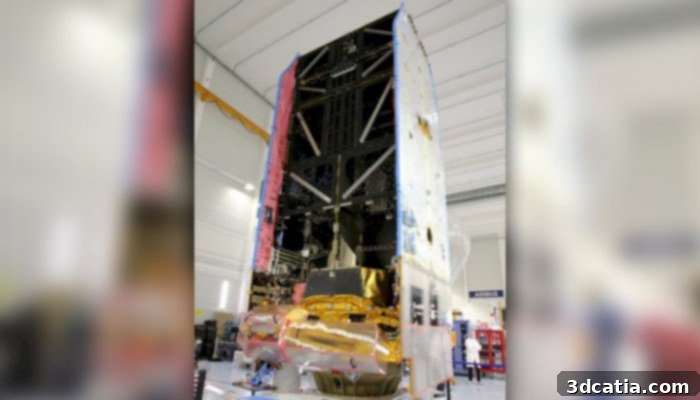
The Eurostar Neo HOTBIRD 13F (photo credits: Airbus)
Airbus’s Advanced 3D Printed Satellite Components for Eurostar Neo
For this specific and highly ambitious project, the team at Airbus Defence and Space in Portsmouth, UK, has meticulously 3D printed an impressive total of 500 radio frequency (RF) components. These intricate components are primarily composed of multi-waveguide blocks and advanced switch assembly networks. RF components are fundamental elements essential for the flawless operation of any communication device, and in the context of satellites, they are critical for transmitting and receiving signals with precision and efficiency.
These pioneering components are integrated into two next-generation satellites, aptly named EUTELSAT HOTBIRD 13F and 13G. Once successfully deployed into orbit, these satellites will play a crucial role in significantly reinforcing and enhancing Eutelsat’s already extensive TV broadcasting services across vast regions, including Europe, the Middle East, and North Africa. The use of additive manufacturing for these components allows for highly optimized designs that minimize signal loss, reduce weight, and integrate multiple functionalities into a single part, thereby improving the overall performance and longevity of the satellites.
Gareth Penlington, the Payload Manager for HOTBIRD, underscored the immense significance of incorporating additive manufacturing into this groundbreaking project. He stated, “This is recognized as the first large-scale deployment of RF products using the ALM process, and it puts us in an industry-leading position for the technology’s application in producing radio frequency components.” Penlington’s comments highlight Airbus’s pioneering role in scaling up AM for critical satellite components, setting a new benchmark for the entire industry.
Furthermore, Penlington emphasized that the strategic integration of 3D printing in the production of components for the EUTELSAT HOTBIRD satellites has led to a dramatic reduction in the total number of individual parts required for assembly. This consolidation of components into fewer, more complex 3D printed structures translates directly into significant labor savings for the company, streamlining the manufacturing process and accelerating production timelines. The first fully integrated communications module for the EUTELSAT HOTBIRD satellite has already been successfully transferred from Portsmouth to the advanced Airbus Defence and Space facility in Toulouse, France, for final integration. Concurrently, the second HOTBIRD communications module is currently under construction, with comprehensive testing anticipated to commence shortly, further solidifying the efficiency and progress of this remarkable endeavor. For more in-depth information about this project and its implications, the official press release can be accessed HERE.
The Future is Now: Additive Manufacturing in Aerospace
The successful deployment of 3D printed RF components by Airbus on the Eurostar Neo satellites is more than just a technological achievement; it’s a testament to the maturation of additive manufacturing as a reliable and indispensable tool for the aerospace sector. This project underscores AM’s capacity to deliver highly specialized, performance-optimized parts that meet the stringent requirements of space missions. From reducing payload weight and increasing satellite lifespan to enabling entirely new design possibilities for antennas and other critical systems, 3D printing is fundamentally reshaping how space vehicles and their components are conceived, designed, and manufactured.
As the demand for more advanced, cost-effective, and efficient satellites continues to grow, the role of additive manufacturing will undoubtedly expand. We can expect to see further innovations in materials, printing processes, and component integration, leading to even more sophisticated satellite designs. This ongoing evolution will not only benefit communication services here on Earth but also accelerate humanity’s journey deeper into space, enabling more ambitious missions and pushing the boundaries of what is possible. The commitment of industry leaders like Airbus to embracing and scaling these advanced manufacturing techniques ensures that the future of space exploration will be built, quite literally, layer by layer.
If you are interested in the pivotal role of Additive Manufacturing in the aerospace sector and wish to delve deeper into its applications and future prospects, be sure not to miss out on our next virtual event, ADDITIV Aerospace! You can register for free and secure your spot HERE. What do you think about Airbus using AM for the creation of RF components for their satellites? We welcome your thoughts! Let us know in a comment below or connect with us on our Linkedin, Facebook, and Twitter pages! For the very latest news and updates in 3D printing delivered straight to your inbox, sign up for our free weekly Newsletter here.
*Thumbnail photo credits: Airbus