
Experience the Future: The Fibonacci House – Canada’s First 3D Printed Airbnb Marvel
In recent years, Airbnb has cemented its position as a global leader in accommodation, transforming the way millions travel and experience destinations. What began as a simple platform for individuals to rent out spare rooms has evolved into a digital giant, often mentioned in the same breath as industry titans like Netflix and Uber. A key driver of Airbnb’s success is its remarkable array of unique and often exotic listings, from rustic treehouses nestled in ancient forests to luxurious boathouses floating on serene waters. This commitment to offering unconventional stays has continually pushed the boundaries of hospitality. Now, marking a significant milestone in both architectural innovation and short-term rentals, Airbnb is featuring its very first 3D printed house: the ‘Fibonacci House’.
This pioneering dwelling is located amidst the breathtaking natural beauty of British Columbia, Canada, offering a truly unique escape for up to four guests. The realization of this architectural marvel is the result of an ambitious collaboration between World House, a visionary organization dedicated to addressing housing challenges, and Twente Additive Manufacturing (TAM), a leading 3D printing service renowned for its innovative construction techniques. Together, they have not only designed and 3D printed a habitable structure but have also placed it on one of the world’s most popular rental platforms, opening up the world of additive manufacturing to a broader audience and demonstrating its practical applications in real-world living spaces.
Unveiling The Fibonacci House: A Masterpiece of Design and Mathematics
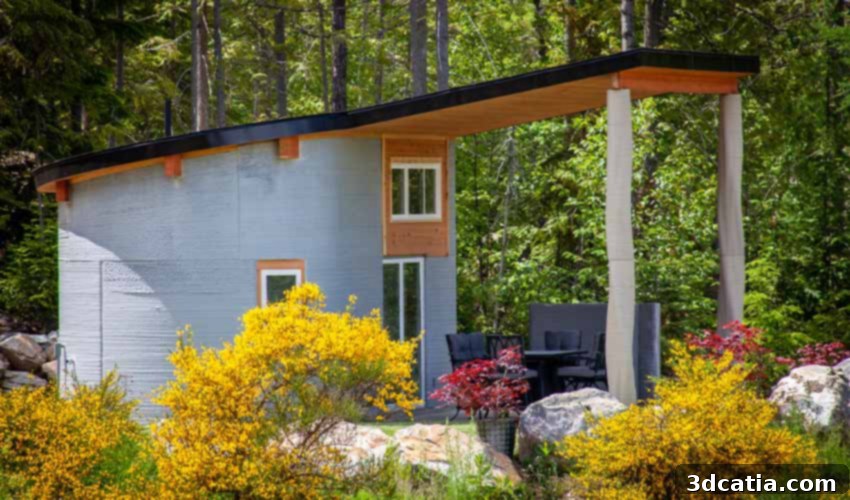
The Fibonacci House is not merely a name; it is a direct homage to the famous mathematical sequence, where each number is the sum of the two preceding ones (0, 1, 1, 2, 3, 5, 8, etc.). This natural pattern, found in everything from the spirals of a seashell to the branching of trees, profoundly influenced the home’s distinctive design. True to its namesake, the house takes the captivating shape of a spiral, mirroring the elegant logarithmic spirals prevalent throughout the natural world. This organic form creates a visually stunning aesthetic that seamlessly blends into its natural surroundings, offering guests an experience that feels both modern and intrinsically connected to nature.
Spanning a modest yet intelligently utilized area of 28 square meters on the ground floor, the Fibonacci House is a testament to efficient and thoughtful design. Despite its compact footprint, the interior is remarkably well-appointed and exceptionally functional. Guests will find a fully furnished kitchen, equipped with modern appliances, perfect for preparing meals. A comfortable living room area provides a cozy space for relaxation and socializing. Cleverly integrated into the design is a charming mezzanine, which serves as an additional sleeping or lounging area, maximizing the vertical space. Completing the amenities is a modern bathroom, ensuring all the comforts of home are met within this innovative structure. Every detail has been considered to ensure a comfortable and memorable stay, proving that small spaces can be incredibly luxurious and practical when designed with ingenuity.
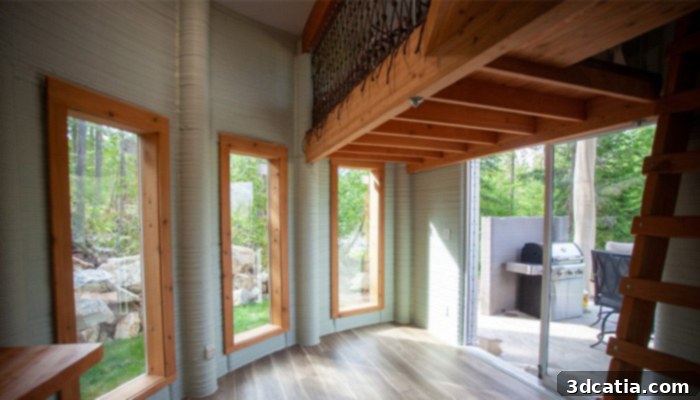
The innovative interior of the Finobacci House, showcasing its unique design and functional layout. (Photo Credit: Twente Additive Manufacturing)
A Rustic Retreat in the Heart of British Columbia
Nestled in the pristine countryside of British Columbia, one of Canada’s most geographically diverse and visually stunning provinces, the Fibonacci House offers more than just a place to stay—it provides an immersive experience. This idyllic location allows tenants to fully discover the raw, untamed beauty of Canadian landscapes. Guests can embark on adventures through towering mountain ranges, explore dense, ancient forests teeming with wildlife, or unwind on serene beaches along the Pacific coast. The house serves as a perfect base for outdoor enthusiasts, offering easy access to hiking, biking, kayaking, and wildlife viewing opportunities, varying with the season.
The appeal of the Fibonacci House extends beyond its architectural uniqueness; it lies in the promise of tranquility and an intimate connection with nature. Far removed from the hustle and bustle of city life, this rural setting encourages relaxation and rejuvenation. Imagine waking up to the sounds of local wildlife, enjoying a morning coffee with panoramic views of lush greenery, or stargazing under an exceptionally clear night sky. The combination of pioneering architecture with a breathtaking natural backdrop creates a truly unforgettable retreat, appealing to eco-tourists and those seeking a peaceful, distinctive getaway. This setting not only enhances the charm of the 3D printed home but also highlights how innovative housing solutions can coexist harmoniously with the environment.
The Ingenuity Behind the Build: Twente Additive Manufacturing’s Vision
Construction of the Fibonacci House
The construction of the Fibonacci House represents a significant leap forward in additive manufacturing for residential purposes. The expert team at Twente Additive Manufacturing (TAM), a Dutch printing service, accomplished the impressive feat of printing the entire structure in just 11 days. This remarkably swift construction time underscores one of the primary advantages of 3D concrete printing over traditional building methods, which often involve lengthy processes and significant labor. The house itself is composed of 20 intricate elements, each meticulously 3D printed using Laticrète material, known for its durability and structural integrity. This modular approach allows for complex geometries to be realized efficiently, while ensuring the strength and longevity of the building.
Adding to the home’s distinctive design are the two elegant spiraling columns that adorn the patio. Each of these columns stands at an impressive 4.5 meters in height and contributes significantly to the house’s Fibonacci-inspired aesthetic. For these particular structural elements, TAM utilized two specialized materials from Baumit, a company recognized for its innovative building solutions. While the specific 3D printer model employed for this groundbreaking project has not been publicly disclosed by the printing department, TAM has proudly highlighted the overarching benefits of their 3D concrete printing technology. They emphasize its capability to construct affordable housing solutions, even those featuring highly complex and unconventional geometries, all while significantly minimizing material waste and resource consumption. This method not only offers design freedom but also presents a more sustainable and cost-effective approach to building, paving the way for future advancements in construction.
A Sustainable Solution to the Global Housing Crisis
Beyond providing unique Airbnb experiences, the efforts of Twente Additive Manufacturing, in collaboration with the World House Organization, are rooted in a far more impactful mission: to leverage the power of 3D printing to construct affordable homes for individuals and families facing housing insecurity. This initiative is a direct response to the escalating global housing crisis, a pervasive issue that impacts nations across every continent, leaving millions without adequate shelter. The ability of additive manufacturing to create homes not only quickly but also inexpensively makes it a truly revolutionary tool in this critical humanitarian endeavor.
Traditional construction methods are often plagued by high labor costs, lengthy timelines, and significant material waste. In stark contrast, 3D printing offers a streamlined process that drastically reduces construction time—as demonstrated by the Fibonacci House’s 11-day build—and material expenditure. This efficiency translates directly into lower overall costs, making homeownership a more attainable reality for vulnerable populations. Furthermore, the technology’s ability to utilize locally sourced or recycled materials contributes to a more sustainable building practice, reducing the environmental footprint of new developments. Imagine entire villages or communities being rapidly constructed to provide durable, safe, and comfortable housing in areas affected by natural disasters or in developing regions where conventional building infrastructure is lacking. Additive manufacturing has the potential to become an indispensable key tool in responding to these urgent housing challenges, offering hope and tangible solutions where they are most desperately needed. This pioneering approach is not just about building houses; it’s about building futures and fostering resilient communities.
The Broader Impact: 3D Printing’s Role in Sustainable Living and Tourism
The Fibonacci House on Airbnb signifies much more than a novel vacation rental; it marks a pivotal moment in the evolution of both the construction and hospitality industries. By showcasing a fully functional, aesthetically pleasing, and comfortable 3D printed home, TAM and World House are demonstrating the immense potential of additive manufacturing beyond industrial applications. This innovative project challenges conventional notions of architecture and sustainable living, proving that complex designs can be achieved with unprecedented speed and efficiency, while simultaneously addressing pressing societal needs.
From an environmental perspective, 3D printing in construction often leads to significantly reduced waste compared to traditional building. Precise material deposition means less off-cut waste, and the potential to use eco-friendly or recycled concrete mixtures further enhances its sustainability credentials. This aligns perfectly with the growing demand for greener building practices and eco-conscious travel options. For the tourism sector, unique listings like the Fibonacci House allow Airbnb to further diversify its offerings, attracting a new segment of travelers interested in technological innovation, sustainable tourism, and one-of-a-kind experiences. Such properties not only generate economic benefits for local communities but also inspire future architects, engineers, and designers to explore unconventional solutions for housing and infrastructure, fostering a culture of innovation.
The success of the Fibonacci House could pave the way for a new era of personalized, sustainable, and affordable housing solutions globally. It represents a tangible step towards a future where housing shortages are mitigated through advanced technology, and where vacation rentals offer guests not just a place to stay, but an opportunity to live in and experience the cutting edge of modern design and sustainable practices. This house is a beacon, illustrating how creative partnerships and technological advancements can converge to create beautiful, practical, and impactful solutions for the world.
What are your thoughts on Twente Additive Manufacturing’s groundbreaking 3D printed Fibonacci House and its potential impact on future housing and tourism? We’d love to hear your perspective! Let us know your opinions in a comment below, or engage with us on our Facebook and Twitter pages. Don’t miss out on the latest advancements and news in the world of additive manufacturing; remember to sign up for our free weekly newsletter, delivered straight to your inbox!
Cover Photo Credit: Twente Additive Manufacturing