
Transformative Synergy: Exploring the Most Innovative Applications of AI in 3D Printing
The realms of artificial intelligence (AI) and 3D printing stand at the forefront of technological innovation, each individually possessing the power to redefine numerous industries. These “disruptive” technologies promise to revolutionize manufacturing, design, and even our daily lives. However, their true potential is unleashed when they converge. The integration of AI with additive manufacturing creates a synergy that transcends the capabilities of either technology alone, paving the way for unprecedented advancements. From optimizing complex designs to automating entire production lines, the combination of AI and 3D printing is enabling the creation of intricate parts and solutions across diverse sectors, including aerospace, medical, and automotive. This article delves into some of the most compelling projects and applications showcasing how AI-powered 3D printing is shaping a more efficient, customized, and sustainable future.
Personalized Pain Relief: Lemki Robotix’s AI-Integrated 3D Printed Back Care
Back and neck pain are widespread issues, often exacerbated by sedentary lifestyles, poor posture, and inadequate seating. Ukrainian tech startup Lemki Robotix offers a revolutionary solution through its Back Care product, which ingeniously combines 3D printing and artificial intelligence to deliver personalized back support. The process begins with users utilizing a mobile application to capture images of their body and posture. AI algorithms then meticulously process these images, extracting detailed anatomical data. This data forms the precise blueprint for designing a custom back support tailored to the individual’s unique physique. The resulting 3D printed support is expertly crafted to conform to the user’s specific anatomy and structure, ensuring optimal ergonomic design, unparalleled comfort, and targeted pain relief. Committed to sustainability, Lemki Robotix manufactures these supports using recycled plastic materials. Furthermore, optional “Trigger Point Switches” allow users to customize the level of support, addressing specific discomfort areas and maximizing pain alleviation. Back Care exemplifies how AI and 3D printing can collaborate to create highly personalized, effective, and environmentally conscious medical-grade solutions, significantly enhancing user comfort and support for chronic pain.

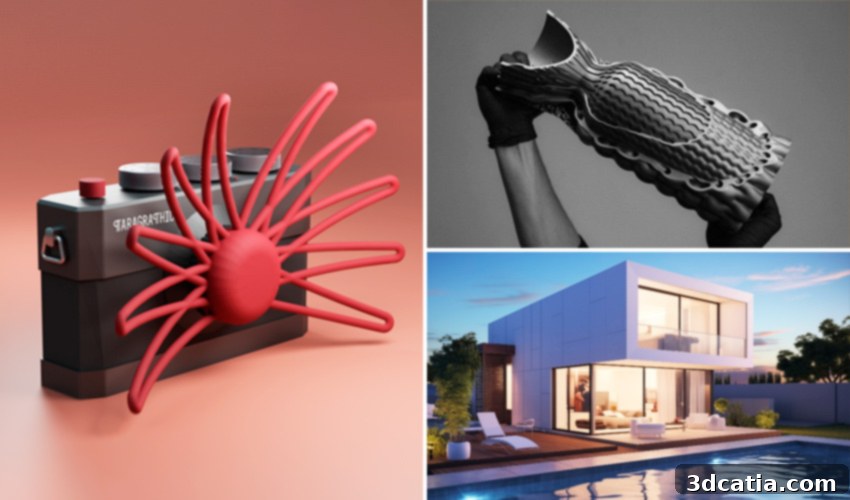
Lemki Robotix’s 3D printed Back Care (Photo Credits: Back Care Kitckstarter Campaign)
Architectural Innovation: The World’s First AI-Designed 3D Printed House by Litehaus
While 3D printed houses have gained considerable traction, especially in recent years with numerous companies adopting the technology, the integration of AI into their design process marks a truly groundbreaking evolution. Litehaus has emerged as a trailblazer in this field, harnessing artificial intelligence to fundamentally transform the design and construction of additive manufactured homes. Their inaugural construction project, located in Portela da Villa, Portugal, stands as a historic achievement: the world’s first AI-designed, 3D printed house. While AI has previously assisted in generating designs for smaller 3D prints, this ambitious project represents an unprecedented fusion of technology, with AI overseeing both the interior and exterior architectural elements of the residence. Beyond its innovative design methodology, this sustainable housing solution offers remarkable practical advantages. It boasts a construction time that is 70% faster and a cost reduction of 20% compared to conventional building methods. Incredibly, 45m² of housing can be erected in a mere 20 hours at an exceptionally low cost, demonstrating the immense potential of this AI-integrated approach to address housing shortages and promote sustainable construction worldwide. This project highlights AI’s capacity to not only optimize complex designs but also accelerate construction timelines and reduce environmental impact.

The design behind Litehaus’ 3D printed house in Portela da Villa, Portugal. (Photo Credits: Litehaus)
Enhancing Sustainability: AI for Material Reuse in Metal 3D Printing
The vast potential of metal 3D printing is often hampered by high material costs and powder waste, making it seem cost-prohibitive for many. However, a significant £600,000 research project, spearheaded by Innovate UK in the United Kingdom, aims to mitigate these challenges through the power of AI. This collaborative initiative brings together the Materials Processing Institute, Additive Manufacturing Solutions, and AMFG to develop SMART-APP – a predictive artificial intelligence-based material reuse management tool. The core objective of SMART-APP is to introduce intelligent predictive models that significantly enhance resource efficiency and reduce waste in metal 3D printing processes. By leveraging AI, the tool will analyze material properties and predict optimal reuse strategies, ensuring that valuable metal powders are utilized to their fullest extent. If successful, SMART-APP will be made commercially available to users of Laser Powder Bed Fusion (LPBF) 3D printing technology, a common method for metal additive manufacturing. This project has the potential to dramatically improve the accessibility and economic viability of metal 3D printing, making it a more sustainable and attractive option for a wider range of industrial applications by addressing critical issues such as powder waste and lengthy processing times.
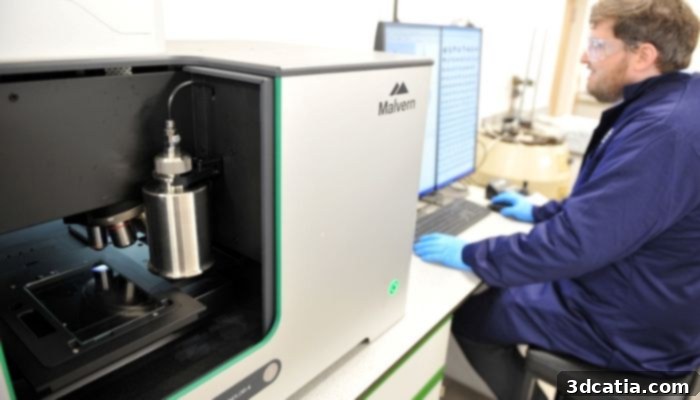
Photo Credits: Materials Processing Institute
Art Meets Engineering: 3D Printing Inspired by Jackson Pollock with AI Guidance
Pushing the boundaries of conventional additive manufacturing, researchers at Harvard University have developed an innovative 3D printing technique, drawing inspiration from the dynamic “drip painting” style of the renowned American painter Jackson Pollock. This groundbreaking method integrates artificial intelligence with fundamental principles of physics to emulate Pollock’s iconic technique within the realm of 3D printing. In traditional Fused Deposition Modeling (FDM), maintaining a close and consistent distance between the nozzle and the printing plate is paramount to ensure stable material flow and prevent printing inconsistencies. However, when liquids are projected from greater heights, they become inherently susceptible to instabilities, often leading to undesirable folding or curling. The Harvard researchers aimed to overcome this challenge, seeking to enhance printing speed and precision, particularly for intricate geometries, even when operating the nozzle at significantly greater distances from the printing surface. Artificial intelligence played a pivotal role in this endeavor. The AI system was trained to teach the 3D printer’s nozzle how to precisely control the flow of liquid material from elevated positions. This AI-driven control allowed for the creation of complex shapes with high fidelity, demonstrating a novel approach to additive manufacturing that marries artistic inspiration with advanced engineering and intelligent control, opening new avenues for rapid and precise fabrication of delicate structures.
Automated Construction: Building a Hydroelectric Dam in China with AI and 3D Printing
The construction sector has already witnessed significant transformations through the adoption of additive manufacturing, notably reducing labor requirements and mitigating the arduousness of manual work. However, by combining 3D printing with artificial intelligence, the efficiency and scope of construction projects can be amplified exponentially, as AI can autonomously oversee and control the sophisticated machinery involved. This powerful synergy is at the heart of an ambitious project underway in China: the construction of a 180-meter-high hydroelectric dam, designed to be erected by 3D printers and an advanced artificial intelligence program with minimal to no direct human intervention. Should this pioneering project proceed as planned, the resulting structure will set a global benchmark as the tallest ever constructed without the need for direct human involvement on-site. Slated for construction on the challenging Tibetan plateau, the dam’s design is strategically engineered to serve as a critical source of electricity for the entire Henan province. This monumental endeavor underscores the potential of AI-driven 3D printing to tackle large-scale infrastructure projects, enhance safety by reducing human exposure to hazardous environments, and accelerate construction timelines while pushing the boundaries of autonomous building capabilities.
Propelling Innovation: 3D Printed Rocket Engines with LEAP 71’s AI Integration
Dubai-based tech firm LEAP 71 is spearheading a new era in rocket propulsion by integrating artificial intelligence into their industrial 3D printing processes. Their mission is to manufacture highly efficient, cost-effective, and customizable rocket engines, thereby ushering in a paradigm shift for space exploration. The fusion of AI and 3D printing at LEAP 71 promises not only accelerated engine development cycles but also opens up wider access to space for both governmental agencies and private entities. Cheaper and more efficient engines translate into expanded possibilities for satellite deployment, interplanetary missions, and commercial space ventures. By leveraging their unique, AI-powered computational engineering model, LEAP 71’s system can seamlessly generate complex objects and designs, which are then precisely optimized for rapid 3D printing. This streamlined design-to-production process significantly reduces lead times and manufacturing costs while enhancing performance. Through this sophisticated integration of AI, LEAP 71 is actively driving forward the frontier of space propulsion systems, fostering innovation, and making significant contributions to the future of the aerospace industry and human endeavors in space.
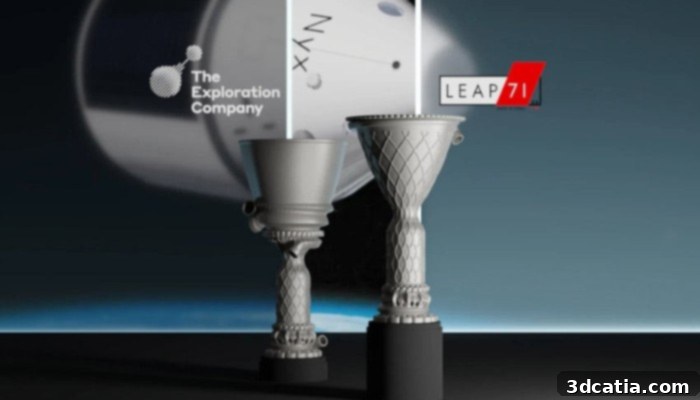
(Photo Credits: Leap 71)
Designing Better Rocket Engines: Hyperganic’s AI-Powered Additive Manufacturing
Munich-based Hyperganic made significant waves in 2020 with the unveiling of its prototype rocket engine, engineered using a potent combination of 3D printing and artificial intelligence. Since then, the company, dedicated to accelerating innovation through AI-based engineering, has achieved remarkable progress. In a notable development in 2022, Hyperganic, in partnership with AMCM (an EOS sister company), announced the creation of what they claimed to be the world’s largest aerospike rocket engine, standing an impressive 80cm tall. This groundbreaking component was brought to life through additive manufacturing guided by AI. The integration of AI-based software during the design process enabled the creation of significantly more complex geometries than previously possible, allowing Hyperganic to “obliterate the limits of what can be achieved with additive manufacturing.” A prime example of this advanced capability is the successful design and 3D printing of intricate regenerative cooling channels directly into the manufactured part. This innovative approach results in a more contained and integrated solution for managing overheating within the engine, enhancing both efficiency and durability. Hyperganic’s work showcases the transformative power of AI in enabling the design and fabrication of previously unimaginable parts, pushing the boundaries of what is achievable in advanced manufacturing.
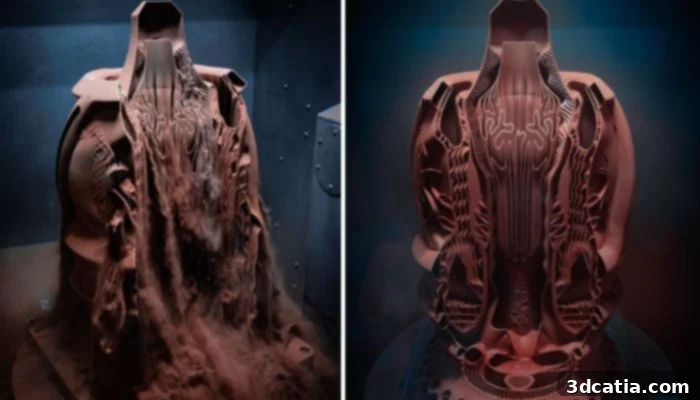
The 80cm, copper aerospike rocket engine as seen during depowdering (left) and in its final form (right) (Photo Credits: AMCM)
Automotive Excellence: Czinger 21C, the Hypercar Forged by AI and 3D Printing
In the high-performance automotive sector, the US car manufacturer Czinger has masterfully merged the innovative capabilities of 3D printing with artificial intelligence to create the extraordinary Czinger 21C. Founded by the visionary father-son duo, Kevin and Lukas Czinger, the company initiated production of this cutting-edge hypercar in 2021. Within the intricate production process of this flagship vehicle, AI plays a paramount role in the design and optimization of components before they are manufactured using 3D printing. Through sophisticated algorithmic analysis, the AI meticulously assesses the potential G-forces that will be applied to the car during extreme performance. It then employs advanced simulations to determine the absolute optimal size, shape, and weight for each individual part. This data-driven, meticulous approach ensures highly efficient additive manufacturing of complex metal components utilizing advanced laser technology, thereby minimizing material waste and maximizing structural integrity. Contrary to common perceptions of racing machines, the Czinger 21C is not solely a track-day marvel; it is meticulously designed and fully licensed for everyday road use in the USA. Aptly dubbed the “hypercar of the 21st century,” it boasts an astonishingly low weight of under 1,500 kg and houses a remarkable 950 hp engine, all made possible by the synergistic advancements facilitated by AI-powered design and additive manufacturing.
Creative Computing: Paragraphica’s ‘Smart’ AI-Powered 3D Printed Camera
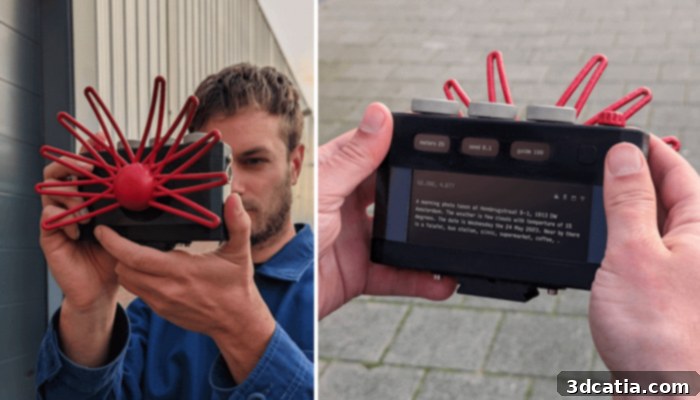
Another captivating project that seamlessly blends artificial intelligence with 3D printing is Paragraphica. Conceived by Danish artist and designer Bjørn Karmann, this ingenious camera integrates a sophisticated AI algorithm capable of processing ambient data to generate a contextual “image” based on a specific place and time. Instead of capturing light, Paragraphica’s AI analyzes information such as the date, time, cardinal direction, current weather conditions, temperature, and even nearby points of interest. It then uses this data to compose a textual or conceptual representation of the environment. The entire physical structure of this unique camera has been skillfully 3D printed using Fused Deposition Modeling (FDM) technology, showcasing the versatility of additive manufacturing in creating bespoke electronic housings. Paragraphica is powered by a Raspberry Pi 4 Model B board, which is connected to a 1.5-inch touch screen, providing users with intuitive control and visualization of the AI-generated descriptions. For those intrigued by this blend of art and technology, the camera is available both as a tangible physical prototype and as a virtual model for digital experimentation, accessible via the manufacturer’s website. Paragraphica is a testament to how AI and 3D printing can converge to create new forms of artistic expression and interactive technology, bringing the invisible narratives of our surroundings to life.
The Future is Here: AI and 3D Printing Continue to Innovate
The examples above merely scratch the surface of the boundless possibilities unlocked when artificial intelligence and 3D printing are combined. This powerful synergy is not just enhancing existing processes; it is creating entirely new paradigms in design, manufacturing, and problem-solving across virtually every industry. From personalized healthcare devices and sustainable housing to advanced rocket propulsion and automated mega-construction, AI-powered additive manufacturing is driving unprecedented levels of customization, efficiency, complexity, and sustainability. As these technologies continue to evolve, we can anticipate even more sophisticated integrations, leading to smarter factories, more resilient supply chains, and groundbreaking products that were once confined to the realm of science fiction. The future of innovation is undeniably intertwined with the continuous evolution and collaborative application of AI and 3D printing.
Which of these incredible projects integrating AI and 3D printing caught your attention the most? We invite you to share your thoughts in a comment below or connect with us on our LinkedIn, Facebook, and Twitter pages! Don’t miss out on the latest advancements; remember to sign up for our free weekly newsletter here to receive top 3D printing news directly in your inbox. You can also explore all our insightful videos on our YouTube channel.