
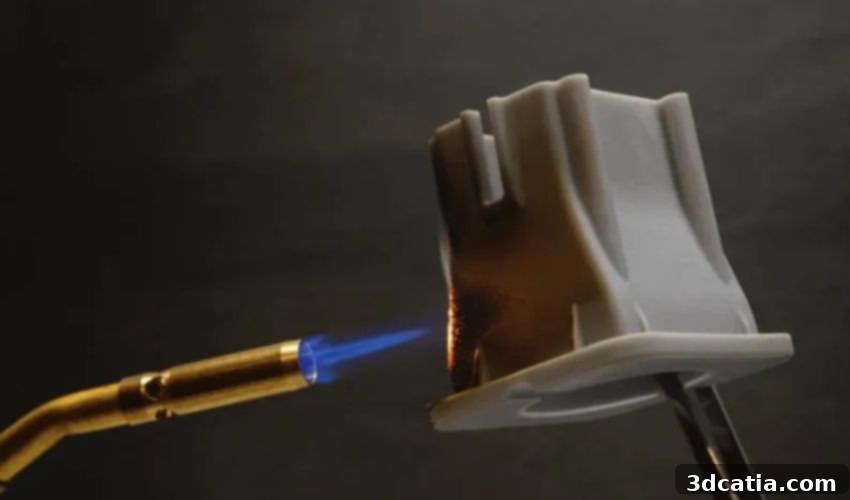
Advancing Safety and Performance: The Rise of Flame-Retardant 3D Printing Materials
In today’s rapidly evolving industrial landscape, where innovation often pushes the boundaries of traditional manufacturing, one constant remains paramount: safety. Particularly in critical applications across diverse sectors, fire safety is not merely a recommendation but an absolute necessity. Additive manufacturing, or 3D printing, is demonstrating its remarkable capacity to meet this challenge head-on. Over recent years, we have witnessed an exponential growth in the development and availability of specialized fire- and flame-retardant materials specifically engineered for additive manufacturing processes. These materials come in various forms, including high-performance filaments, advanced resins, and meticulously formulated powders, each designed to integrate seamlessly into different 3D printing technologies.
The primary objective of these groundbreaking materials is to drastically enhance safety by resisting ignition, slowing the propagation of flames, and minimizing the emission of smoke and toxic gases during combustion. This makes them indispensable for components used in high-risk environments or those subject to stringent regulatory oversight. As industries continue to demand safer, more reliable, and higher-performance parts, the range of flame-retardant plastics and composites adapted for 3D printing continues to expand. But what precisely distinguishes these materials from their standard counterparts, how are their properties verified, and where are they making the most significant and transformative impact?
Understanding Flame-Retardant and Fire-Retardant Properties in 3D Printing
To truly appreciate the advancements in this field, it’s crucial to first understand the nuanced distinction between “fire-retardant” and “flame-retardant” materials, as these terms are often used interchangeably, yet carry slightly different meanings. Fire-retardant materials possess an inherent, permanent resistance to fire, either due to their intrinsic chemical structure or through their specific manufacturing process that embeds fire-resistant properties throughout the material. Conversely, flame-retardant materials derive their ability to impede the spread of flames from targeted chemical treatments or additives introduced during their formulation. While some flame-retardants exhibit self-extinguishing characteristics, their overall effectiveness can often depend on the specific coating or additive system applied.
Despite this subtle difference, both categories of materials share fundamental characteristics critical for safety applications. They are engineered for low flammability, meaning they are difficult to ignite and burn slowly. Furthermore, they are designed to emit minimal smoke and toxic gases when exposed to heat or flames, a crucial factor for evacuation safety and reducing harm. Crucially, they offer controlled or significantly reduced combustion, preventing rapid fire spread and allowing more time for intervention or escape. These properties are rigorously tested and certified to meet demanding safety standards, ensuring that 3D printed components can withstand extreme thermal challenges.
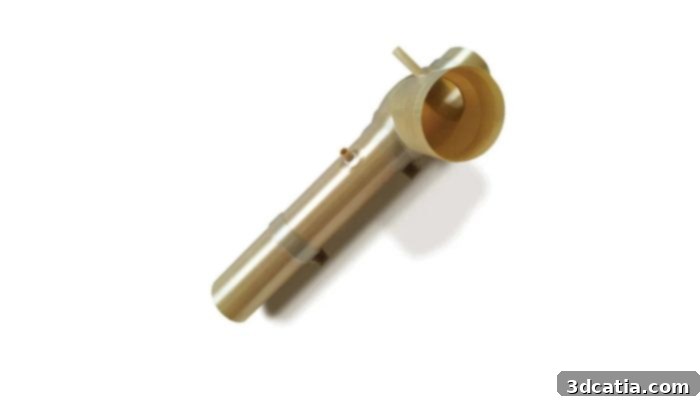
ULTEM 9085 is one of the high-performance, flame-retardant materials used in 3D printing, frequently seen in aerospace applications.
In the realm of additive manufacturing, both fire-retardant and flame-retardant materials are extensively utilized, irrespective of whether they are processed as resins in VAT polymerization, filaments in Fused Deposition Modeling (FDM), or polymer powders in selective laser sintering (SLS). Their classification and certification as flame-resistant are achieved through a series of specialized tests, typically adhering to international standards. The most widely recognized standard for plastics is UL94, developed by Underwriters Laboratories (UL). This standard provides a comprehensive framework for classifying the flammability behavior of plastic materials when exposed to an open flame.
The UL94 testing protocol involves evaluating a material under several variables. Key tests include Horizontal Burning (HB), which assesses whether a material burns slowly in a horizontal orientation, and Vertical Burning (VB), which tests the material in a vertical position. The Vertical Burning test, in particular, yields three possible grades of certification: V-0, V-1, and V-2, each indicating a different level of fire retardancy based on how the materials respond to the test conditions. The V-0 certification represents the highest and most desirable level of flame retardancy. Materials achieving a UL94 V-0 rating are characterized by their ability to self-extinguish within 10 seconds after ignition, with no flaming drips, making them ideal for the most demanding safety-critical applications. This superior performance is a benchmark for many advanced flame-retardant 3D printing materials.
Beyond general industrial standards, specific sectors have their own stringent requirements. For materials used within the aviation industry, an additional certification is often mandated by the American Federal Aviation Administration (FAA). This is known as FAR Fire Test Procedure 25.853. This critical procedure ensures that all materials utilized in aircraft interiors and structures meet highly specific performance criteria when subjected to heat or flame. Compliance with FAR 25.853 is vital for guaranteeing passenger safety and operational integrity, making flame-retardant 3D printing materials indispensable for components ranging from cabin panels to ventilation systems.
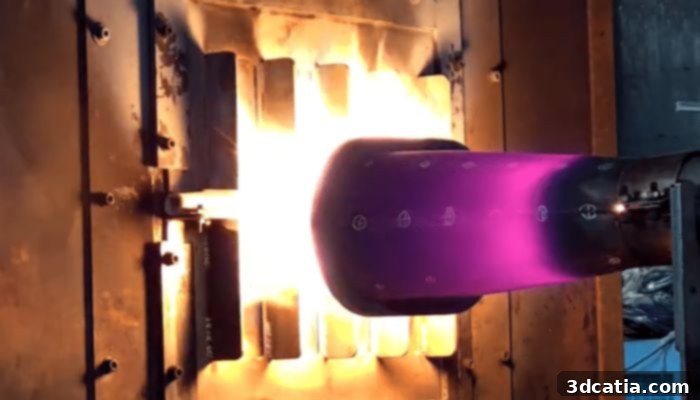
3Deus Dynamics has developed composite silicones via additive manufacturing for the aerospace industry, capable of withstanding extreme temperatures up to 1200°C and preventing flame propagation for 15 minutes. (Credits: 3Deus Dynamics)
The versatility of flame- and fire-retardant materials extends across a wide spectrum of 3D printing technologies, from the extrusion-based FDM and sophisticated resin-based processes like SLA and DLP, to high-volume polymer powder methods such as SLS. When these advanced materials are synergistically combined with the capabilities of additive manufacturing, they unlock an expansive array of applications across vastly different industries. A core advantage offered by 3D printing is the unparalleled precise control it provides over material behavior and processing temperatures. In certain advanced additive manufacturing technologies, this even allows for dynamic modification of material properties during the printing process itself. For example, functionally graded or composite materials, optimized for specific fire-resistant zones, can be created directly within a single print job, paving the way for unprecedented functionality and performance.
Moreover, 3D printing’s inherent ability to produce geometrically complex structures – often impossible to achieve with conventional manufacturing techniques – further accentuates the value of these specialized materials. This design freedom enables the creation of lightweight components with optimized internal structures for thermal management, or parts with integrated safety features that would be prohibitively expensive or impossible to produce otherwise. It is this powerful combination of advanced material science and innovative manufacturing processes that explains why flame-retardant 3D printing materials are rapidly gaining traction in sectors where safety, regulatory compliance, and technological innovation must go hand in hand.
Key Applications Across Critical Industries
The applications of flame-retardant and fire-retardant 3D printing materials are remarkably diverse, yet they are predominantly concentrated in industries where the risk of fire poses significant threats to human life, critical infrastructure, or operational continuity. These sectors include, but are not limited to, aerospace, oil and gas, and automotive, as well as electronics, construction, and healthcare.
In the **aerospace industry**, where every gram of weight matters and safety standards are among the most rigorous in the world, high-performance materials such as ULTEM 9085, which boasts a UL94 V-0 certification, are indispensable. These materials are used for 3D printing critical aircraft interior components, including intricate cabin panels, robust ventilation system parts, and lightweight seat structures. Their ability to provide both exceptional mechanical performance and a robust fire barrier is crucial for enhancing passenger safety and meeting stringent aviation regulations like FAR 25.853. The lightweighting capabilities of 3D printing with these materials also contribute to fuel efficiency, offering a dual benefit.
Similarly, within the **automotive and broader transportation sectors**, flame-retardant materials are transforming design and production. They are extensively utilized to additively fabricate interior parts for train cars, such as overhead bins and wall panels, which must comply with strict rail industry fire standards (e.g., EN 45545-2). Furthermore, these materials are increasingly used for components in automobile bodies, electrical enclosures within electric vehicles (EVs) where battery safety is paramount, and even under-the-hood components that must withstand high temperatures and potential flame exposure. The ability to prototype and produce low-volume, specialized parts quickly with integrated fire safety features is a major advantage here.
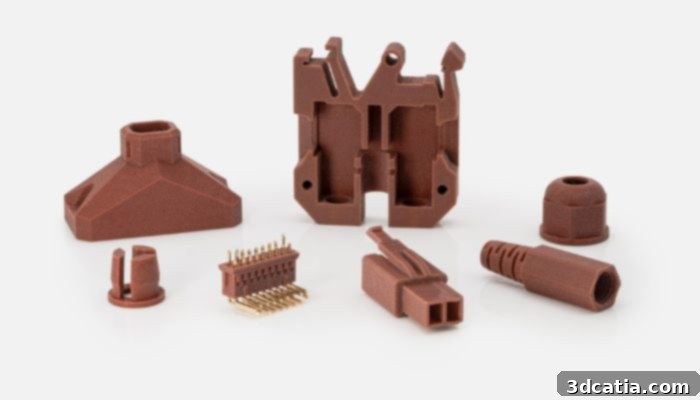
Parts for the electronics industry 3D printed with Cubicure Evolution FR resin (Credit: Cubicure).
The **electronics industry** benefits immensely from flame-retardant 3D printing, especially for the additive manufacturing of small, highly detailed parts such as enclosures, connectors, and internal insulating components. Resins like Cubicure Evolution FR, which also achieves a UL94 V-0 rating, are perfect for creating housings that prevent the spread of flames in the event of an electrical short circuit or internal fire, thereby protecting sensitive components and minimizing damage or injury. This is critical for everything from consumer electronics to industrial control systems.
Beyond these established areas, flame-retardant materials are also finding significant traction in sectors where high safety standards and strict adherence to fire regulations are non-negotiable. Consider the **construction sector**, where it is now possible to 3D print fireproof ceilings, interior wall panels, bespoke doors, or protective siding. These materials can contribute to creating safer buildings, particularly in public spaces or high-occupancy structures, by slowing fire propagation and reducing smoke inhalation risks.
In the **medical sector**, where patient safety is paramount, some medical equipment and devices are now being fabricated from fireproof materials. This includes housings for sensitive diagnostic equipment, components for operating room machinery, or custom protective gear, ensuring that even in the unlikely event of an electrical fault, the spread of fire is contained, protecting both patients and medical personnel. The ability to create custom, biocompatible, and fire-resistant components tailored to specific medical applications represents a significant leap forward in patient care and device safety.
The integration of flame-retardant capabilities with the inherent advantages of 3D printing offers a powerful toolkit for innovation across virtually every industry. From enhancing product performance and durability to, most importantly, ensuring greater safety for people and property, these materials are not just preventing fires—they are actively shaping a more secure and resilient future for additive manufacturing.
What are your thoughts on the transformative potential of 3D printing with flame-retardant materials? We invite you to share your insights in a comment below or join the conversation on our LinkedIn, Facebook, and Twitter pages! Don’t forget to sign up for our free weekly Newsletter here, to get the latest 3D printing news delivered straight to your inbox! You can also find all our videos and interviews on our YouTube channel.
*Cover Photo Credits: Formlabs