
The State of 3D Printing 2020: Unveiling Key Trends, Applications, and Future Insights in Additive Manufacturing
Every year, the renowned 3D printing service Sculpteo delivers its highly anticipated annual report, “The State of 3D Printing.” This comprehensive study offers invaluable insights into how professionals are leveraging additive manufacturing across diverse industries. More than just a snapshot, the report provides a panoramic view of emerging market trends, identifies the primary challenges encountered by companies and industrialists, and thoroughly outlines the tangible benefits they derive from this transformative technology. The 6th edition of this pivotal report, published in 2020, underscored a significant and clear trend: additive manufacturing is not only increasingly adopted by professionals but is also reaching a new level of maturity. A remarkable 80% of survey participants reported having utilized the technology for at least two years, signaling a deep integration into their operational workflows. Despite this growing maturity and widespread acceptance, the report candidly highlighted that the technology still faces hurdles, particularly regarding its cost-effectiveness. The investment required remains substantial, and the initial entry costs are notably high, posing a barrier for some potential adopters. Nevertheless, a powerful shift in perception is underway; mindsets are gradually evolving as a consensus emerges that the production of functional, end-use parts via 3D printing is no longer a futuristic concept but a present-day reality, fundamentally altering traditional manufacturing paradigms.
The “Sculpteo State of 3D Printing 2020” report stands as a robust compilation of data, drawing responses from professionals spanning an impressive 71 different countries. A significant portion of these respondents, specifically 48%, represented companies based in Europe, providing a strong regional perspective while maintaining global relevance. From its inception, the study meticulously identified and elaborated on four overarching key trends that are currently shaping the additive manufacturing landscape: materials, durability, technology evolution, and accessibility. These trends are not isolated but interconnected, collectively driving the industry forward. The report emphasizes the dramatic expansion in the availability of innovative materials. Today, a broader and superior array of materials is accessible, specifically engineered to meet the stringent requirements of a multitude of industries, ranging from aerospace to medical and consumer goods. Alongside material advancements, significant improvements have been made in post-processing technologies. These enhancements are crucial for refining the final appearance, mechanical properties, and functional performance of 3D printed parts, ensuring they meet the highest quality standards. When examining the evolution of the technology itself, Sculpteo’s report highlights that contemporary 3D printing equipment is notably more reliable, significantly faster, and increasingly accessible to a wider user base. Finally, additive manufacturing is increasingly embracing a more sustainable dimension. This is evidenced by the growing availability of bio-sourced materials and the rise of local production processes. These developments collectively contribute to a substantial reduction in the ecological footprint associated with manufacturing, aligning with global efforts towards sustainability. But beyond these macro trends, what do the direct users, those actively employing the technology, truly think and experience?
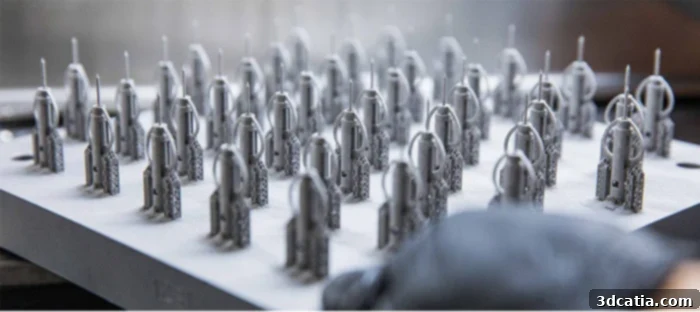
Professionals have more confidence in the technology to produce end-use parts
The State of 3D Printing 2020: How Additive Manufacturing is Being Utilized
A groundbreaking revelation from the 2020 report indicates a significant paradigm shift in the application of 3D printing. Over 50% of the survey participants are now predominantly using 3D printing for the direct production of end-use parts. This pivotal trend, which was already hinted at in previous reports, has now firmly established itself as a dominant application. This shift signifies a departure from additive manufacturing’s traditional role primarily as a prototyping tool and firmly positions it as a viable method for final product creation. For the first time in five years, the use of additive manufacturing specifically for rapid prototyping purposes has seen a decline in comparison to other applications. This statistic is compelling evidence that 3D printing is increasingly demonstrating its potential and capability to play a crucial role in full-scale mass production, moving beyond bespoke or small-batch manufacturing. Furthermore, the report highlights that 42% of professionals are employing additive manufacturing for research and development (R&D) and educational purposes – a figure that has been steadily rising, indicating a growing recognition of AM’s utility in innovation and skill development. Interestingly, while professionals acknowledge that contemporary design software is more efficient and powerful than ever before, CAD design and prototype testing remain the two most time-consuming stages in their workflow. This suggests that despite technological advancements, the intricacies of design optimization and thorough validation require significant investment of time and expertise. Clément Moreau, CEO and co-founder of Sculpteo, eloquently summarized these developments: “After six years, we can see a clear evolution in the applications of this technology. Companies are identifying additive manufacturing opportunities for their business, increasing their investments and showing real confidence in the future of 3D printing for their professional uses.” This statement underscores the industry’s burgeoning trust and strategic commitment to additive manufacturing as a cornerstone of future innovation and production.
Delving into the technological preferences and adoption patterns, the report offers a granular view of the most widely utilized 3D printing processes. Fused Deposition Modeling (FDM) continues to hold its position as the most widely used in-house process, a testament to its accessibility, relative affordability, and ease of operation. FDM printers are often the entry point for many companies due to their versatility with various plastic filaments and their suitability for rapid prototyping and functional part creation within a controlled environment. However, when it comes to more advanced industrial applications requiring higher precision, superior material properties, or complex geometries, Selective Laser Sintering (SLS), Multi Jet Fusion (MJF), and various forms of metal additive manufacturing remain exceptionally popular. These sophisticated technologies, while offering unparalleled capabilities, are more frequently accessed through specialized 3D printing services rather than being adopted in-house. This preference for service bureaus can largely be attributed to the significantly higher investment costs associated with acquiring and maintaining such advanced machinery, as well as the need for specialized expertise and infrastructure to operate them effectively. For many organizations, particularly small and medium-sized enterprises, outsourcing to a service bureau provides access to cutting-edge technology without the prohibitive upfront capital expenditure. Finally, a detailed examination of material usage reveals that plastic filaments dominate the market, utilized by the vast majority of users. This is closely followed by resins, particularly for applications requiring fine detail and smooth surface finishes, and finally, metals, which are gaining significant traction for high-performance and critical industrial components. This stratification of technology and material usage highlights the diverse landscape of additive manufacturing, catering to a wide spectrum of needs and budgetary considerations.
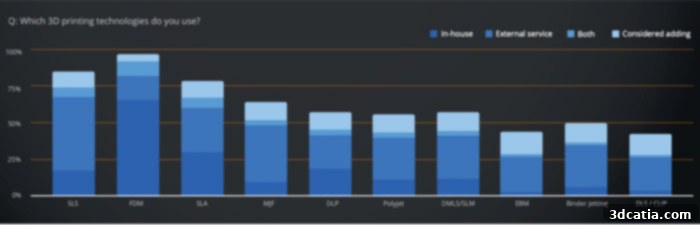
The most widely used 3D printing technologies
Benefits and Limitations of Additive Manufacturing: A Balanced Perspective
The Sculpteo report thoroughly enumerates the compelling advantages that drive the increasing adoption of 3D printing technologies. Unsurprisingly, a substantial 66% of participants lauded 3D printing for its unparalleled ability to create more complex parts. This capability is revolutionary, enabling engineers to design geometries previously impossible with traditional subtractive or formative manufacturing methods, leading to lightweighting, functional integration, and optimized performance. The flexibility of additive manufacturing also allows for the multiplication of design iterations, with 45% of respondents highlighting this benefit. This rapid iteration capability significantly accelerates the design and development cycle, fostering innovation and allowing for quicker refinement of products. Furthermore, 43% of users noted a significant reduction in time-to-market, attributing this efficiency to faster prototyping and the ability to produce on-demand parts without the lengthy lead times associated with conventional tooling. Complementing these benefits, 37% of participants reported reduced production costs, primarily through minimized material waste, optimized designs requiring less material, and the elimination of expensive tooling. These advantages collectively position 3D printing as a powerful tool for enhancing product development and manufacturing efficiency.
Despite its numerous advantages, the path to wider adoption of additive manufacturing is not without its obstacles, as candidly revealed by the report. The most prominent limitation, identified by a significant 59% of participants, is the prohibitively high entry costs. The substantial initial investment required for acquiring industrial-grade 3D printers, specialized software, and necessary infrastructure acts as a significant barrier, particularly for smaller enterprises or those cautiously exploring the technology. Beyond financial considerations, a considerable 51% of respondents pointed to a widespread lack of knowledge and specialized skills within their organizations as a major impediment. This skill gap highlights a critical need in the market for comprehensive training programs, educational resources, and certified courses that can equip professionals with the expertise required to effectively design for, operate, and maintain additive manufacturing systems. Addressing this knowledge deficit is crucial for unlocking the full potential of 3D printing across industries.
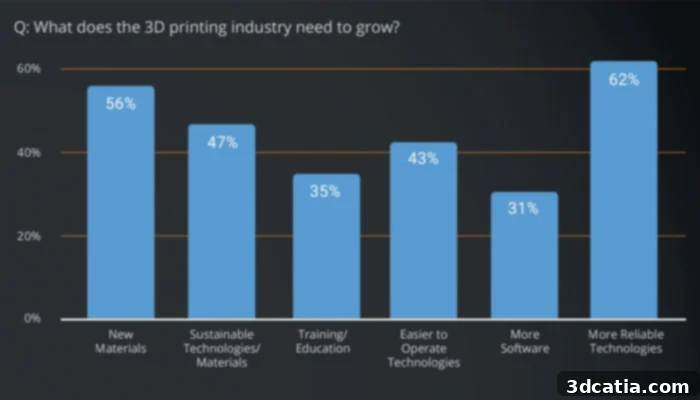
The report further illuminates what the industry most urgently needs to propel additive manufacturing into its next phase of growth. A substantial 62% of professionals expressed a clear demand for more reliable technologies. This encompasses not just the hardware but also the entire ecosystem, including software, processes, and consistent part quality. While current technologies are advanced, the call for even greater repeatability, uptime, and predictable outcomes underscores the desire for industrial-grade robustness. Closely related to reliability, 56% of respondents indicated a need for new and advanced materials. Although the supply of materials has indeed expanded significantly over the past five years, the industry is continuously seeking materials with enhanced mechanical properties, broader application suitability, and certifications for highly regulated sectors like aerospace and medical. The final, yet critically important, challenge facing professional users revolves around the intricate issue of quality control. A compelling 51% stated that ensuring the quality and consistency of 3D printed parts – specifically, guaranteeing that prints meet the stringent requirements and specifications of their respective markets – is the primary obstacle to the broader, more widespread adoption of additive manufacturing within their businesses. This underscores the imperative for standardized testing methods, robust post-processing quality assurance protocols, and reliable certification pathways to instill greater confidence in the integrity and performance of 3D printed components.
In conclusion, Sculpteo’s “State of 3D Printing 2020” report paints a vivid picture of an industry undergoing rapid transformation and maturation. Additive manufacturing is definitively moving beyond its foundational role in prototyping to become a central pillar in the production of functional, end-use parts. The increasing confidence in the technology, coupled with advancements in materials, equipment, and overall accessibility, suggests a bright future. However, the industry must collectively address the persistent challenges of high entry costs, the critical need for upskilling the workforce, and the imperative for robust quality control mechanisms. Overcoming these hurdles will be key to unlocking the full potential of 3D printing and integrating it even more seamlessly into the global manufacturing landscape. The journey ahead promises continued innovation, greater industrial integration, and a pivotal role for additive manufacturing in shaping the products and processes of tomorrow.
What are your thoughts on these significant findings and the direction of additive manufacturing? We invite you to share your insights and opinions by leaving a comment below or engaging with us on our Facebook and Twitter pages! For all the latest news, trends, and breakthroughs in the dynamic world of 3D printing, remember to sign up for our free weekly Newsletter, delivered straight to your inbox.