
Revolutionizing 3D Printing: Adaptive Nozzles Achieve Unprecedented Speed and Precision
For years, the promise of 3D printing has been accompanied by a persistent trade-off: users typically had to choose between achieving either high resolution or high speed. This fundamental limitation meant that intricate details often came at the cost of prolonged print times, while rapid production frequently sacrificed fine features and surface quality. Traditional 3D printers, with their fixed-diameter nozzles, inherently struggled to reconcile these two crucial demands without significant compromises. Small-diameter printing nozzles are renowned for their ability to produce incredibly intricate details and precise prints, essential for highly functional or aesthetically critical components. Conversely, larger nozzle diameters are favored for their capacity to extrude more material quickly, drastically reducing overall print durations for larger, less detailed objects. Bridging this gap has been a significant challenge for researchers and engineers in the additive manufacturing sector.
A groundbreaking new approach, however, promises to redefine this dilemma, offering a solution that could liberate users from the age-old choice between “precise & slow” and “fast & sloppy.” This innovation stems from the collaborative efforts of Jochen Müller and Seok Won Kang from the Whiting School of Engineering at Johns Hopkins University. Together, they have developed an adaptive nozzle system that can seamlessly achieve both high precision and high speed within a single print job, setting a new standard for versatility in 3D printing. This development marks a significant leap forward, potentially unlocking new applications and efficiencies across various industries.
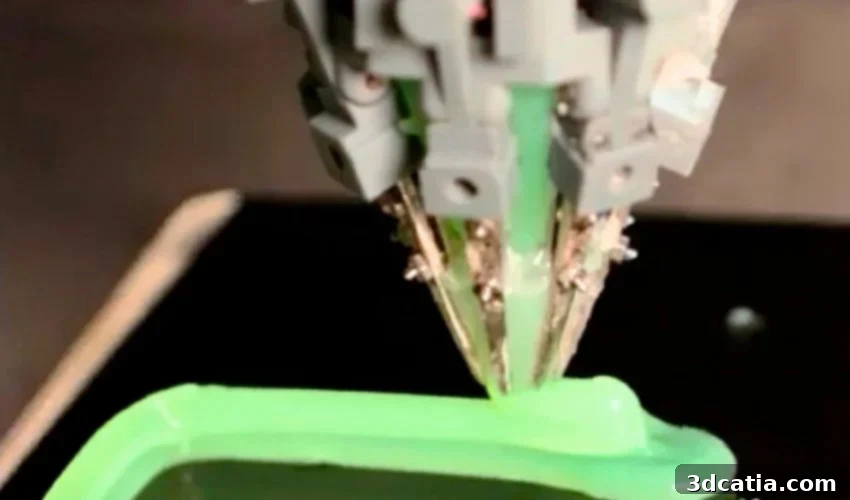
Müller and Kang have introduced a novel printing technique centered around their specialized adaptive nozzle, dubbed AN3DP. What makes AN3DP truly revolutionary is its capability to dynamically alter both its diameter and cross-sectional shape *during* the printing process. This on-the-fly adaptability allows for unprecedented control over material extrusion, enabling the simultaneous production of parts with both rapid construction and meticulously detailed elements. Furthermore, a core design principle behind AN3DP is its inherent ability to actively prevent common printing errors that plague conventional fixed-nozzle systems, leading to superior print quality and reduced material waste.
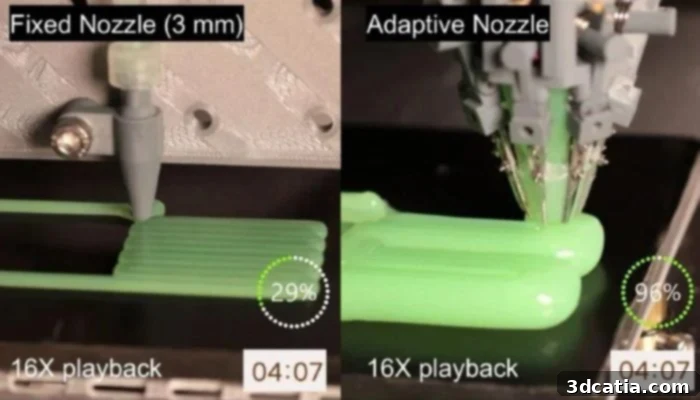
Photo Credits: Johns Hopkins University
The limitations of fixed nozzles are well-documented and frequently manifest as issues like over-extrusion or under-extrusion. These problems are particularly noticeable and detrimental when printing components that feature a complex interplay of intricate details and solid, volumetric elements. Such scenarios often result in an undesirable “stair-stepping” effect on sloped or curved surfaces, where the layers become visibly segmented rather than smooth. This not only diminishes the aesthetic quality of the print but can also compromise its structural integrity and functional performance. Recognizing these pervasive challenges, the Johns Hopkins team was primarily motivated to leverage an adaptive nozzle design to fundamentally improve the reliability, efficiency, and overall quality of the 3D printing process and its resultant objects.
The engineers drew profound inspiration for their innovative approach from the elegant mechanisms observed in retractable grabber tools and, more profoundly, from the sophisticated interplay of tendons in human and animal anatomy. These biological and mechanical systems, capable of precise, dynamic shape changes, provided the conceptual blueprint for AN3DP’s intricate design. At its core, AN3DP features eight precisely movable pins, ingeniously interconnected by a highly elastic membrane. These pins are individually controlled by a series of micro-motors, allowing them to adjust the nozzle’s diameter and cross-sectional shape in real-time. Crucially, the elastic membrane plays a vital role in maintaining an even and consistent flow of material, regardless of the nozzle’s dynamic configuration. This biomimetic design ensures that the material is extruded smoothly and uniformly, even as the nozzle changes shape to accommodate varying geometric requirements.
The synergy between the moving pins and the elastic membrane is absolutely critical for AN3DP’s ability to produce both precise and complex structures while simultaneously achieving impressive manufacturing speeds. This unique combination enables the nozzle to intelligently account for and adapt to various printing parameters that are often overlooked or simply unaddressable by other variable nozzle technologies currently on the market. While there are indeed several variable nozzles available today that can change their diameter, they typically lack the sophisticated control over the *cross-sectional shape* of the extruded filament. This limitation means they cannot precisely dictate the form of the material as it exits the nozzle, leading to potential inconsistencies or compromises in print quality, particularly for non-circular geometries. AN3DP, in stark contrast, is meticulously designed to influence both the nozzle’s overall size and, critically, the filament’s cross-sectional shape, offering unparalleled control and opening up new possibilities for complex part fabrication.
Beyond the ingenious pin-and-membrane system, a significant factor contributing to AN3DP’s remarkable precision and speed is its distinctive conical inner design. Jochen Müller, the lead author of the study and an assistant professor in the Department of Civil and Systems Engineering at the Whiting School of Engineering, emphasized the profound importance of this specific design element. He elaborates: “Traditional 3D printers rely on fixed nozzles, which inherently force a limitation—either on resolution or speed. Smaller nozzles undeniably enhance resolution, allowing for incredibly fine details, but they invariably slow down the printing process considerably. Conversely, larger nozzles dramatically increase printing speed but come at the expense of reduced detail and precision. AN3DP’s innovative design fundamentally overcomes this long-standing trade-off by dynamically adjusting its configuration to meet the precise requirements of each specific feature being printed. This revolutionary capability allows for the simultaneous achievement of both exceptionally high resolution and significantly faster printing speeds, a combination previously thought to be impossible.” This adaptability ensures optimal material deposition for every part of the print, from broad infills to delicate outer perimeters.
Adaptive Nozzle Eliminates the “Minecraft Effect” for Superior Surface Quality
One of AN3DP’s most compelling capabilities is its versatility in material handling. The adaptive nozzle is currently capable of extruding a vast array of materials, including various polymers, hydrogels, advanced ceramics, robust metals, complex composite materials, and even delicate biological materials. This broad compatibility makes it an invaluable tool for diverse applications, from rapid prototyping to specialized biomedical engineering. Furthermore, the nozzle is engineered to withstand demanding operating conditions, capable of enduring temperatures exceeding 200°C, which is critical for processing many engineering-grade thermoplastics and specialized resins. The ultimate vision for AN3DP is its seamless integration into existing Fused Filament Fabrication (FFF) systems, a move that would democratize access to this advanced technology and significantly improve the print quality achievable by a wider range of 3D printers.
“One of the major benefits of this adaptive nozzle is its unparalleled ability to virtually eliminate the persistent ‘stair-stepping’ effect,” explains Müller, highlighting a common frustration for 3D printing enthusiasts and professionals alike. “This pervasive effect, which is strikingly reminiscent of the blocky, pixelated figures found in the highly popular game Minecraft, inevitably occurs when printing sloped or curved surfaces using traditional fixed-size nozzles. The result is a series of small, distinctly visible steps rather than the desired smooth, continuous surface. By dynamically adjusting the nozzle’s shape and size throughout the entire printing process, we can now create far smoother, truly continuous surfaces, thereby significantly enhancing the overall quality and aesthetic appeal of printed objects.” This improvement is not merely cosmetic; it profoundly impacts the functional performance of parts, particularly those requiring precise fluid dynamics, aerodynamic smoothness, or biological compatibility.
While AN3DP undeniably offers transformative solutions to two of the most persistent and vexing challenges in 3D printing—namely, achieving both accuracy and speed—the researchers acknowledge that there is still considerable room for refinement and improvement. A current practical limitation of the nozzle’s design is the requirement for manual attachment and, more significantly, manual cleaning. This added labor and downtime present a barrier to its immediate widespread adoption in high-volume industrial environments where automation and minimal human intervention are paramount. Furthermore, in its current iteration, the nozzle is primarily optimized for a single manufacturing process at a time. This means that while it excels in its specific application, adapting it for diverse, multi-stage or multi-material manufacturing workflows may still require further development.
Undeterred by these initial hurdles, Assistant Professor Müller and postdoctoral researcher Kang are actively engaged in refining the design of AN3DP to systematically overcome these limitations. Their ongoing research and development efforts are focused on enhancing the nozzle’s usability, durability, and versatility, with the ultimate goal of transforming AN3DP into a robust and commercially viable solution for a broad spectrum of applications. Their ambitious objective is to make AN3DP an exceptionally attractive and indispensable tool for both everyday hobbyist use and demanding industrial applications, significantly improving printing results across various fields. The potential applications are vast and impactful, ranging from the fabrication of lightweight yet incredibly strong aerospace components and the creation of delicate, functional soft electronic devices, to the construction of large-scale structural beams and walls for the architecture and construction industries. Müller remains profoundly optimistic about the long-term potential of AN3DP, concluding with a visionary statement:
I’m really excited about AN3DP and its future applications. Its inherent flexibility is poised to dramatically improve the structural integrity and greatly enhance the functionality of a wide array of printed objects, rendering them far more suitable and reliable for even the most complex and demanding engineering applications. This technology holds the key to unlocking new frontiers in additive manufacturing, pushing the boundaries of what is currently possible.
You can find out more about this groundbreaking research HERE. We’d love to hear your thoughts on the AN3DP adaptive nozzle! Let us know in a comment below or join the conversation on our LinkedIn, Facebook, and Twitter pages! Don’t forget to sign up for our free weekly newsletter here for the latest 3D printing news straight to your inbox! You can also find all our videos on our YouTube channel, showcasing the dynamic world of 3D printing innovations.