
Revolutionizing Metal 3D Printing: EPFL Pioneers Acoustic Monitoring for Defect Detection
The rapid advancements in metal 3D printing, particularly through laser-based processes, have opened unprecedented possibilities across various industries, from aerospace and automotive to medical and energy. This innovative manufacturing technique allows for the creation of complex geometries and lightweight structures that are impossible to achieve with traditional methods. However, a persistent challenge in this field is the occurrence of defects during the printing process. These imperfections, often microscopic, can compromise the mechanical properties, structural integrity, and overall reliability of the final product, leading to costly failures and significant material waste. Ensuring the consistent production of high-quality, defect-free parts is paramount for the widespread adoption and trust in additive manufacturing.
Addressing this critical need, a pioneering team of scientists at the École Polytechnique Fédérale de Lausanne (EPFL) has embarked on groundbreaking research. Their focus is squarely on the intricate issue of defects inherent in metal 3D printing, especially when employing laser processes. The core objective of their ambitious project is to engineer a novel methodology rooted in the sophisticated analysis of 3D printer sounds. By decoding the acoustic signatures emitted during printing, their aim is to accurately anticipate potential errors even before they fully manifest, thereby facilitating corrective actions and ensuring the achievement of superior results. To this end, their comprehensive study involved meticulous comparisons: they analyzed the distinct sounds produced by a machine operating flawlessly against those emitted by a 3D printer exhibiting faults during various stages of the manufacturing process. This detailed acoustic mapping forms the foundation of their innovative defect detection system. In a collaborative effort that harnessed interdisciplinary expertise, EPFL joined forces with the esteemed Paul Scherrer Institute (PSI) and the Swiss Federal Laboratories for Materials Science and Technology (Empa). Together, they strategically placed a highly sensitive microphone within the printing chamber. This setup was crucial for precisely detecting subtle yet significant shifts in the acoustic signal, which occur as the metal powder undergoes critical phase changes – from solid to liquid and sometimes gaseous – during the laser-melting process.
The concept of detecting printing errors is by no means a novel one in the additive manufacturing landscape. Indeed, numerous projects and research initiatives have emerged over recent years, all striving to guarantee reliable and repeatable outcomes in 3D printing. The prevailing approach in many of these systems typically hinges on sophisticated algorithms. These algorithms are designed to draw conclusions and identify anomalies based on vast datasets of known situations and pre-defined error patterns. While effective to a certain extent, these traditional methods often suffer from inherent limitations. They can be imperfect, struggling to adapt to unforeseen variables or subtle deviations that don’t fit established profiles. Consequently, they frequently necessitate extensive and time-consuming testing and calibration phases to achieve a desirable level of accuracy. This often translates into higher development costs and longer time-to-market for new materials or processes. The EPFL scientists, by ingeniously shifting their focus to a sound-based technique, are determined to transcend these conventional constraints. Their acoustic monitoring system promises a more dynamic, real-time, and less data-intensive approach to identifying and mitigating defects, potentially setting a new benchmark for quality assurance in metal additive manufacturing.
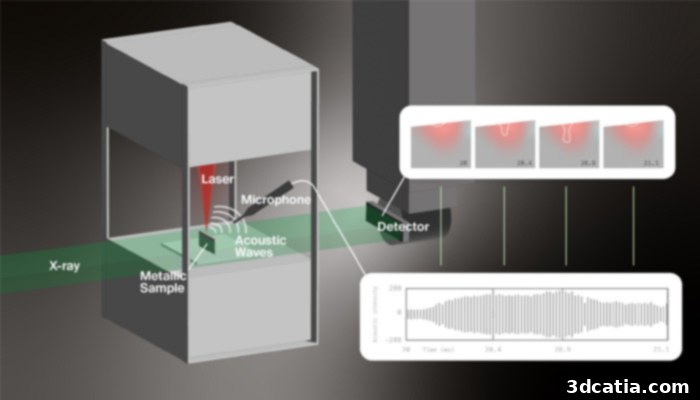
Graphic representation of the experimental device for monitoring printing defects – 2023 EPFL / Titouan Veuillet – CC-BY-SA 4.0
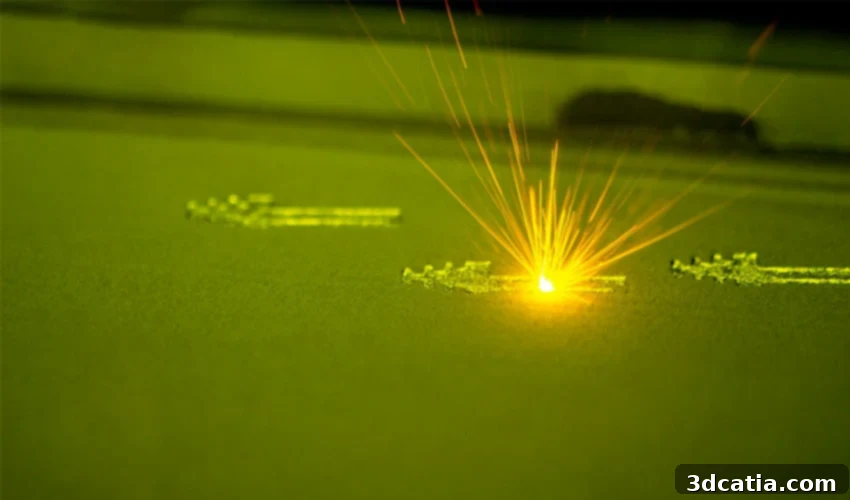
At the heart of metal additive manufacturing lies Laser Powder Bed Fusion (LPBF), a process renowned for its precision and capability to produce complex parts. In LPBF, the fabrication of a desired object occurs layer by meticulously fused layer. A powerful laser selectively scans and melts a thin stratum of metal powder, which then rapidly solidifies. This intricate dance of material transformation involves the metal passing through distinct phases: solid powder transforms into a liquid melt pool, and under certain intense conditions, can even briefly vaporize into a gaseous state. This dynamic transition creates what is known as the molten bath – a critical region where the laser energy interacts with the material. The stability and characteristics of this melt pool are fundamental to the quality of the final part. However, as EPFL scientists explain, this delicate equilibrium can be disrupted. “Occasionally, due to variables such as the laser’s angle or the presence of specific geometrical attributes of the powder or of the part, the process might falter. These instances, termed “inter-regime instabilities”, can sometimes prompt shifts between two melting methods, known as “conduction” and “keyhole” regimes.” These regime shifts are not merely academic curiosities; they are critical indicators of potential defects. The conduction regime, characterized by a wider, shallower melt pool, results from less intense laser interaction and typically produces smoother, denser material. Conversely, the keyhole regime, formed under higher laser power densities, creates a deep, narrow cavity in the molten material, often leading to porosity and an increased likelihood of defects due to rapid solidification and vapor entrapment. Understanding and controlling these transitions is vital for consistent part quality.
To precisely characterize these melt pool dynamics, the research teams employ advanced X-ray imaging techniques. This allows them to accurately measure the melt pool’s dimensions, specifically its width and depth, in real time. By visualizing the molten metal as it transforms, they have developed a sophisticated method that enables them to observe the subtle, yet crucial, changes occurring within the liquid phase of the material. This direct visual insight provides an unparalleled understanding of the physical processes at play. Crucially, it’s at this juncture that the innovative acoustic monitoring system integrates seamlessly. Thanks to a highly sensitive microphone meticulously installed within the printing chamber, the scientists are able to capture and record the distinct sounds produced during these critical transitions between melting regimes. The premise is that changes in the melt pool’s behavior, particularly shifts from the stable conduction regime to the more volatile keyhole regime, generate unique acoustic signatures. By analyzing these recorded sounds, the system can effectively spot any significant shifts or anomalies in the acoustic signal. If such shifts are detected, it serves as an immediate and unequivocal indicator that a defect has occurred or is imminent. Lead researcher Milad Hamidi Nasab encapsulates the profound significance of this integrated approach, stating, “The synergy of synchrotron X-ray imaging with acoustic recording provides real-time insight into the LPBF process, facilitating the detection of defects that could jeopardize product integrity.” This powerful combination allows for not just post-mortem analysis, but proactive, in-situ quality control, drastically improving the chances of producing flawless metal parts.
The pioneering researchers at EPFL, in collaboration with PSI and Empa, are only at the genesis of their extensive experiments. Despite being in the early stages, there is an palpable sense of confidence and optimism regarding the transformative potential of this innovative acoustic-based solution. Their initial findings strongly suggest that this method holds the key to significantly enhancing the reliability and repeatability of metal 3D printed parts. This aspect of manufacturing is not merely a desirable feature but a critical, non-negotiable requirement for a multitude of industries today, particularly those where component failure can have catastrophic consequences, such as aerospace, medical devices, and high-performance automotive sectors. The ability to monitor the printing process in real-time and detect subtle anomalies through sound offers a proactive approach to quality control, moving beyond the limitations of traditional post-process inspection which can be time-consuming, expensive, and sometimes unable to detect sub-surface defects. By ensuring greater process stability and immediate error detection, manufacturers can reduce material waste, lower production costs, and accelerate the development cycle of new components. This advancement promises to solidify the position of metal 3D printing as a mature, trustworthy, and indispensable manufacturing technology, unlocking new possibilities for innovation and application across diverse industrial landscapes. This research paves the way for smarter, more efficient, and ultimately more reliable additive manufacturing. You can find the official press release detailing this breakthrough HERE.
What are your thoughts on this revolutionary method for detecting defects in metal 3D printing through acoustic monitoring? Do you envision its widespread adoption in industrial settings, and how might it impact the future of additive manufacturing quality control? We invite you to share your insights and comments below, or engage with us on our social media platforms. Join the conversation on our LinkedIn, Facebook, and Twitter pages! For those who wish to stay informed with the very latest developments in the world of 3D printing, remember to sign up for our free weekly Newsletter here, delivering the most pertinent news straight to your inbox! Additionally, immerse yourself in our comprehensive video content by visiting our dedicated YouTube channel, where you can explore a wide range of topics and innovations in additive manufacturing.