

Direct Sound 3D Printing: Revolutionizing Additive Manufacturing with Ultrasonic Waves
The field of additive manufacturing, commonly known as 3D printing, has been relentlessly pushing the boundaries of what’s possible in various industries, from aerospace to healthcare. Traditionally, most 3D printing technologies rely on either light (photopolymerization) or heat (thermal activation) to solidify materials and construct objects layer by layer. However, a groundbreaking innovation from researchers at Concordia University is poised to introduce a fundamentally new paradigm: Direct Sound 3D Printing (DSP). This revolutionary platform technology harnesses the power of ultrasonic waves to precisely transform liquid resins into solid, intricate structures, opening doors to previously unimaginable applications, including the potential to create medical implants directly within the human body.
At its core, Direct Sound Printing utilizes ultra-high frequency sound waves, meticulously focused onto a minuscule spot within a liquid polymer resin. This concentration is incredibly brief yet exceptionally potent, lasting for only a trillionth of a second. The intense energy delivered in this short burst triggers a phenomenon known as acoustic cavitation – the rapid formation and collapse of a tiny bubble. This micro-bubble, though ephemeral, generates immense localized energy sufficient to initiate a powerful chemical reaction. This reaction, in turn, causes the surrounding liquid resin to solidify instantaneously, forming a tiny, solid voxel, or 3D pixel.
This novel approach distinguishes itself significantly from established 3D printing techniques. While light-activated (SLA, DLP) and heat-activated (FDM, SLS) methods have become industry standards for their precision in polymer manipulation, DSP introduces a formidable third pathway. Professor Muthukumaran Packirisamy, the corresponding author of the pioneering research report, highlighted the inspiration behind this unconventional method, stating:
“Ultrasonic frequencies are already being used in destructive procedures like laser ablation. We wanted to use them to create something.”
This vision underscores the transformative potential of redirecting destructive forces into constructive ones, paving the way for a new generation of additive manufacturing capabilities.
Understanding the Mechanics of Direct Sound 3D Printing (DSP)
Direct Sound Printing is a sophisticated process rooted in the intricate dynamics of acoustic cavitation within a liquid polymer solution. When ultra-high frequency sound waves are precisely targeted and concentrated, they induce rapid pressure fluctuations. These fluctuations are powerful enough to overcome the surface tension of the liquid, leading to the nucleation and subsequent explosive collapse of microscopic bubbles, or vesicles. This phenomenon is known as acoustic cavitation. The researchers at Concordia University meticulously identified that by fine-tuning the specific type, frequency, and power of the ultrasound, they could generate incredibly localized and intensely focused regions of chemical reactivity within the liquid.
The conditions within these collapsing micro-bubbles are nothing short of extreme, albeit for an astonishingly brief duration – mere picoseconds. During this fleeting moment, the implosion of the bubbles generates extraordinary temperatures, estimated to reach up to 15,000 degrees Celsius, which is comparable to the surface of the sun. Simultaneously, the localized pressure skyrockets to approximately 1,000 times the atmospheric pressure at sea level. It is these extreme, transient conditions that provide the necessary energy to initiate and drive the polymerization reaction, effectively solidifying the liquid resin into a solid material.
A critical advantage of DSP lies in the extremely short reaction time. Because the high temperatures and pressures are confined to such infinitesimal spaces and durations, the surrounding material remains largely unaffected. This exquisite spatial and temporal control is paramount. It ensures that only the intended liquid resin at the precise focal point undergoes solidification, preventing unwanted thermal damage or polymerization in adjacent areas. This characteristic not only guarantees exceptional print resolution and intricate detail but also broadens the range of materials that can be processed, including those that might be sensitive to prolonged heat exposure.
In their pioneering experiments, the Concordia University team successfully demonstrated Direct Sound Printing using polydimethylsiloxane (PDMS), a versatile polymer already recognized for its utility in various additive manufacturing applications due to its biocompatibility and mechanical properties. The operational principle involves a transducer – a device that converts electrical energy into ultrasonic waves. This transducer generates a focused ultrasonic field capable of penetrating solid objects, including biological tissues, without causing damage.
The process unfolds by precisely controlling the transducer’s movement along a digitally predetermined path. As the transducer scans across the liquid resin, it selectively solidifies the material at each focal point, effectively building the desired object pixel by pixel, or rather, voxel by voxel. This layer-by-layer or point-by-point fabrication method is characteristic of additive manufacturing, but with the unique advantage of sound as the activating agent. The newly solidified material adheres to a plate or a previously formed part of the object, progressively constructing the intricate 3D structure.
The ability of sound waves to traverse opaque and solid barriers without significant attenuation is what truly sets Direct Sound 3D Printing apart. Unlike light, which is easily scattered or absorbed by non-transparent materials, or heat, which diffuses, ultrasonic waves can be precisely directed deep within complex environments. This fundamental property opens up an array of novel possibilities in additive manufacturing that were previously considered unattainable. For instance, it provides a viable pathway for fabricating medical implants directly inside the human body, eliminating the need for invasive surgical procedures to insert pre-made implants. Researcher Mohsen Habib emphasized this point, highlighting that DSP introduces the unprecedented potential for non-invasive printing deep within biological systems, heralding a new era for personalized medicine and biofabrication.
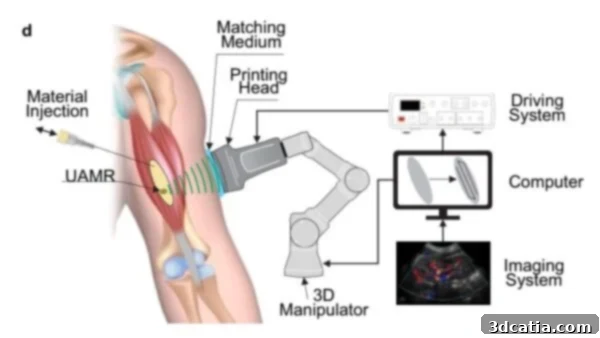
Graphical representation of the Direct Sound 3D Printing process (Photo credits: Nature Communications)
Unlocking Versatile Applications Across Industries
The inherent versatility and unique capabilities of Direct Sound 3D Printing position it as a truly transformative technology with far-reaching implications across numerous sectors. Industries that demand exceptional precision, require in-situ fabrication, or deal with highly sensitive or inaccessible equipment stand to benefit immensely from this innovative process. The ability of DSP to solidify materials remotely, without physical contact or invasive procedures, opens up entirely new paradigms for design, manufacturing, and repair.
One of the most compelling applications lies within **aerospace engineering and maintenance**. Modern aircraft and spacecraft feature incredibly complex internal structures, often with critical components located deep within opaque metallic casings or fuel tanks. Traditional repair methods often necessitate extensive dismantling, which is time-consuming, costly, and can compromise structural integrity. With DSP, ultrasonic waves can effortlessly penetrate these dense metal shells, allowing maintenance teams to precisely print repairs, reinforcement structures, or even integrate new components in otherwise inaccessible areas. This could dramatically reduce downtime, extend the lifespan of critical parts, and enhance the safety and efficiency of aerospace operations by enabling on-demand, non-destructive servicing.
Equally significant are the **medical and biomedical applications** of Direct Sound 3D Printing. The prospect of directly fabricating biocompatible implants, prosthetics, or even drug-delivery systems inside the human body represents a monumental leap forward for personalized medicine. Imagine a scenario where a patient requires a custom bone graft or a stent; DSP could allow clinicians to non-invasively print these structures with unparalleled precision, directly at the site of need. This eliminates the risks associated with traditional surgery, reduces recovery times, and allows for highly individualized treatments tailored to each patient’s unique anatomy and pathological condition. Beyond humans, this technology also holds promise for veterinary medicine, enabling similar in-body fabrication for animals.
The potential extends further into microfluidics, electronics, and customized sensor fabrication, where intricate designs and the ability to work with various materials are paramount. As research progresses, DSP could facilitate the creation of novel meta-materials or components with embedded functionalities that are currently impossible to achieve. This groundbreaking research, published in Nature Communications, offers a deeper dive into the technical specifics and experimental results. Readers interested in the scientific intricacies can download the full paper HERE. Additionally, to visualize this innovative process in action, you can watch the explanatory video below.
The Future of Manufacturing: Non-Invasive, Precise, and Transformative
The advent of Direct Sound 3D Printing represents a significant milestone in the evolution of additive manufacturing. By leveraging ultrasonic waves to trigger localized chemical reactions, Concordia University researchers have not only introduced a novel method for solidifying liquid resins but have also unlocked a realm of possibilities that were previously confined to science fiction. From enabling intricate repairs within complex aerospace components to revolutionizing medical procedures with non-invasive, in-situ implant fabrication, DSP stands as a testament to human ingenuity and the relentless pursuit of technological advancement.
As this technology matures, we can anticipate further refinements in material science, resolution capabilities, and broader industrial adoption. The ability to print within opaque environments and biological systems without collateral damage is a game-changer, promising to reshape how we design, build, and repair objects across numerous high-stakes applications. This innovation underscores the dynamic nature of 3D printing and its continuous potential to disrupt conventional manufacturing paradigms.
Considering these exciting developments, we pose the question to you: Would you consider having a medical implant printed directly inside your body using Direct Sound 3D Printing technology in the future? Share your thoughts and engage with us! We invite you to leave a comment below or join the discussion on our social media channels, including LinkedIn, Facebook, and Twitter. For the very latest updates and breaking news in the world of 3D printing, make sure to sign up for our free weekly newsletter here. You can also explore our extensive library of videos and insights on our dedicated YouTube channel.