
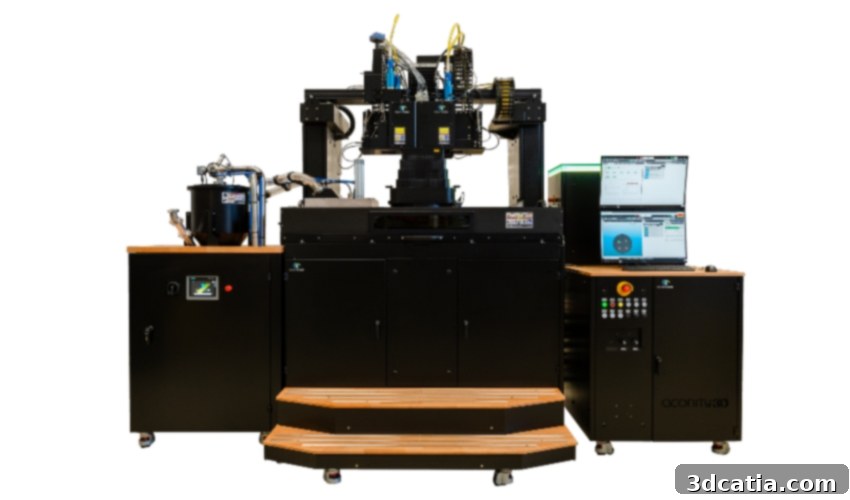
AconityTWO: Driving the Future of Industrial Metal Additive Manufacturing with Advanced LPBF Technology
Since its establishment in 2014, Aconity3D GmbH has solidified its position as one of Germany’s most innovative forces in the realm of additive manufacturing. The company’s core expertise lies in Laser Powder Bed Fusion (LPBF), a sophisticated 3D printing technology where high-power lasers meticulously fuse successive layers of metal powder to construct intricate and robust components. Aconity3D’s impressive portfolio exclusively features LPBF machines, catering to diverse industrial needs with models such as the AconityMICRO, AconityMINI, AconityMIDI, AconityMIDI+, and the large-format AconityONE, which boasts a Ø 400 mm building platform. Building on this legacy of innovation, the German manufacturer is now expanding its advanced range with a significant upgrade to its flagship model, proudly unveiling the AconityTWO. This much-anticipated product launch raises critical questions for industry professionals and enthusiasts alike: What distinguishes this new machine from its predecessors and competitors? What tangible benefits and competitive advantages can industrial buyers expect? And how does the AconityTWO redefine the benchmarks for metal 3D printing solutions? In the following sections, we delve into the groundbreaking features and capabilities of the AconityTWO, exploring how it is set to elevate industrial additive manufacturing to unprecedented levels of precision, efficiency, and versatility.
A cornerstone of all Aconity3D solutions, including the new AconityTWO, is the intuitive and powerful AconitySTUDIO web-based control software. This innovative platform empowers users with seamless remote machine access, fostering unparalleled flexibility in operations and ensuring robust data security. Operators can monitor and control printing processes from virtually anywhere, facilitating global collaboration and optimized resource allocation. Complementing this is the AconityPLATFORM, a sophisticated system designed to allow meticulous configuration of machines for specific, demanding applications. This modularity not only drastically expands the potential range of applications but also makes the AconityTWO a highly adaptable tool for industrial-scale production. The inherent simplicity of modifications, coupled with the freedom to define and fine-tune process parameters, means users can achieve truly customized additive manufacturing solutions. This level of control is crucial for optimizing material properties and performance for specific end-use parts. Consequently, the AconityTWO, with its generous installation space, is exceptionally well-suited for producing components from standard industrial materials such as aluminum, various grades of steel, nickel-based superalloys, or titanium. Furthermore, its advanced capabilities extend to enabling the creation of bespoke material compositions, pushing the boundaries of material science in additive manufacturing. The comprehensive range of applications for this versatile system spans critical sectors from classic mechanical engineering and high-performance automotive parts to the rigorous demands of aerospace components and highly specialized medical technology implants, illustrating its broad utility and transformative potential across industries.

In addition to the new AconityTWO, Aconity3D offers five other machines for industrial applications.
Beyond enhanced flexibility and unparalleled customization, the AconityTWO distinguishes itself with dramatically increased rigidity in its mechanical design, a fundamental improvement that directly translates into superior component accuracy and overall part quality. This robust construction minimizes vibrations and deflections during the printing process, ensuring precise laser focusing and stable powder bed conditions, which are critical for achieving high-performance metal parts. To meet the stringent demands of industrial production, the AconityTWO can be configured with an advanced multi-laser system, supporting up to four independent lasers. These lasers offer variable focus sizes, ranging from a fine 80 µm for intricate details and high resolution to a broader 500 µm for faster processing of larger areas and increased productivity. Coupled with integrated on-axis process monitoring, this system provides real-time feedback on melt pool dynamics and layer quality. This capability is vital for comprehensive quality assurance, allowing for immediate detection and correction of potential defects, thereby ensuring consistent part quality and process reliability crucial for industrial applications where deviations are unacceptable. The ability to deploy multiple lasers not only accelerates build times significantly but also allows for parallel processing of multiple parts or distinct sections of a single large part, maximizing throughput.
A significant innovation within the AconityTWO‘s laser system is its advanced master-slave configuration. This sophisticated control mechanism enables different lasers to “communicate” and operate in a coordinated fashion, allowing for precise temporal and spatial offsetting. This capability unlocks the potential for implementing highly advanced scanning strategies, which are pivotal for achieving targeted thermal influence on the component during the build process. By precisely controlling thermal gradients and cooling rates, manufacturers can significantly enhance the material properties of the printed parts, such as their mechanical strength, ductility, and fatigue resistance. This intricate thermal management reduces internal stresses, mitigates warping, and allows for the creation of components with superior microstructural integrity. For instance, varying laser power and scanning speed in different regions can create localized material enhancements or tailored properties within a single part, opening up new possibilities for functional design and performance optimization. This flexibility in thermal control not only improves part quality but also broadens the range of materials that can be successfully processed, especially those prone to cracking or residual stress. Dr. Yves Hagedorn, CEO of Aconity3D, further emphasizes the company’s commitment to operational excellence, stating, “In addition, the AconityTWO is equipped with the Easy-Access cover system. This allows easy and complete access into the process chamber, with interfering fixtures, such as axes and the shielding gas exhaust, located outside the machine operator’s interaction zone.” This thoughtful design dramatically simplifies routine maintenance, cleaning procedures, and part retrieval. By providing unobstructed access, it significantly reduces the time required for these tasks, thereby minimizing downtime and boosting overall productivity. The ergonomic design enhances user-friendliness and safety, streamlining the workflow for operators. Moreover, the AconityTWO addresses another critical aspect of productivity through its optimized powder supply system, which enables bidirectional powder application. This intelligent feature, combined with automatic refilling of the process chamber with powder, virtually eliminates interruptions in the printing process caused by manual powder handling. Continuous operation not only saves valuable time but also ensures consistent layer quality throughout extended print jobs. In fact, this advanced powder management system can effectively cut non-productive time in half, leading to substantial gains in efficiency and a lower cost per part. The AconityTWO was initially made available in August 2021 and can be conveniently ordered directly online from Aconity3D, offering a straightforward path to integrating this cutting-edge technology into industrial workflows.
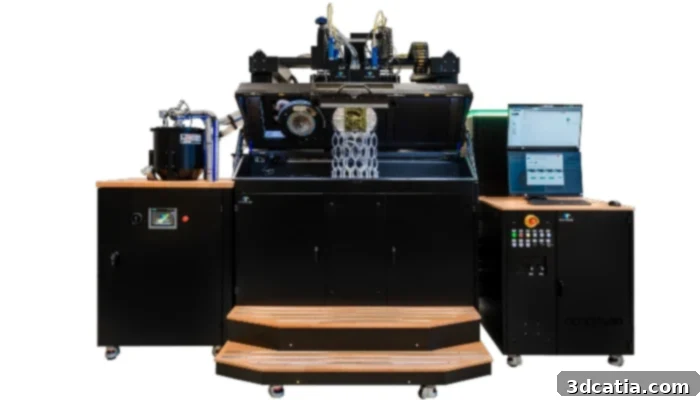
The AconityTWO – seen here opened – scores with a large installation space.
The AconityTWO represents a significant leap forward in industrial metal additive manufacturing, offering a comprehensive solution that addresses key pain points in production. Its combination of robust mechanical design, advanced multi-laser capabilities with sophisticated thermal control, intelligent software integration, and optimized user experience positions it as a market leader for demanding applications. From aerospace components requiring extreme precision and lightweighting to custom medical implants demanding biocompatibility and unique geometries, or high-performance automotive parts needing rapid iteration and robust material properties, the AconityTWO provides the flexibility, speed, and quality necessary to meet and exceed modern industrial requirements. Its ability to process a wide array of materials, from standard alloys to custom compositions, further enhances its versatility, making it an indispensable tool for research, development, and high-volume production. The integration of AconitySTUDIO and AconityPLATFORM ensures that users have complete control over their processes, enabling them to push the boundaries of what’s possible with LPBF technology and achieve superior results consistently. As industries increasingly adopt additive manufacturing for serial production and complex part fabrication, machines like the AconityTWO are pivotal in driving this transformation, offering a reliable, efficient, and highly capable platform for the next generation of metal parts.
What are your thoughts on the innovative new AconityTWO and its potential impact on metal 3D printing? Share your insights and comments below, or join the conversation on our Facebook and Twitter pages. Stay ahead of the curve by signing up for our free weekly newsletter, which delivers all the latest news and advancements in 3D printing directly to your inbox!
*All Image Credits: Aconity3D