

Unlocking Next-Generation Materials: The Rise of Continuous Fiber 3D Printing and Anisoprinting in Additive Manufacturing
Additive manufacturing, commonly known as 3D printing, has undeniably revolutionized and continues to reshape our approach to product creation and manufacturing processes. Diverging significantly from traditional subtractive manufacturing methods, additive manufacturing involves conceptualizing and designing objects digitally, then building them layer by precise layer. This innovative ‘bottom-up’ approach offers a multitude of benefits, allowing for unparalleled optimization across various aspects of product development. Objects can be significantly optimized for weight, dramatically reducing lead times from design to finished part, and considerably cutting manufacturing costs. Furthermore, in terms of design freedom, additive manufacturing enables the creation of highly complex geometries and intricate internal structures that are often impossible with conventional techniques. These complex shapes not only enhance the mechanical properties and performance of the final product but also lead to substantial material savings. In essence, 3D printing technologies offer transformative advantages that most industries have come to recognize as pivotal in reshaping the entire manufacturing supply chain. However, despite these remarkable advancements, the process still faces certain limitations. One of the primary bottlenecks has historically been the restricted availability of suitable materials. While plastics and metals have been the dominant options, the question arises: is that truly the extent of what’s possible?
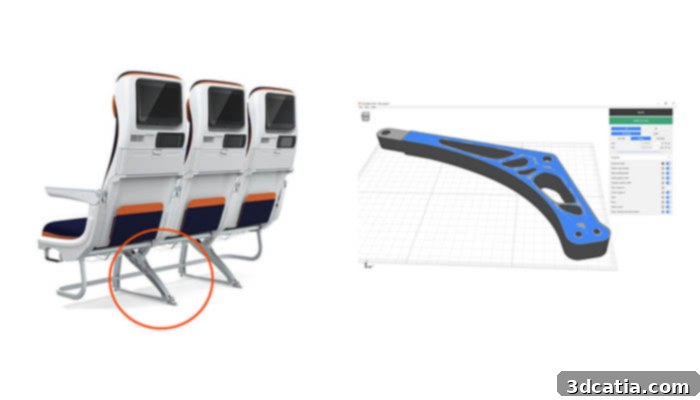
An aircraft seat support piece optimized through topology optimization, showcasing the potential of advanced manufacturing.
Beyond Traditional Materials: The Limitations of Plastics and Metals in 3D Printing
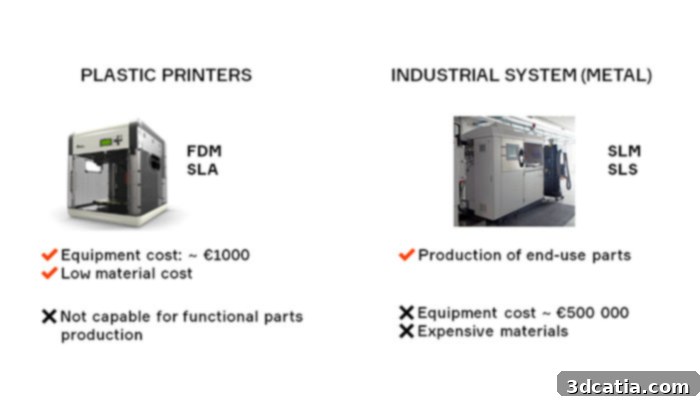
When a company embarks on adopting additive manufacturing for industrial applications, they are typically confronted with a choice between two primary material categories: plastic or metal. Each material type presents its own set of advantages and inherent limitations, often dictating the suitability for specific applications. Plastic 3D printing, for instance, is widely accessible and cost-effective, making it the go-to choice for rapid prototyping, concept validation, and producing non-structural parts. Its ease of use and the widespread familiarity with the technology have made it a staple in various sectors. However, when it comes to creating end-use parts that demand superior mechanical properties, high strength-to-weight ratios, enhanced durability, or resistance to extreme conditions, plastics often fall short.
On the other hand, metal 3D printing offers the promise of producing incredibly strong, durable, and high-performance components, often with complex geometries previously unachievable. These parts can rival or even surpass the properties of conventionally manufactured metal components, making them ideal for demanding applications in aerospace, medical, and automotive industries. Yet, the adoption of metal 3D printing comes with significant hurdles. The machines themselves are considerably more expensive, as are the specialized metal powders. Furthermore, the metal 3D printing process is inherently more complex, requiring specialized knowledge, stringent safety protocols, and often extensive post-processing steps such as heat treatment and surface finishing. This combination of high cost and operational complexity means that metal 3D printing remains a niche solution for very specific, high-value applications, leaving a substantial gap for applications requiring robust, lightweight parts without the prohibitive costs and complexities of metal.
Are Composites the Ultimate Solution for High-Performance 3D Printing?
In the quest for materials that bridge the performance gap between plastics and metals, composite materials emerge as a highly promising solution. They possess the unique ability to produce functional, load-bearing parts that are both relatively easy to manufacture and economically viable. The term “composites,” however, can be broad. Many people initially envision polymers merely filled with short or chopped fibers. While these are indeed composites, they typically do not fully address the performance limitations mentioned earlier. In fact, composites reinforced with short fibers generally exhibit strength approximately two times greater than pure plastic. While an improvement, this level of reinforcement is often insufficient for demanding end-use applications where structural integrity is paramount.
The true game-changer lies in composites reinforced with *continuous* fibers. These advanced materials boast exceptional mechanical properties, providing a significant leap in performance. Continuous fiber composites can be up to 20 times stronger than unreinforced plastic, demonstrating a strength profile that is comparable to, or even superior to, many metals. Beyond their remarkable strength, these materials offer several other compelling advantages. They are significantly lighter than their metal counterparts, often by several times, contributing to considerable weight savings in applications where every gram counts. Furthermore, the production costs associated with continuous fiber composites can be substantially lower than those for metal parts, making high-performance manufacturing more accessible. This combination of superior strength, lightweight properties, and cost-effectiveness positions continuous fiber composites as a vital material class for the future of advanced manufacturing, offering a pathway to unlock new possibilities for structural and functional components.
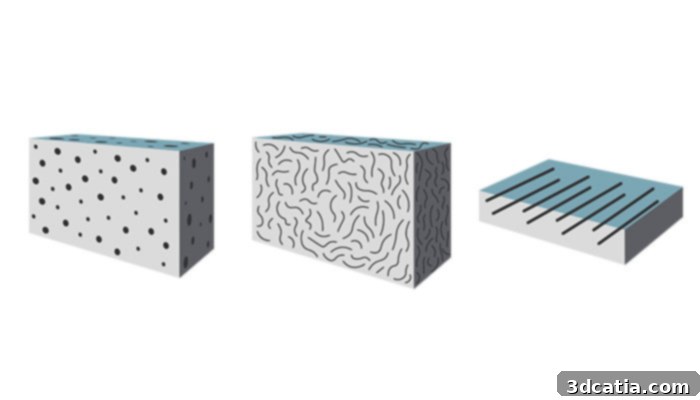
Visualizing composite structures: from left to right, composite with particles, composite with short/chopped fibers, and the superior composite with continuous fibers.
Introducing Anisoprinting: A New Paradigm for Continuous Fiber 3D Printing
Addressing the critical need for both enhanced design freedom and expanded material choice, Anisoprinting emerges as a groundbreaking solution designed to enable comprehensive part optimization. More precisely, Anisoprinting is an innovative technology developed by the Luxembourgish-Russian startup, Anisoprint, focusing on the production of optimal composites through continuous fiber 3D printing. This advanced process allows engineers and designers to create and manufacture end-use composite parts that can match the strength of their metal counterparts – achieving tensile strengths of up to 860 MPa – while being significantly lighter (up to 7 times lighter than steel). This remarkable combination of strength and low weight opens up new possibilities for performance-critical applications. Beyond these mechanical benefits, Anisoprinted parts are also easier to produce, streamlining manufacturing workflows, and ultimately proving to be more cost-effective compared to traditional high-performance materials and manufacturing processes.
The Anisoprint Composer: Hardware and Open Material System
The manufacturing of these high-performance composite parts is achieved through a unique, one-stage, fully automated process on Anisoprint’s specialized composite 3D printers, known as the Anisoprint Composer series. These state-of-the-art machines are engineered to precisely lay down continuous fibers within a polymer matrix, ensuring optimal reinforcement and structural integrity. A key differentiator of Anisoprint’s technology is its open material system. This crucial feature grants users unparalleled freedom in material selection, allowing for tailored part properties to meet specific application requirements. For Anisoprinted composites, virtually any thermoplastic can be utilized as the matrix material, including popular options such as PLA, PETG, PC (Polycarbonate), Nylon, TPU (Thermoplastic Polyurethane), and many others. This versatility means that engineers can choose the ideal plastic matrix to achieve desired chemical resistance, weather resistance, impact resistance, heat deflection, stiffness, and other essential properties, without being locked into proprietary material ecosystems.
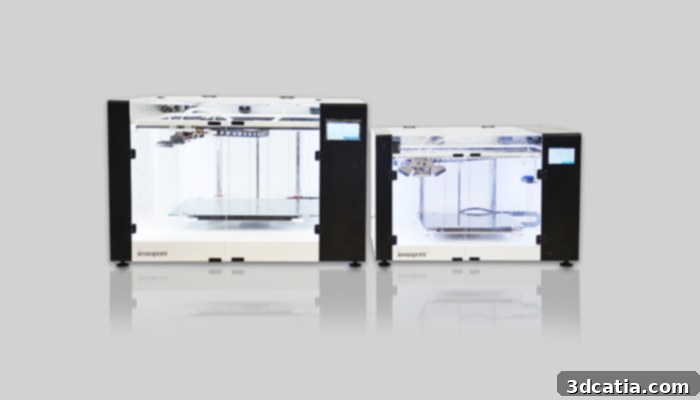
Anisoprint’s composite 3D printers: the Anisoprint Composer A3 (460mm x 297mm x 210mm build plate) and A4 (297mm x 210 mm x 140 mm build plate), designed for precision continuous fiber additive manufacturing.
Optimizing Structures: The Power of Anisotropic Lattice Designs
A significant advantage of Anisoprint’s technology lies in its capability to 3D print intricate lattice structures. These aren’t just any lattices; they are specifically designed to be the optimal structures for composite 3D printing. The effectiveness of lattices with continuous fibers stems from a fundamental property of composites: anisotropy. This means that composites exhibit their maximum strength and stiffness along the direction of the reinforcing fibers, with significantly less strength perpendicular to them. Therefore, composites perform most efficiently in one-dimensional structures, which is precisely what lattices offer, being composed of a multitude of strategically oriented one-dimensional ribs or struts.
The benefits of these composite lattice structures extend far beyond theoretical efficiency. Anisoprint demonstrates that parts incorporating such designs can bear the same substantial loads as their solid metal counterparts, yet they achieve this with considerably less material. This reduction in material directly translates to lighter components and, consequently, lower manufacturing costs. For industries like aerospace, automotive, and robotics, where weight reduction is paramount for fuel efficiency or performance, this capability is revolutionary. In essence, Anisoprinting allows for a dual optimization strategy: not only is the material itself optimized for performance, but the component’s geometry is also meticulously designed to fully leverage the anisotropic properties of continuous fiber composites, resulting in truly high-performing, lightweight, and cost-effective parts.
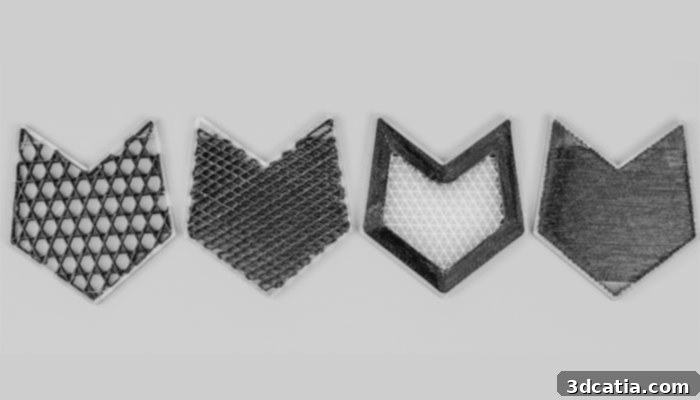
Illustrating 4 types of reinforcement possible with Anisoprint’s Aura software: anisogrid reinforced infill, rhombic reinforced infill, reinforced perimeters, and solid infill, enabling customized part strength and weight.
Embracing the Future of Manufacturing with Continuous Fiber 3D Printing
For forward-thinking professionals and companies ready to explore the immense potential of advanced composite materials in additive manufacturing, Anisoprint offers a compelling pathway. The future of manufacturing is increasingly leaning towards high-performance, lightweight, and cost-efficient solutions, and continuous fiber 3D printing is at the forefront of this evolution. Companies interested in discovering how to integrate these optimal composites into their own workflows were invited to meet Anisoprint at Formnext on November 19th (Booth: G58) to witness their innovative solutions firsthand. According to Anisoprint’s commitment to innovation, they continuously develop and release new solutions that aim to elevate continuous fiber 3D printing to unprecedented levels of capability and accessibility. For more information on their cutting-edge technology and product offerings, you can visit their website HERE.
Are you prepared to make the strategic shift towards continuous fiber 3D printing and harness its transformative power? We invite you to share your thoughts, questions, and insights by leaving a comment in the section below. You can also engage with our community and stay updated on the latest developments in 3D printing by connecting with us on our Facebook and Twitter pages. Don’t miss out on crucial industry news and technological breakthroughs – sign up for our free weekly Newsletter to receive all the latest updates on additive manufacturing delivered straight to your inbox!