
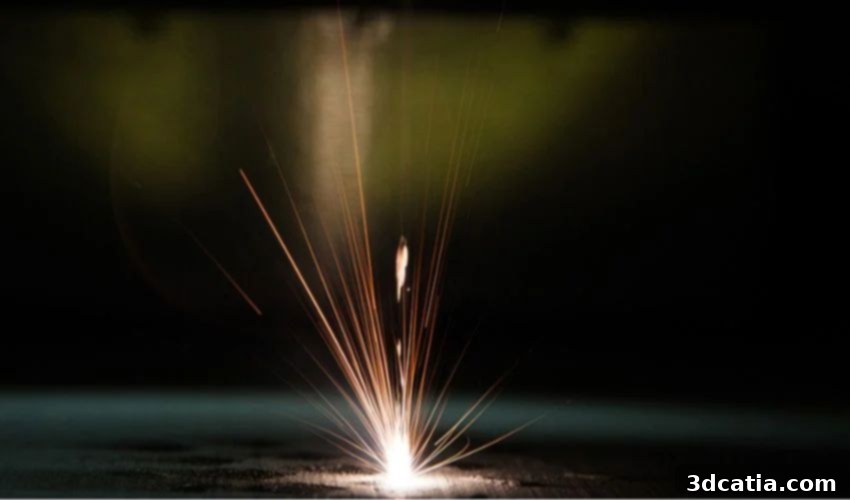
Revolutionizing Metal 3D Printing: Achieving Unprecedented Reliability with LLNL’s Advanced NDE
Additive manufacturing, commonly known as 3D printing, promises a new era of design freedom and rapid prototyping, but its widespread adoption, especially in critical applications, hinges on overcoming a fundamental hurdle: process reliability. Ensuring that every 3D-printed component consistently meets stringent design specifications, withstands the rigors of its operational environment over time, and can be reproduced with perfect consistency remains one of the most persistent challenges. This issue is particularly acute in metal 3D printing, a domain where many industrial professionals and engineers remain hesitant to fully embrace the technology due to concerns regarding a perceived lack of reliability and repeatability. Imagine a future where we could exert unparalleled control over the entire printing process, achieve significantly more precise monitoring, and simulate outcomes with unprecedented accuracy. This ambitious vision forms the core of groundbreaking research being conducted at the Lawrence Livermore National Laboratory (LLNL) by its dedicated Non-Destructive Evaluation (NDE) group. Their overarching goal is to meticulously observe and analyze the dynamic evolution of materials and structures within a part as it is being printed, ultimately developing innovative techniques to guarantee superior quality and unwavering consistency in every manufactured component. This work is not merely about incremental improvements; it aims to fundamentally transform how metal additive manufacturing is perceived and implemented globally.
The inherent complexities of metal 3D printing make predicting the behavior of finished parts incredibly difficult. Most metal additive manufacturing technologies rely on an intense heat source, such as lasers or electron beams, to selectively fuse fine metal powder particles layer by layer. While this process enables the creation of intricate geometries, metals are inherently highly sensitive to thermal fluctuations. These dramatic thermal changes—rapid heating followed by cooling—induce significant microstructural alterations, residual stresses, and potential defects within the material. The way heat diffuses, or is absorbed and dissipated, within the 3D printer’s build chamber can profoundly affect how individual metal particles bond together. Inadequate or inconsistent bonding can lead to a host of detrimental issues, including microscopic voids, porosity, cracks, delamination, and undesirable grain structures. These imperfections directly translate into compromised mechanical properties, such as reduced strength, ductility, and fatigue resistance, leading to non-conformities that render parts unsuitable for demanding applications and erode confidence in the technology itself.
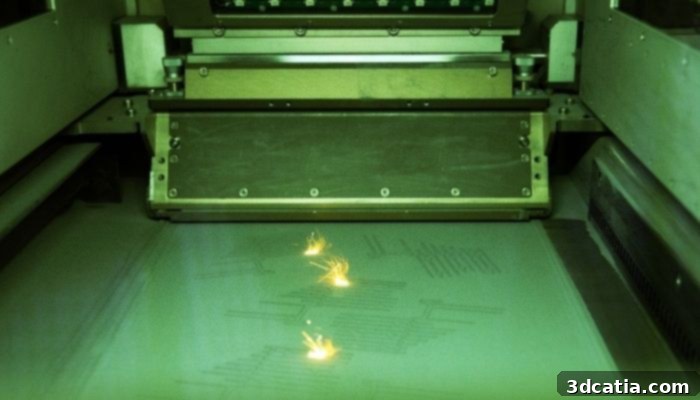
LLNL’s pioneering research is set to significantly promote the broader adoption of metal 3D printing across various industries.
The imperative for robust validation in metal additive manufacturing cannot be overstated, particularly for components destined for safety-critical roles. David Stobbe, the distinguished group leader for NDE ultrasonics and sensors within LLNL’s Materials Engineering Division (MED), articulates this necessity with clarity and conviction. He explains, “If you want people to use metal AM components out in the world, you need NDE. If we can prove that AM-produced parts behave as designed, it will allow them to proliferate, be used in safety-critical components in aerospace, energy and other sectors and hopefully open a new paradigm in manufacturing.” Stobbe’s statement underscores a critical truth: trust is the currency of industrial adoption. Without verifiable assurance that an additively manufactured part will perform exactly as engineered, industries such as aerospace, automotive, medical, and energy—where failure is not an option—will remain cautious. LLNL’s work is therefore not just about scientific discovery; it’s about building the foundational confidence required to unleash the full potential of metal 3D printing, enabling its use in applications that demand the highest levels of performance and reliability.
How Non-Destructive Evaluation (NDE) Drives Process Control in Metal AM
So, how precisely do these non-destructive evaluation (NDE) techniques operate to deliver such crucial insights? At their core, NDE methods leverage various types of signals that are emitted or passed through the material being examined. These signals can manifest as electrical currents, high-energy X-rays, or even ultrasonic sound waves. Unlike traditional destructive testing, which requires cutting apart or breaking a sample to assess its properties, NDE allows researchers to interrogate the internal structure and integrity of a part without causing any damage. The principle is elegant: these signals are sent through the parts as they are being printed, or immediately afterward, and researchers meticulously observe any changes or anomalies in how the signals propagate or are reflected. Any deviation from expected signal behavior can indicate the presence of defects, variations in material density, or changes in microstructure, providing a real-time window into the quality of the manufactured component. This capability to detect and characterize flaws without compromising the part is what makes NDE indispensable for advanced manufacturing processes like metal 3D printing.
A prime example of this innovative application of NDE comes from the work of Saptarshi Mukherjee, a dedicated research scientist in LLNL’s Atmosphere, Earth, and Energy Division (AEED). Mukherjee’s project focuses on real-time monitoring of internal temperatures during the powder bed laser fusion process, a critical phase in metal AM. He achieves this using eddy currents, which are essentially electric currents induced within a conductor by applying changing magnetic fields. The brilliance of this approach lies in the fundamental physics: eddy currents are highly sensitive to the electrical conductivity of the material. Since electrical conductivity is directly influenced by temperature—it generally decreases as temperature increases in metals—these eddy currents can serve as exquisitely precise, non-contact thermometers. By continuously measuring the changes in these induced currents, researchers can acquire real-time, dynamic information about the temperature distribution and fluctuations occurring inside the 3D-printed parts during the very act of fusion and solidification. This real-time thermal mapping is revolutionary, as it allows for the identification of hotspots, cooling rate anomalies, and other thermal irregularities that are direct precursors to material defects.
Ethan Rosenberg, a postdoctoral researcher at MED, emphasizes the pioneering nature of this work: “To our knowledge, this is the first time that eddy current sensors have been used to look at these very rapid non-equilibrium thermal processes, which are suggestive of the sort of thermal processes you would see in a metal AM process.” His statement highlights that the thermal events within a metal 3D printer occur incredibly fast and are often far from equilibrium, making them notoriously challenging to observe and control. The ability of eddy current sensors to capture these fleeting, dynamic thermal signatures represents a significant leap forward in understanding and ultimately mastering the complex thermal mechanics of metal additive manufacturing. This precise, in-situ temperature data is vital for optimizing process parameters, reducing internal stresses, and ensuring the desired microstructural development within the printed part, thereby enhancing its overall integrity and performance.
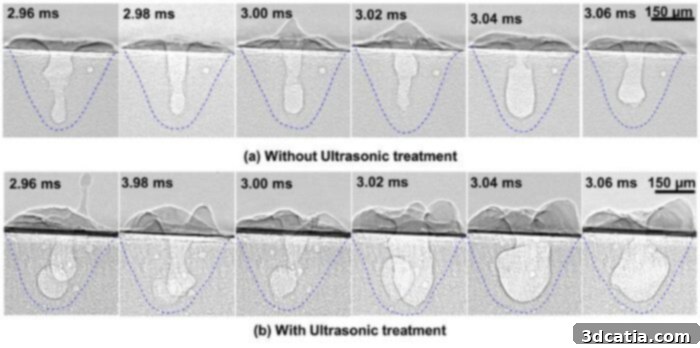
X-ray images reveal the intricate dynamics of melting and solidification in a 3D-printed part, illustrating common defects like tube-shaped air holes—a frequent issue in metal AM components—and the potential impact of ultrasonic treatment.
Beyond eddy currents, LLNL’s NDE group is actively developing and integrating a broad spectrum of advanced diagnostic techniques. Current and follow-up projects leverage sophisticated methods such as X-ray computed tomography (CT), which provides detailed 3D insights into internal geometries and defect distributions; electrical resistance measurements, capable of detecting subtle changes in material state or the presence of cracks; and advanced ultrasound, which can probe deeper into material structures to identify voids, inclusions, and variations in material density. These diverse NDE techniques are often applied to study complex geometric designs, including intricate lattice structures or functionally graded materials, where traditional quality control methods fall short. The primary objective is to continually advance this research, refine the methodologies, and ultimately generalize these in-situ monitoring and characterization techniques so they can be universally applied across various metal additive manufacturing platforms and materials. The long-term vision is truly transformative: to develop sophisticated machine learning algorithms capable of interpreting the vast streams of NDE data in real time. These AI-powered systems would not only monitor metal 3D printing processes but also actively predict and correct potential errors or deviations before they can lead to irreparable defects. This level of intelligent, closed-loop process control promises to dramatically increase the reliability, efficiency, and material utilization of metal additive manufacturing, leading to its much more widespread adoption across all industrial sectors and unlocking entirely new possibilities in design and functionality. For those interested in delving deeper into LLNL’s groundbreaking initiatives, further information is available HERE.
The innovative research conducted by LLNL into enhancing the reliability of metal 3D printing represents a pivotal moment for the additive manufacturing industry. By providing unprecedented levels of process control and real-time quality assurance through advanced Non-Destructive Evaluation techniques, this work has the potential to dismantle existing barriers to adoption and accelerate the integration of metal AM into mainstream manufacturing. Do you believe LLNL’s research will significantly promote the widespread adoption of metal 3D printing in industries currently hesitant to fully embrace the technology? Share your thoughts and insights with us by leaving a comment below, or engage with our community on our LinkedIn or Facebook pages. Additionally, make sure you don’t miss out on the latest advancements and news in the dynamic world of 3D printing by signing up for our free weekly Newsletter. You can also explore a wealth of informative and engaging videos on our dedicated YouTube channel.
*All Photo Credits: LLNL