
Revolutionizing Vision: The Promise of 3D and 4D Bioprinting for Corneal Regeneration
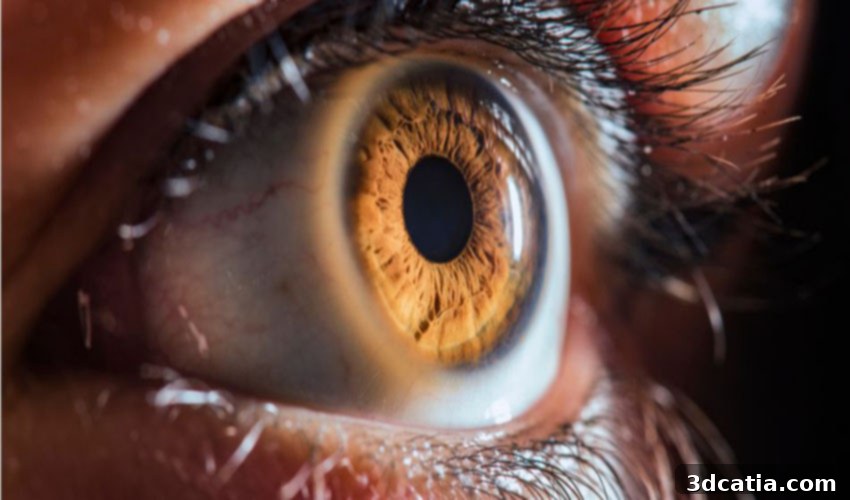
Corneal blindness remains a staggering global health crisis, affecting millions worldwide. The World Health Organization (WHO) estimates that approximately 10 million individuals are in urgent need of surgical intervention to prevent corneal blindness, while a further 4.9 million already live with complete vision loss due to irreversible corneal scarring. The cornea, the eye’s outermost transparent layer, plays a crucial role in focusing light and is fundamental to clear vision. Damage or disease to this delicate tissue can lead to severe visual impairment or total blindness. Traditionally, corneal transplants, relying on human donor tissue, have been the primary treatment. However, a severe shortage of suitable donors, coupled with challenges like immune rejection and the complexities of surgical procedures, severely limits the availability and success of these life-changing operations. This pressing need has ignited a search for revolutionary solutions, and the field of advanced bioprinting, specifically 3D and emerging 4D technologies, is rapidly pointing towards a future where corneal blindness could become a thing of the past.
The Global Burden of Corneal Blindness: A Critical Unmet Need
To truly appreciate the transformative potential of bioprinting, it’s essential to understand the magnitude of corneal disease. The cornea, a highly specialized and avascular tissue, protects the eye and contributes significantly to its refractive power. Its transparency is vital for light to reach the retina. Various conditions can compromise its integrity and clarity, including infections (bacterial, viral, fungal), trauma, genetic disorders (e.g., Fuchs’ dystrophy), autoimmune diseases, and degenerative conditions like keratoconus. When the cornea becomes scarred or opaque, vision is severely compromised, leading to significant disability and reduced quality of life. Current treatments often involve complex surgical procedures, and for many, a corneal transplant (keratoplasty) is the last resort. Yet, the global demand for donor corneas far outstrips supply, leaving countless patients on prolonged waiting lists or without any hope for restoration of sight. This severe donor scarcity, compounded by logistical hurdles, the risk of graft rejection, and the need for lifelong immunosuppression, underscores the urgent requirement for innovative and scalable alternatives.
3D Bioprinting: Paving the Way for Artificial Corneas
In the quest to overcome the limitations of traditional transplants, 3D bioprinting has emerged as a groundbreaking approach in regenerative medicine. This innovative technology involves the layer-by-layer deposition of “bio-inks” – materials containing living cells and biocompatible polymers – to create functional tissues and organs. The precision and customization offered by 3D bioprinting make it an ideal candidate for fabricating complex structures like the human cornea. A significant milestone in this domain was achieved earlier this year by a pioneering team of researchers from the University of Newcastle. For the first time, they successfully developed a 3D-printed artificial human cornea, marking a pivotal moment in ophthalmology and tissue engineering.
The research journey began with a meticulous study of a volunteer’s eye. Using detailed imaging techniques, the team gathered sufficient data to construct an accurate 3D digital model of the human cornea. This blueprint then guided the bioprinting process. Che Connon, a lead tissue engineer on the project, highlighted some of the most formidable challenges encountered during this phase. One critical aspect was identifying and utilizing the right biomaterials that could not only maintain the cornea’s distinct concave shape but also be formulated into an ink thin enough to be precisely extruded through the fine nozzle of a 3D printer. The delicate balance between structural integrity and printability required extensive experimentation and material science expertise. The ultimate breakthrough was remarkable: from a single healthy human cornea, the Newcastle team was able to 3D print an astounding 50 artificial corneas. This unprecedented capability addresses the core issue of donor scarcity head-on, offering a scalable solution that could potentially transform access to sight-restoring treatments for millions globally. This achievement represents a significant leap forward, demonstrating the practical feasibility of using bioprinting to create a vital, transparent ocular tissue, bringing hope to those suffering from corneal blindness.
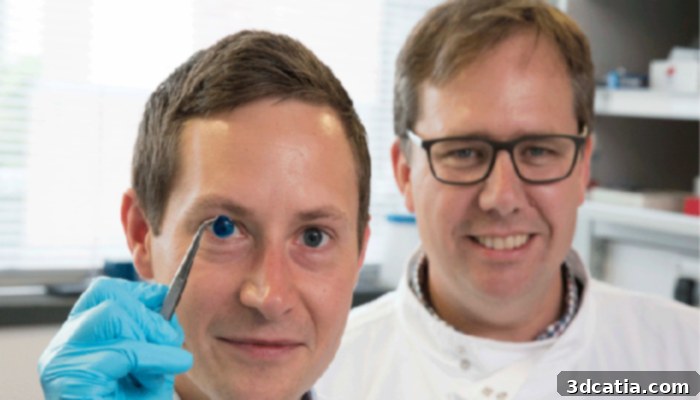
The two creators of the artificial cornea | Source: Newcastle University
4D Biomaterials: Unlocking New Dimensions in Self-Assembling Tissues
While 3D bioprinting represents a monumental step, the frontiers of regenerative medicine are continually expanding. Building upon the successes of 3D printing, researchers are now exploring “4D bioprinting,” which integrates the concept of time as the fourth dimension. This exciting field focuses on creating structures from “4D biomaterials” – intelligent materials designed to change their shape, properties, or even function when exposed to specific external stimuli. These stimuli can include variations in temperature, pH levels, light, electrical fields, or even simple hydration.
Continuing the legacy of innovation at Newcastle University, Martina Miotto, a post-doctoral researcher specializing in tissue engineering, has spearheaded the creation of a self-assembling cornea using these revolutionary 4D biomaterials. Miotto’s team utilized Corneal Cell Collagen Gels (CCCGs), a specialized bio-ink formulation possessing inherent contracting properties. The magic of 4D behavior unfolded over a period of five days: the CCCGs, under the influence of the collective contractile forces of the embedded cells, gradually curved and molded themselves into distinct cornea-like shapes. Miotto eloquently describes this emergent 4D behavior: “Each cell’s force is tiny, but together they can shape a one-inch-wide block of tissue into a cornea-like structure.” This remarkable ability to self-organize and self-assemble mimics natural biological development, offering a powerful paradigm shift from merely printing static structures to engineering dynamic, responsive tissues that actively participate in their own formation. This advancement holds immense potential for creating more physiologically accurate and functional tissue constructs, moving closer to perfectly replicating the intricate architecture of natural tissues.
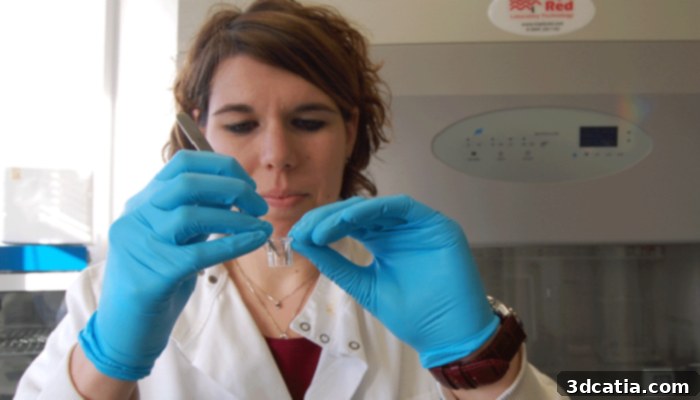
Martina Miotto | Credits: Newcastle University
A Spectrum of Transformative Applications for 4D Biomaterials
The implications of 4D biomaterials extend far beyond just corneal regeneration, promising to enhance and redefine current 3D bioprinting efforts across a vast range of medical applications. Martina Miotto further elaborated on the profound synergy between 3D and 4D printing: “It’s possible to take this technology one step further with the invention of 4D printing, the printing of structures that can self-assemble by folding after the manufacturing process is done, just like our corneas. Printing biological structures that can arrange themselves into an even more complex shape would mean you wouldn’t need to produce scaffolds to print the cells on, or remove them afterwards. The accuracy of the printing process would be extremely useful in precisely positioning the peptide-based molecules that make the cells contract within the bio-material.”
This insight highlights a key advantage: the elimination of scaffolds. In traditional tissue engineering, cells are often grown on temporary support structures (scaffolds) that must either degrade naturally or be removed after the tissue has formed. The self-assembly capabilities of 4D biomaterials can circumvent this complex and often costly step, simplifying the bioprinting process, reducing manufacturing time, and potentially leading to more biologically harmonious constructs. Furthermore, the ability to precisely control the environment and trigger specific cellular responses, such as contraction, allows for unprecedented accuracy in positioning active molecules. This level of control can lead to tissues that are not only structurally sound but also functionally superior, mimicking the natural complexities of native tissues with greater fidelity.
The potential applications of 4D biomaterials stretch across multiple medical disciplines. One particularly compelling example Miotto cites is the development of shape-changing stents: “The process could be used to create shape-changing stents to keep clogged blood vessels open. A closed stent could easily be injected into the bloodstream and then made to open up by the contracting force of cells at a site of injury, avoiding the need for surgery.” Imagine a tiny, collapsed stent that can be minimally invasively delivered to a blocked artery. Once in place, external stimuli or engineered cellular responses within the stent itself could cause it to expand to its full functional size, reopening the vessel without the need for traditional, more invasive surgical intervention. This could revolutionize the treatment of cardiovascular diseases, making procedures safer, less traumatic, and more accessible.
Beyond corneas and stents, 4D bioprinting opens doors to a plethora of innovative solutions. It could facilitate the creation of complex cartilage structures that can self-fold into anatomically correct shapes, or heart valves that actively respond to changes in blood pressure. The precision and responsiveness of 4D materials also hold promise for advanced drug delivery systems, where therapeutics are released in response to specific physiological cues, and for developing soft robotics that can adapt and interact with biological systems. The ability to engineer dynamic, adaptive biological structures represents a fundamental shift in regenerative medicine, moving from static replacements to intelligent, responsive implants that can integrate more seamlessly with the human body.
The Future of Vision and Regenerative Medicine
The advancements in 3D and 4D bioprinting, particularly the pioneering work at Newcastle University in creating artificial and self-assembling corneas, mark an extraordinary chapter in the fight against blindness. These technologies offer a tangible pathway to overcome the critical shortage of donor corneas and provide scalable, personalized solutions for millions suffering from corneal disease. While the journey from laboratory breakthrough to widespread clinical application involves rigorous clinical trials, regulatory approvals, and optimization for mass production, the foundational science is exceptionally promising. We are witnessing the dawn of an era where bespoke, biologically engineered tissues could become a standard treatment, revolutionizing ophthalmology and regenerative medicine as a whole. This is not just about restoring sight; it’s about redefining the potential of human health through cutting-edge science and innovation.
What are your thoughts on these groundbreaking developments in 3D printed corneas and the future of 4D biomaterials? We invite you to share your perspectives in the comments section below or join the conversation on our Facebook and Twitter pages! Don’t miss out on the latest news and insights in the world of 3D printing; sign up for our free weekly Newsletter to have all the updates delivered directly to your inbox!