

Revolutionizing NASCAR: How LEGACY MOTOR CLUB Gains a Competitive Edge with 3D Printing
In the fiercely competitive arena of NASCAR, where victory hinges on the slimmest of margins, the ability to rapidly translate ideas into tangible components is paramount. LEGACY MOTOR CLUB, a team co-owned by racing legends Jimmie Johnson and Richard Petty, has embraced industrial 3D printing to accelerate their “speed to track,” gaining a significant competitive advantage. Through a strategic partnership with BigRep and the deployment of two STUDIO systems, LEGACY MOTOR CLUB has transitioned from relying on external vendors to establishing a high-efficiency, in-house production model. This transformative shift enables the team to compress the timeline from raw materials to a fully assembled race car to approximately four weeks, a feat that was previously unattainable.
LEGACY MOTOR CLUB proudly competes under the Toyota Racing banner, fielding three meticulously engineered Toyota Camry XSE race cars for the NASCAR Cup Series. These include the No. 43, skillfully driven by Erik Jones, the No. 42, expertly piloted by John Hunter Nemechek, and the No. 84, which is driven part-time by Jimmie Johnson, adding a touch of racing royalty to the team’s lineup.

Breaking Free from Outsourcing Constraints
Prior to integrating large-format additive manufacturing into their operations, LEGACY MOTOR CLUB encountered significant delays due to lengthy lead times. Prototyping even a single aerodynamic component or specialized fixture often required waiting for two to three weeks for delivery from external suppliers. This protracted turnaround time hindered the team’s ability to rapidly iterate and optimize their designs, potentially compromising their on-track performance. Steven Sander, the Director of Aerodynamics at LEGACY MOTOR CLUB, highlighted the critical importance of in-house additive manufacturing in an interview with BigRep, stating, “Our cars are rebuilt weekly, and the performance margins are extremely small, so we need to prototype, iterate, and produce parts very quickly. That is where having in-house additive manufacturing becomes a real advantage.”
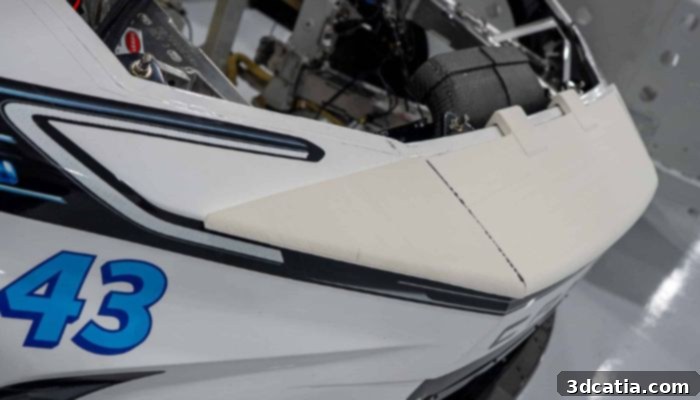
LEGACY MOTOR CLUB operates its two BigRep STUDIO printers almost continuously, 24 hours a day, seven days a week, producing a wide range of essential components. These include fixtures, templates, and functional parts that are directly integrated into the race cars. Sanders elaborated on the specific applications, stating, “For example, we print nose ducts for the front brakes, which are basically one-time-use parts and not practical to make in carbon, and we also print a large gear cooler plenum at the rear of the car.” He further emphasized the need for industrial-grade equipment, adding, “That component is far too big for a hobby printer, so we need an industrial, large-format system with accurate dimensional control and a big build volume.” The BigRep STUDIO systems provide the necessary capacity and precision to produce these critical components efficiently and effectively.
Unlocking High-Performance Applications with 3D Printing
LEGACY MOTOR CLUB leverages the capabilities of engineering-grade filaments to manufacture end-use parts that can withstand the extreme conditions encountered in the Cup Series. A particularly noteworthy application is the gear-cooler plenum, a complex duct designed to regulate temperatures within the car’s powertrain. Previously, procuring this part from external sources incurred a cost of approximately $2,000 per unit. However, by adopting in-house 3D printing and utilizing high-temperature materials, LEGACY MOTOR CLUB has dramatically reduced the material cost to approximately $56 per unit, resulting in substantial cost savings.
“In motorsports, saving weight usually costs money,” Sanders added. “Here, we are saving weight and saving money at the same time. That is rare.”
The ability to reduce weight stems from the enhanced control over materials, wall thickness, orientation, and infill offered by 3D printing. With expert engineering support from BigRep, LEGACY MOTOR CLUB can transmit designs, receive slicing feedback, determine optimal materials, and fine-tune the printing process. “That collaborative process is how we took the same gear cooler plenum from being heavier than the original carbon part to matching its weight,” Sanders explained, highlighting the value of the partnership.
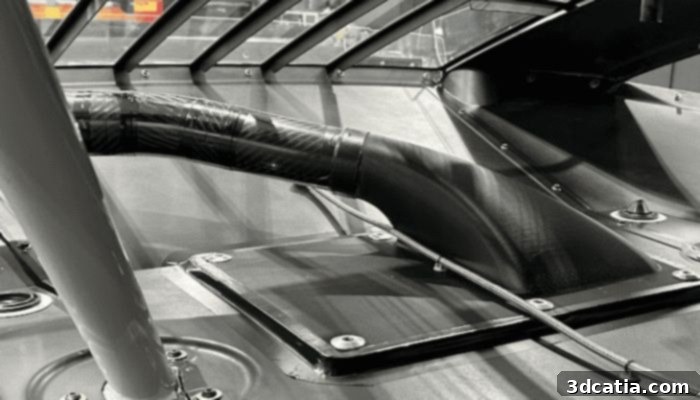
A 3D printed gear cooler plenum
To satisfy the rigorous demands of the racetrack, the team utilizes specialized filaments, including HI-TEMP CF (Carbon Fiber reinforced) for exceptional heat resistance, PRO HT for general-purpose applications, and TPU for flexible components. In addition, they employ water-soluble support material (BVOH) to create intricate internal geometries that would be virtually impossible to manufacture using traditional methods. This capability allows them to design and produce parts with optimized performance characteristics.
3D Printing in the Broader Automotive Landscape
LEGACY MOTOR CLUB’s embrace of 3D printing mirrors the growing trend among major U.S. automakers, from established giants like Ford and GM to innovative companies like Rivian and Divergent. These manufacturers are increasingly leveraging additive manufacturing for applications beyond prototyping, integrating it into the production of end-use components and tooling. While companies like Ford utilize 3D printing for specialized components in high-performance models like the Mustang GTD, LEGACY MOTOR CLUB’s implementation demonstrates the technology’s ability to address immediate engineering challenges on a weekly basis, allowing race teams to rapidly adapt and optimize their vehicles.
The Trifecta: Speed, Quality, and Cost Efficiency
For LEGACY MOTOR CLUB, the transition to in-house industrial 3D printing offers a compelling combination of speed, quality, and cost benefits. By leveraging the capabilities of the BigRep STUDIO systems, the team no longer needs to compromise on any of these critical factors. Sander emphasized that fabricating their own fixtures, templates, and other essential components ensures consistent build quality across their race cars. Furthermore, they can prototype 3D printed car parts before committing to machining expensive metal pieces, reducing waste and streamlining the design process. “That is where I see the sport heading,” Sanders concluded, “because new ideas come out of the shop every single day, and we are already doing things with 3D printing that I never would have thought were possible a few years ago.”
The implementation of 3D printing at Legacy Motor Club is not just about creating parts faster; it’s about fostering a culture of innovation and rapid iteration. By bringing the manufacturing process in-house, the team has gained unprecedented control over their designs and timelines. This allows them to experiment with new ideas and make adjustments quickly, giving them a significant edge on the competition.
Moreover, the cost savings associated with 3D printing are substantial. The ability to produce complex parts in-house at a fraction of the cost of traditional manufacturing methods frees up resources that can be invested in other areas of the team, such as research and development. This contributes to a virtuous cycle of continuous improvement and innovation.
The team’s success with 3D printing also highlights the importance of collaboration and knowledge sharing. By working closely with BigRep, LEGACY MOTOR CLUB has been able to leverage the expertise of additive manufacturing specialists to optimize their designs and printing processes. This collaborative approach has been instrumental in achieving the impressive results they have seen to date.
As 3D printing technology continues to evolve, it is likely that we will see even wider adoption of this technology in the world of motorsports. The ability to create custom parts quickly and cost-effectively is a game-changer for teams looking to gain a competitive advantage. LEGACY MOTOR CLUB is at the forefront of this trend, and their success serves as a testament to the transformative potential of 3D printing.
The impact of 3D printing extends beyond just the race cars themselves. The technology is also being used to create custom tooling and fixtures, which further streamlines the manufacturing process and improves efficiency. This holistic approach to 3D printing is what sets LEGACY MOTOR CLUB apart and allows them to fully realize the benefits of this technology.
In addition to the direct benefits, 3D printing also has a positive impact on the environment. By reducing waste and optimizing the use of materials, the technology contributes to a more sustainable manufacturing process. This is an increasingly important consideration for companies in all industries, including motorsports.
Looking ahead, LEGACY MOTOR CLUB plans to continue expanding its use of 3D printing, exploring new applications and pushing the boundaries of what is possible. The team is committed to staying at the forefront of this technology and using it to achieve even greater success on the racetrack.
What are your thoughts on LEGACY MOTOR CLUB’s innovative use of 3D printing? Share your opinions in the comments below or connect with us on LinkedIn or Facebook! Don’t forget to subscribe to our free weekly Newsletter for the latest 3D printing news delivered straight to your inbox. You can also find all our videos on our YouTube channel. For more 3D printing news in the automotive and transportation sector, visit our dedicated page HERE.
*All Photo Credits: BigRep / LEGACY MOTOR CLUB