
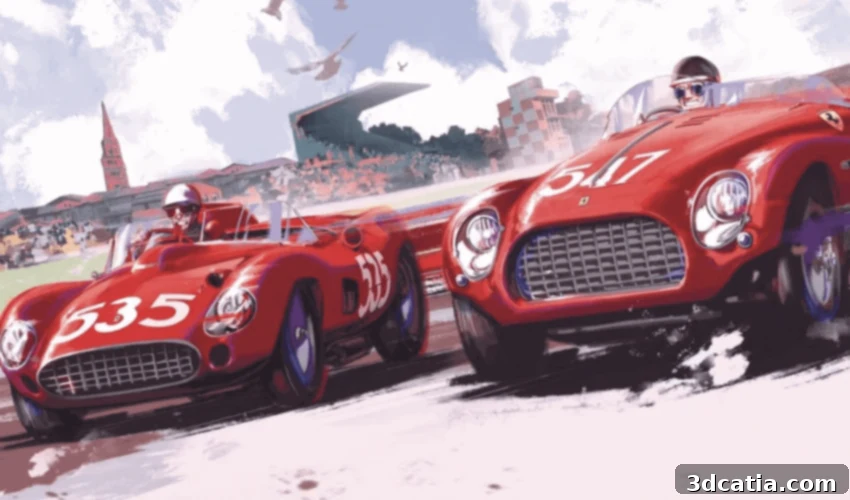
Driving Authenticity: How 3D Printing Elevated Michael Mann’s “Ferrari” Film with CRP Technology
Michael Mann’s highly anticipated biographical drama, “Ferrari,” which premiered in Italy on December 14th, transports audiences to the bustling heart of Modena, a city indelibly linked to its rich automotive heritage. This cinematic endeavor, meticulously crafted from Brock Yates’ seminal 1991 biography, “Enzo Ferrari: Man and Machine,” delves deep into the life of Enzo Ferrari, the legendary founder behind the world-renowned luxury sports car brand. The film boasts an impressive ensemble cast, featuring Adam Driver in the titular role, Penélope Cruz as Laura Ferrari, Shailene Woodley as Lina Lardi, and Patrick Dempsey embodying Piero Taruffi, alongside other esteemed Hollywood talents. What truly distinguishes this film project and contributes significantly to its immersive authenticity, however, is the innovative contribution of CRP Technology, a pioneering Italian company specializing in advanced 3D printing and additive manufacturing solutions. Indeed, the strategic application of 3D printing technology played an absolutely crucial role in the meticulous production of “Ferrari,” imbuing this period piece with an innovative and unparalleled dimension of historical accuracy and technical excellence.
Strategically situated in Italy’s illustrious “Motor Valley,” in close proximity to Ferrari’s historic headquarters, CRP Technology engaged in an intensive and collaborative partnership with Michael Mann’s visionary production team. Leveraging their profound expertise in a cutting-edge 3D printing technique, specifically Selective Laser Sintering (SLS), and their development of high-performance Windform composite materials, the company made an invaluable contribution to creating a multitude of functional parts and exquisitely detailed accessories for the film. This advanced additive manufacturing capability not only facilitated the rapid creation of these bespoke components but also ensured their incredibly swift delivery, a critical factor for maintaining the tight production schedules inherent in a major motion picture. The synergy between CRP Technology’s engineering prowess and the film’s artistic demands allowed for a seamless integration of high-tech manufacturing into the creative process.
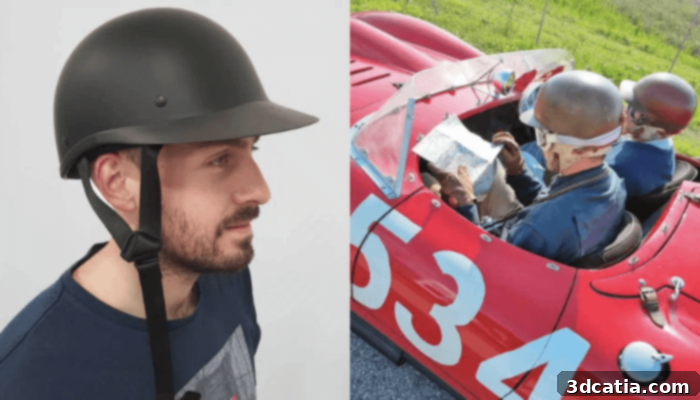
A 3D-printed visor for a Windform GT helmet (left), then tested by an actor from the film (right) (photo credits: CRP Technology)
Precision Engineering for Cinematic Authenticity: CRP Technology’s Role in “Ferrari”
CRP Technology, widely recognized for its continuous advancements in additive manufacturing, was instrumental in the precise production and timely delivery of various crucial accessories for the “Ferrari” film. These included highly specific driver’s helmet components, such as custom-fitted visors, and other intricate stand elements, all of which demanded an uncompromising degree of historical fidelity and robust functionality to genuinely reflect the 1950s era. The meticulous design and manufacturing of these items were masterfully executed utilizing CRP Technology’s sophisticated SLS process. This technique ensured not only optimal precision in geometry and fit but also an unparalleled level of visual and structural authenticity, vital for a film renowned for its commitment to historical detail. The careful selection of materials was equally paramount, with CRP deploying its high-performance Windform family of composite materials. Specifically, glass-fiber-filled Windform GT, carbon-fiber-filled Windform XT 2.0, and the rubber-like thermoplastic elastomer Windform RL were chosen, each for their unique mechanical properties and exceptional adaptability to the varied and exacting requirements of film props.
Each Windform material brought distinct advantages to the production. Windform GT, fortified with glass fibers, offered an excellent combination of rigidity, impact resistance, and a superior surface finish, making it perfectly suited for components like helmet visors that needed both durability under filming conditions and a polished, period-accurate aesthetic. For parts demanding extreme structural integrity, lightweight characteristics, and high stiffness, such as certain internal helmet components or display elements, Windform XT 2.0, reinforced with carbon fibers, was the material of choice. Its exceptional mechanical performance ensured that these props were not only visually correct but also structurally sound for extensive use on set. Furthermore, for elements requiring flexibility, vibration damping, or a soft, tactile, rubber-like texture, Windform RL was strategically employed. Its elastomeric properties proved invaluable for creating seals, grips, or any component that needed to flex, absorb impact, or provide enhanced comfort for the actors, thereby boosting both the realism and practical utility of the props.
Transforming Film Production: The Efficacy of Additive Manufacturing
The synergistic collaboration between CRP Technology and the “Ferrari” film production team stands as a powerful testament to the transformative potential of additive manufacturing within the demanding entertainment industry. A pivotal factor underpinning this immensely successful partnership was CRP Technology’s unparalleled capability for rapid prototyping and agile production. This ensured that all necessary components, from intricate helmet details to structural stand elements, were not only produced with exacting precision but also delivered with remarkable speed, perfectly aligning with the film’s rigorous and often unforgiving shooting schedule. This “design-to-delivery” efficiency for functional, high-fidelity accessories proved to be exceptionally advantageous, significantly compressing valuable time from the overall production timeline. In stark contrast, traditional manufacturing methods typically involve lengthier lead times, higher upfront tooling costs, and considerably less flexibility for iterative design changes – formidable challenges that advanced 3D printing techniques like SLS elegantly overcome.
The film’s production team expressed profound appreciation for CRP Technology’s contributions, publicly commending the company for its unwavering professionalism, deep technical expertise, and the consistently outstanding quality of the 3D-printed parts. This successful partnership serves not only to underscore CRP Technology’s unparalleled mastery in state-of-the-art additive manufacturing but also to substantially bolster its already stellar reputation as an incredibly reliable and innovative partner for complex, high-stakes projects across a diverse range of industries. For the film industry specifically, the integration of 3D printing unlocks unprecedented levels of customization, empowering filmmakers to bring even the most intricate and unique creative visions to life without any compromise on historical accuracy, structural integrity, or aesthetic quality. From crafting highly detailed historical props to fabricating elaborate futuristic components, additive manufacturing offers an incredibly flexible, cost-effective, and powerful toolset for contemporary creators.
Beyond “Ferrari”: The Expanding Horizons of 3D Printing in Cinema
The resounding success story exemplified by CRP Technology’s involvement in “Ferrari” serves as a compelling and influential case study for the broader and increasingly diverse applications of 3D printing in cinematic production worldwide. Historically, the creation of highly specialized props, intricately designed costumes, or bespoke set pieces frequently demanded laborious manual craftsmanship, often accompanied by prohibitive costs and lengthy production timelines. Additive manufacturing now offers a revolutionary and highly efficient alternative, fundamentally streamlining these complex processes and concurrently opening up entirely new avenues for creative expression and visual innovation. This cutting-edge technology facilitates the rapid iteration of designs, allowing directors, prop masters, and costume designers to experiment with and refine concepts quickly and with remarkable cost-efficiency. Whether the requirement is to meticulously craft historically accurate automotive components, as vividly showcased in “Ferrari,” or to produce elaborate creature costumes for fantasy blockbusters, or even to design futuristic gadgets for cutting-edge sci-fi epics, 3D printing provides unparalleled flexibility, precision, and speed.
Moreover, the capability to produce truly functional parts using high-performance materials like the Windform composites means that film props are no longer merely visual adornments but can also actively perform specific actions, thereby adding another profound layer of realism and practical utility to the storytelling. This extends far beyond simple aesthetics, encompassing functional mechanics, ensuring structural integrity for demanding stunt work, or providing ergonomic designs for optimal actor comfort and safety. The inherent environmentally conscious aspects of 3D printing, with its significant potential for reduced material waste and localized, on-demand production, also perfectly align with the growing sustainability efforts and green initiatives within the modern film industry. As such, the pioneering collaboration between CRP Technology and Michael Mann’s production team is not an isolated incident but rather a potent indicator of a burgeoning trend, echoing numerous previous projects where 3D printing has already been successfully employed to enhance various aspects of movie production. This successful integration profoundly positions CRP Technology to further expand its significant influence within the dynamic entertainment sector, forging future opportunities and firmly cementing its pivotal role at the fascinating intersection of high-performance engineering and unparalleled cinematic artistry.
The Enduring Legacy of Enzo Ferrari and the Future of Film Production
Enzo Ferrari’s extraordinary life was an enduring testament to unyielding passion, audacious ambition, and a relentless, often solitary pursuit of perfection, frequently overshadowed by profound personal tragedy and immense professional pressures. Michael Mann’s film masterfully captures this palpable intensity, deliberately focusing on a critical year that profoundly defined both the man and his legendary marque. The authentic and respectful portrayal of this pivotal era necessitated an almost obsessive attention to historical detail, encompassing everything from the visceral roar of the meticulously recreated engines to the minute, almost imperceptible design nuances of a driver’s helmet. It is precisely within this unwavering pursuit of unparalleled authenticity that CRP Technology’s advanced additive manufacturing prowess proved to be utterly indispensable. By providing historically accurate, functionally robust, and visually indistinguishable components, 3D printing ensured that the film’s powerful visual storytelling was firmly grounded in tangible, undeniable reality, allowing audiences to fully immerse themselves in the high-octane, emotionally charged world of 1957 Italian racing.
This pioneering collaboration between an iconic filmmaker and an innovative technology firm powerfully highlights a fascinating and evolving paradigm: the remarkable synergy between traditional, compelling storytelling and cutting-edge manufacturing technology. It unequivocally demonstrates that the future landscape of film production is highly likely to involve even more sophisticated and integrated applications of advanced manufacturing techniques, continuously pushing the established boundaries of what is visually, narratively, and practically possible on screen. As CRP Technology continues its relentless innovation with its advanced Windform materials and groundbreaking SLS technology, its potential contributions to a myriad of creative industries, most notably film, appear boundless. The “Ferrari” film stands as a shining, exemplary illustration of how harmoniously combining a profound respect for historical accuracy with state-of-the-art technological innovation can culminate in a truly unforgettable, deeply immersive, and cinematically rich experience for audiences worldwide.
What are your thoughts on how CRP Technology’s significant 3D printing contribution impacted the overall authenticity and production efficiency of Michael Mann’s “Ferrari” film? We invite you to share your valuable insights in a comment below or join the engaging conversation on our LinkedIn, Facebook, and Twitter pages! Don’t forget to subscribe to our free weekly Newsletter here, to receive the very latest 3D printing news and industry updates directly in your inbox! Additionally, you can find all our insightful videos and exclusive content on our dedicated YouTube channel.
*Cover Photo Credits: Ferrari