
Revolutionizing Wind Energy: NREL Pioneers Sustainable 3D-Printed Thermoplastic Turbine Blades
The global demand for clean, renewable energy sources continues to accelerate, with wind power standing as a cornerstone of this transition. However, as the wind energy sector expands, so does the critical need for more sustainable manufacturing processes and end-of-life solutions for its core components. Traditional wind turbine blades, while vital for harnessing wind, pose significant recycling challenges at the end of their operational lifespan. Addressing this paradox, a groundbreaking research team at the National Renewable Energy Laboratory (NREL) is at the forefront of innovation, actively testing the production of next-generation wind turbine blades. These modernized blades feature highly-engineered, 3D-printed designs that ingeniously utilize a thermoplastic resin system, marking a pivotal shift towards a more circular economy in renewable energy manufacturing.
Wind turbines are widely celebrated for their profound ability to significantly decrease humanity’s collective carbon footprint and mitigate environmental impact by generating electricity without greenhouse gas emissions. Yet, the question of what happens to these massive structures once they reach the end of their service life has long loomed over the industry. In recent years, the immense benefits of additive manufacturing, commonly known as 3D printing, have been rigorously explored by various sectors of the energy industry. For renewable energy, in particular, the inherent paradox of potentially wasteful production – where the very tools of sustainability themselves create waste – remains a persistent area demanding continuous research and innovative solutions. This critical challenge has garnered such significant attention that, earlier this year, the United States Department of Energy (DOE) demonstrated its commitment by providing substantial funding to leading universities and industry partners. This funding specifically aims to accelerate the development of advanced 3D-printed composite wind blade molds and, more importantly, end-use blade components, signaling a strategic investment in the future of sustainable wind power.
The Thermoplastic Advantage: A Leap Towards Recyclability
The vast majority of existing wind turbine designs, particularly their blades, rely on conventional thermoset resin systems. These include well-known polymers such as epoxies, polyesters, and vinyl esters. While these materials offer excellent structural integrity and durability during operation, their chemical nature presents a significant hurdle at the end of the blade’s life. Derek Berry, Senior Wind Technology Engineer and the NREL team lead, precisely articulates this challenge: “Once you produce a blade with a thermoset resin system, you cannot reverse the process. That also makes the blade extremely difficult to recycle.” This irreversibility stems from the irreversible chemical bonds formed during the curing of thermoset resins, meaning they cannot be melted down and reformed. Consequently, old thermoset blades often end up in landfills, occupying vast spaces and contradicting the very ethos of environmental sustainability that wind energy represents.
Recognizing this fundamental limitation, the NREL team embarked on an ambitious collaborative effort, partnering with several institutions to develop and validate systems that harness the power of thermoplastics. Unlike their thermoset counterparts, thermoplastics possess a unique molecular structure that allows them to be heated, melted, and reshaped multiple times without significant degradation. This inherent property enables what is termed “end-of-life (EOL) recyclability.” By utilizing thermoplastic resins, the NREL team is pioneering a path where wind turbine blades, after their two-decade service life, can be systematically dismantled, the thermoplastic polymers separated through thermal processes, and then reprocessed into new materials or even new wind turbine components. This circular approach not only addresses the immediate recycling problem but also significantly reduces the demand for virgin materials, conserving resources and minimizing the environmental footprint associated with manufacturing.
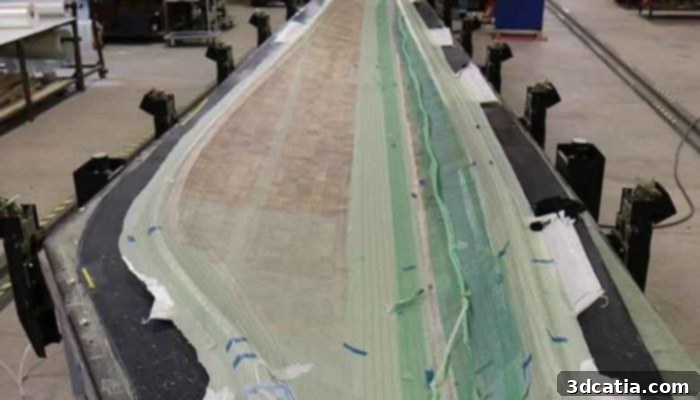
A 13-meter thermoplastic blade 3D-printed at the Composites Manufacturing Education and Technology Facility (CoMET) by an NREL research team. (Photo Credit: Ryan Beach, NREL)
The Transformative Power of 3D Printing for Wind Turbine Blades
The integration of 3D printing technology with thermoplastic materials represents a synergistic advancement for wind energy. According to insightful research from the United States Environmental Protection Agency (EPA), the average operational lifespan of a wind turbine is approximately 20 years. After this period, the sheer volume of material from decommissioned blades presents an escalating waste management challenge. By strategically employing large-format 3D printing technology for the fabrication of these thermoplastic blades, their end-of-life recyclability is dramatically improved, moving closer to a truly sustainable energy infrastructure.
Beyond superior recyclability, additive manufacturing introduces a host of other critical benefits that can revolutionize blade design and production. 3D printing substantially reduces both the weight and manufacturing cost of a turbine blade, conservatively estimated at a minimum of 10%. This weight reduction is crucial, as lighter blades can be longer, capturing more wind energy and increasing overall turbine efficiency without placing undue stress on the tower and drivetrain. The design freedom afforded by 3D printing also allows for highly optimized internal structures, such as lattice designs, that provide strength with minimal material, further contributing to weight savings. Furthermore, this advanced manufacturing technique significantly slashes production cycle time by an impressive 15%, accelerating the deployment of new turbines and reducing time-to-market for innovative designs. This efficiency gain translates into faster scaling of wind energy capacity and a more responsive supply chain.
Enhanced Performance and Environmental Stewardship
The advancements don’t stop at improved recyclability and manufacturing efficiency. The method of joining these thermoplastic blade parts further enhances their environmental profile. Instead of relying on conventional, often environmentally detrimental, adhesives – which typically introduce non-recyclable materials and complicate the separation process – these thermoplastic blade components can be seamlessly joined together using an innovative thermal welding process. Derek Berry elaborates on this elegant solution: “With two thermoplastic blade components, you have the ability to bring them together and, through the application of heat and pressure, join them. You cannot do that with thermoset materials.” This direct material fusion creates a homogenous bond that is as strong as the base material, eliminating the need for foreign chemical binders and simplifying future recycling. It represents a significant step towards a truly integrated and sustainable manufacturing process.
Ultimately, the overarching ambition of the NREL team is to engineer and produce wind turbine blades that are not only lighter and longer but also less expensive to manufacture and demonstrably more efficient in energy capture. These attributes – reduced weight, increased length, lower cost, and enhanced efficiency – are each critical components for substantially increasing the presence and viability of wind energy across the USA. This initiative is a vital part of the broader national goal to aggressively reduce greenhouse gas emissions and combat climate change. By pushing the boundaries of material science and additive manufacturing, NREL is laying the groundwork for a future where wind power is not only abundant but also inherently sustainable throughout its entire lifecycle. Further details on this pioneering research can be found in the video below or by accessing the official NREL press release HERE.
Future Outlook and the Path to a Circular Wind Economy
The innovations from NREL represent a significant paradigm shift for the wind energy industry, moving away from a linear “take-make-dispose” model towards a circular economy where materials are continually reused and recycled. This not only offers tangible environmental benefits but also promises economic advantages through reduced waste disposal costs and the potential for new industries centered around blade recycling and material reprocessing. While the initial tests with the 13-meter thermoplastic blade at the Composites Manufacturing Education and Technology Facility (CoMET) are highly promising, the path forward involves scaling up these technologies for even larger, utility-scale turbine blades. This will require further research into the long-term durability and performance of thermoplastic composites under various environmental conditions, as well as the development of robust supply chains for thermoplastic resins and advanced additive manufacturing equipment capable of producing components of unprecedented scale.
The DOE’s investment underscores the strategic importance of this research, recognizing that sustainable innovation in renewable energy is not just about generating power, but also about building an environmentally responsible infrastructure. As the world moves towards ambitious climate goals, the ability to produce highly efficient, durable, and fully recyclable wind turbine blades will be a critical differentiator. NREL’s pioneering work in 3D printing thermoplastic blades offers a compelling vision for a future where every aspect of wind energy contributes positively to environmental stewardship and resource conservation, cementing wind power’s role as a truly sustainable solution for global energy needs.
What are your thoughts on NREL’s novel additive manufacturing techniques and their potential to transform the wind energy sector? We invite you to share your insights and engage with us in a comment below or connect with our community on our Linkedin, Facebook, and Twitter pages! Don’t forget to sign up for our free weekly Newsletter here, to get the latest 3D printing news straight to your inbox! You can also find all our videos on our YouTube channel.
Cover Photo Credit: Tyler Casey / Unsplash