
Revolutionizing Drug Delivery: 3D Printing Porous Pills for Personalized Medicine
The transformative potential of 3D printing technology in the medical sector has long been unequivocally clear. From the creation of highly customized prosthetics and intricate surgical guides to the cutting-edge advancements in bioprinting organs and tissues, additive manufacturing (AM) continues to redefine the boundaries of healthcare innovation. Now, researchers at the University of East Anglia (UEA) are pushing these boundaries even further, unveiling a groundbreaking application that promises to revolutionize pharmaceutical delivery. In a pivotal study, published in the prestigious International Journal of Pharmaceutics, the research team details how AM can be employed to 3D print pharmaceutical pills with uniquely porous structures. This ingenious approach offers a precise mechanism to regulate the rate of drug release from the medicine into the body, paving the way for truly personalized medications meticulously tailored to each patient’s individual physiological needs.
The paper, entitled “Effects of porosity on drug release kinetics of swellable and erodible porous pharmaceutical solid dosage forms fabricated by hot melt droplet deposition 3D printing,” marks a significant departure from the conventional “one-size-fits-all” paradigm prevalent in drug manufacturing. This traditional model, while effective for mass production and widespread distribution, frequently struggles to accommodate the vast variability in human metabolism, body composition, and specific medical requirements among patients. As a result, a standard dosage may prove to be excessively potent for one individual, leading to undesirable side effects, or conversely, too mild for another, rendering the treatment suboptimal or ineffective. Such inherent limitations underscore the critical and growing demand for more adaptive, patient-centric therapeutic strategies, a demand that advanced 3D printing technologies are uniquely positioned to address.
Personalized Medication: Overcoming the “One-Size-Fits-All” Hurdle
Dr. Sheng Qi, a distinguished Reader in Pharmaceutics at UEA’s School of Pharmacy and a key leader in this research, highlighted the profound significance of this project. “Currently, our medicines are manufactured in a ‘one-size-fits-all’ fashion,” Dr. Qi explained. “Personalised medicine leverages new manufacturing technology to produce pills that contain the precise dose and optimal drug combinations specifically tailored to individual patients. This innovative approach would enable patients to derive maximum therapeutic benefit from their medication while experiencing minimal side effects.” This statement encapsulates the core philosophy driving personalized medicine: to finely tune therapeutic interventions to align with patient specifics, thereby optimizing treatment efficacy and significantly reducing adverse reactions. This paradigm shift holds immense promise for transforming how medications are prescribed and utilized.
The widespread adoption of such personalized drug delivery systems could yield particularly transformative benefits for several vulnerable patient populations. For instance, elderly patients frequently contend with multiple chronic health conditions, necessitating a complex regimen of various medications daily. This phenomenon, known as polypharmacy, often contributes to challenges in medication adherence, elevates the risk of harmful drug-drug interactions, and increases the incidence of adverse effects. Similarly, individuals grappling with intricate conditions such as various forms of cancer, severe mental illnesses, and chronic inflammatory bowel diseases often require highly precise and adaptable dosing schedules that are exceedingly difficult to achieve using standardized pharmaceutical formulations. For these patients, the ability to custom-design drug release kinetics promises to dramatically enhance their quality of life, simplify their treatment protocols, and ensure more consistent, effective therapeutic outcomes.
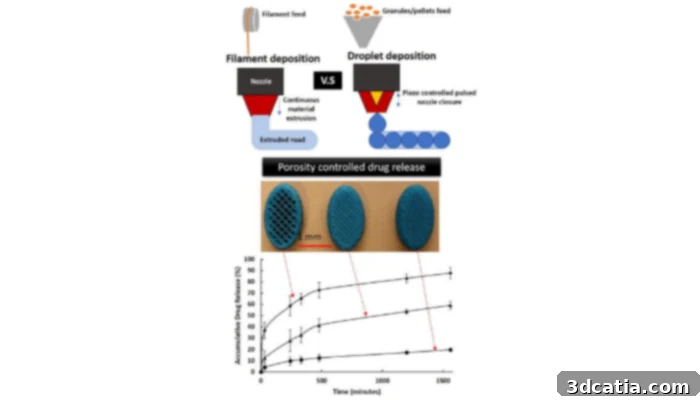
The innovative hot melt droplet deposition method, alongside results illustrating how porosity directly influences drug release time and kinetics. (Image Credits: Zhang et al.)
Exploring the Advanced Hot Melt Droplet Deposition 3D Printing Technology
At the core of this pioneering research lies the strategic application of a newly developed hot melt droplet deposition 3D printing method. This sophisticated technique, likely inspired by or similar to existing material jetting processes, offers significant advantages when compared to more conventional filament-based 3D printing approaches often used in pharmaceutical development. In the hot melt droplet deposition process, drug substances, typically in a granular or pelletized form, are precisely fed into an extruder. Crucially, rather than extruding a continuous, uniform filament, a piezo-controlled pulsed nozzle is employed to accurately eject individual, minuscule droplets of the molten drug mixture. This exquisite level of control over the size, volume, and precise placement of each droplet is fundamental, as it enables the fabrication of intricate internal structures, including highly precise and customizable porous networks, directly within the pharmaceutical pill.
If the underlying technology indeed shares operational similarities with material jetting, it would logically entail the integration of an in-situ curing mechanism, such as ultraviolet (UV) light, which rapidly solidifies the deposited droplets layer by layer. This instantaneous solidification is paramount for preserving the structural integrity and fidelity of the complex internal geometries being constructed. The inherent benefits of such droplet deposition techniques are multifaceted and compelling. They consistently produce pharmaceutical forms with remarkably smooth surface finishes, a critical attribute for patient comfort and compliance with oral medications. Furthermore, these advanced methods frequently facilitate the simultaneous printing of multiple distinct materials. This capability opens exciting avenues for creating sophisticated combination pills that contain various active pharmaceutical ingredients (APIs) or excipients, each strategically designed to perform specific functions or be released at different rates within a single, integrated tablet.
The Mechanism: How Porosity Dictates Drug Release
The strategic selection of 3D printing for this pharmaceutical research was largely motivated by its unparalleled capacity to custom-produce porous solid dosage forms on demand. The central revelation of this study lies in the extraordinary discovery that by meticulously manipulating the size, spatial distribution, and interconnectivity of these internally fabricated pores, researchers can precisely control the rate at which the active drug compound is released from the tablet matrix into the physiological environment. This unprecedented level of control over drug release kinetics represents a monumental paradigm shift in the field of pharmaceutical formulation and drug delivery.
Upon ingestion, when a porous pill encounters fluids within the gastrointestinal tract, these fluids begin to penetrate its intricate structure. The degree and specific characteristics of this internal porosity directly govern the rate of drug dissolution and subsequent diffusion. A pharmaceutical structure with greater porosity, characterized by larger or more numerous interconnected channels, facilitates faster penetration by bodily fluids and presents a significantly increased surface area for the drug to dissolve, thereby leading to a more rapid release of the medication. Conversely, a less porous or more tortuous internal architecture effectively impedes fluid ingress and slows down drug diffusion, resulting in a more sustained, prolonged, and controlled release profile. This groundbreaking capability empowers medical professionals and pharmaceutical scientists to formulate medications that are no longer restricted by rigid, predetermined release patterns but can instead be exquisitely fine-tuned to precisely match a patient’s specific metabolic requirements, the progression of their disease, or even their daily schedule and lifestyle. This precision holds the key to optimizing therapeutic outcomes and minimizing adverse effects.
The Evolving Landscape of Pharmaceutical 3D Printing and Future Prospects
In parallel with rapid advancements in other medical disciplines, the field of pharmaceutical 3D printing research has experienced an exponential surge in recent years. While numerous existing 3D printing methods in this domain often necessitate the complex pre-processing of drug substances into filaments before printing can commence, the hot melt droplet deposition technique pioneered by the UEA team elegantly bypasses this laborious and potentially material-degrading step. This distinction is critically important, as certain active pharmaceutical ingredients are highly sensitive and can degrade or lose their therapeutic efficacy when subjected to the elevated temperatures and significant shear forces typically required for filament extrusion. By avoiding this step, the new method potentially broadens the spectrum of compatible drug compounds and streamlines the manufacturing process.
Looking ahead, the researchers envision a future where this innovative technology not only facilitates the meticulous tailoring of dosage strength and dosing frequency to meet each patient’s precise physiological needs but also enables the seamless integration of multiple distinct medicines into a single daily pill. Consider a patient managing a complex medication regimen, traditionally required to take several different tablets at various intervals throughout the day. With the advent of multi-drug 3D printed pills, their entire daily pharmaceutical intake could be consolidated into one convenient, personalized tablet. This revolutionary concept holds immense promise for significantly improving patient adherence to prescribed treatments, substantially reducing the risk of medication errors, and markedly simplifying the daily lives of individuals managing chronic and complex illnesses.
The potential applications extend far beyond mere pill consolidation. This unparalleled level of customization could facilitate the creation of multi-phasic release profiles within a single tablet – for example, combining an immediate-release component with a sustained-release component, or even orchestrating the sequential release of different drugs designed to act optimally at specific times. Such highly advanced drug delivery systems would represent a monumental leap forward in optimizing therapeutic windows, maximizing drug efficacy, and strategically mitigating unwanted side effects. While the comprehensive study provides intricate details regarding the experimental methodologies and exhaustive results, its overarching message resonates clearly: the era of truly personalized pharmaceutical care, driven by the unprecedented precision and flexibility of 3D printing, is not a distant dream but a rapidly approaching reality, poised to transform global healthcare.
For those interested in delving deeper into the specifics of this groundbreaking research and its detailed findings, the full study is available for purchase and access HERE.
Engage with the Future of Medicine and Additive Manufacturing
What are your thoughts and insights on this truly revolutionary research into 3D printing personalized medications? How do you envision this cutting-edge technology impacting patient care, pharmaceutical development, and the broader healthcare landscape in the years to come? We warmly invite you to share your perspectives, questions, and comments in the section below. Join the ongoing conversation and connect with our vibrant community across our social media platforms: find us and engage on Facebook, Twitter, and LinkedIn. Furthermore, to ensure you stay fully informed about the very latest developments, breaking news, and innovative breakthroughs in the dynamic world of additive manufacturing, make sure to sign up for our completely free weekly Newsletter here, delivered directly to your inbox every week!