
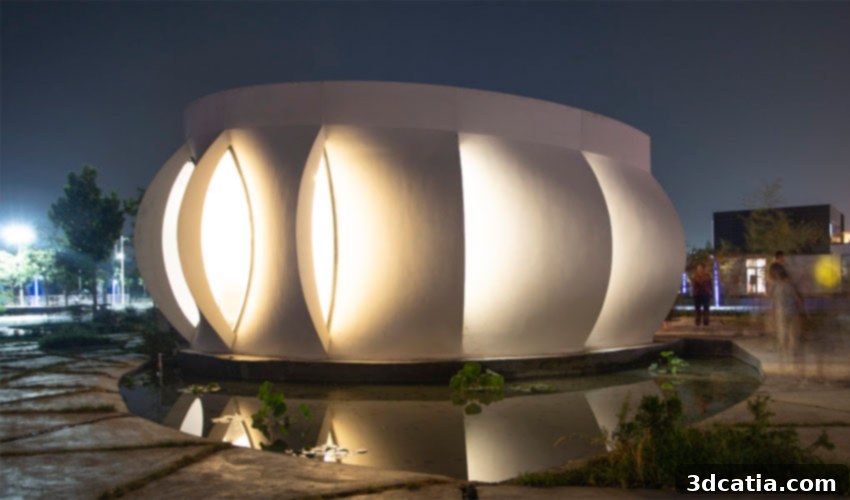
The Lotus House: Pioneering Sustainable Living with 3D Printing and Advanced Solar Technology
In a remarkable display of innovation and sustainable design, students participating in the Solar Decathlon China 2018 competition unveiled the “Lotus House” – a revolutionary 3D printed solar dwelling. This ambitious project, deeply rooted in the cultural symbolism of the lotus flower as a representation of purity and perfection in China, was meticulously designed to achieve unparalleled energy efficiency and environmental harmony. It stands as a beacon of what is possible when cutting-edge technology meets a vision for a greener future.
The Solar Decathlon China 2018 competition challenged interdisciplinary student teams to conceive, design, and construct fully functional, one or two-story solar-powered homes. These residences needed to incorporate all essential household appliances and demonstrate superior energy performance. Hosted in Dezhou, China, the event served as a crucible for emerging architectural talent, fostering the creation of energy-efficient housing prototypes. Among the many impressive entries, the Lotus House garnered significant attention for its innovative integration of additive manufacturing, specifically 3D printing technologies, with traditional construction methods. This hybrid approach positioned it as a standout example in the growing movement of 3D printed architecture.
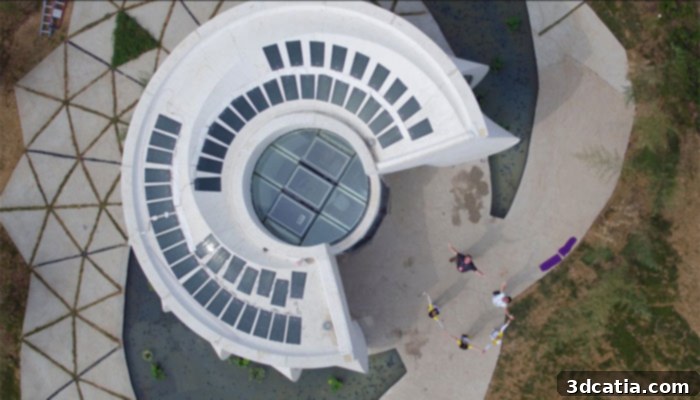
The Lotus House as seen from above, showcasing its unique, petal-like structure.
Innovative Design and the Power of Additive Manufacturing
The visionary team behind the 198 square meter Lotus House hailed from the University of Washington. Their journey to bring this 3D printed residence to life spanned eight months, culminating in a functional prototype that pushed the boundaries of modern construction. Kinga Pabjan, the project manager, articulated the core inspiration: “We were deeply inspired by the inherent beauty, delicate structure, and profound cultural significance of the lotus flower. However, our initial drive wasn’t solely focused on the lotus itself. Our fundamental intention was to leverage emerging technologies, particularly additive manufacturing, to create an organic, biomimetic form that was both aesthetically pleasing and functionally superior.” This statement highlights a crucial aspect of their design philosophy: using technology as a tool to emulate nature’s efficiency and beauty, rather than simply replicating existing architectural styles.
Pabjan further elaborated on the transformative impact of 3D printing, explaining how this technology enabled the creation of a significantly lighter and more environmentally friendly structural system. By precisely depositing materials layer by layer, 3D printing inherently minimizes material usage, drastically reducing waste compared to conventional building methods. This benefit was paramount to the students, aligning perfectly with the competition’s overarching objective of fostering sustainable and resource-efficient housing solutions. The ability to build complex geometries with minimal material offcuts directly translated into a lower carbon footprint and a more responsible approach to construction.
The Petal-Inspired Structure and Reusable 3D Printed Molds
The exterior of the Lotus House is a testament to the aesthetic and functional capabilities of 3D printing. It features a series of gracefully curved and superimposed panels, meticulously arranged around a central axis. This design beautifully mimics the natural unfurling of a blooming lotus flower, creating a visually striking and structurally robust enclosure. Beyond aesthetics, this organic form was crucial for optimizing airflow, natural lighting, and passive solar gain, all contributing to the home’s impressive energy performance.
A cornerstone of the Lotus House’s construction methodology involved the innovative use of 3D printed molds. The University of Washington team ingeniously created these molds, into which concrete was poured to form the building’s distinctive panels. The project team highlighted a significant advantage: these durable 3D printed molds could be reused at least 100 times. This stands in stark contrast to traditional wooden formwork, which typically degrades after only two uses. The longevity of the 3D printed molds translates into substantial material savings, reduced construction waste, and increased cost-effectiveness over multiple construction cycles. Furthermore, these advanced molds offered an unparalleled ability to produce intricate and complex geometric shapes that would be incredibly challenging, if not impossible, to achieve with conventional formwork, enabling the house’s unique biomimetic design.
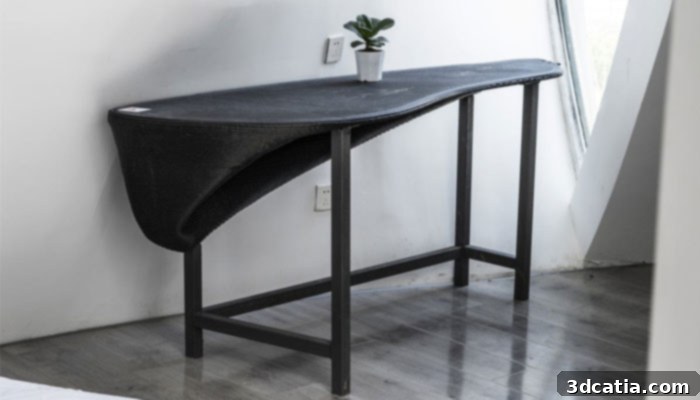
A remarkable 3D printed table, a feature inside the innovative Lotus House.
Challenging the Limits of 3D Printing in Construction
Reflecting on the groundbreaking project, the project manager enthusiastically concluded, “We set out to challenge the perceived limitations of 3D printing, and what we discovered is that its possibilities are virtually limitless!” This sentiment encapsulates the revolutionary potential of additive manufacturing to transform the entire architecture, engineering, and construction (AEC) sector. The Lotus House serves as a powerful case study, demonstrating how digital fabrication can enable faster, more sustainable, and more geometrically flexible building processes.
The impact of 3D printed construction extends far beyond experimental prototypes. Earlier in the same year, Austin, Texas, marked a significant milestone with the construction of its first permanent 3D printed house. This particular initiative aimed to showcase how concrete 3D printing could be a viable solution for addressing the global housing crisis, potentially offering affordable housing to the estimated 1.2 billion people worldwide who lack adequate shelter. More recently, in France, a pioneering social housing project opened its doors to its first family, marking a historic moment for 3D printed social housing. These examples underscore the accelerating adoption and practical application of 3D printing as a legitimate and impactful construction method, moving from conceptual prototypes to tangible, livable homes.
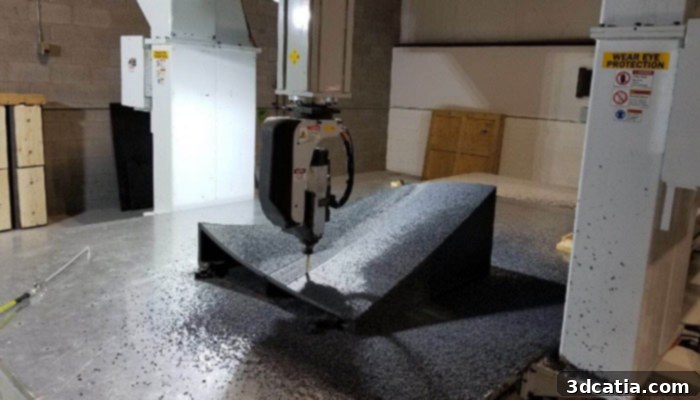
The intricate process of printing the molds for the Lotus House’s unique concrete panels.
The Future of Sustainable Architecture and 3D Printing
While the circular Lotus House remains a prototype for now and is not yet ready for permanent residents, its significance as an exemplar of sustainable architectural innovation cannot be overstated. It powerfully demonstrates the immense potential that 3D technologies bring to the architectural and construction sectors. By showcasing how complex, energy-efficient designs can be realized with unprecedented material and time efficiency, the Lotus House paves the way for future advancements in eco-friendly building practices.
This project serves as an inspiring blueprint for how smart design, coupled with advanced manufacturing techniques, can address contemporary challenges like climate change and housing shortages. The University of Washington team’s work, meticulously documented on their official website, offers a deep dive into the technical details and design philosophy behind this groundbreaking solar dwelling. Their success in the Solar Decathlon China 2018 not only brought them recognition but also provided invaluable insights into the practical application of 3D printing in large-scale construction.
What are your thoughts on the revolutionary Lotus House and the broader implications of 3D printing for sustainable construction? We invite you to share your perspectives in the comments section below or join the conversation on our Facebook and Twitter pages! For all the latest news, breakthroughs, and insights in the world of additive manufacturing, don’t forget to sign up for our free weekly Newsletter, delivered directly to your inbox!