
Revolutionizing Sustainability: How 3D Printing Transforms Ocean Plastic Waste into Innovative Creations
The landscape of manufacturing and material utilization is being profoundly reshaped by the advent of 3D printing technology. Far beyond its traditional applications, additive manufacturing is emerging as a critical player in addressing one of the most pressing environmental challenges of our time: plastic waste. A growing number of forward-thinking companies and organizations are recognizing the immense potential of transforming discarded plastics into valuable new materials for 3D printing. This innovative approach not only mitigates environmental damage but also creates significant added value, fostering a circular economy model. Initiatives like Precious Plastic exemplify this movement, demonstrating how local communities can engage in plastic recycling and product creation.
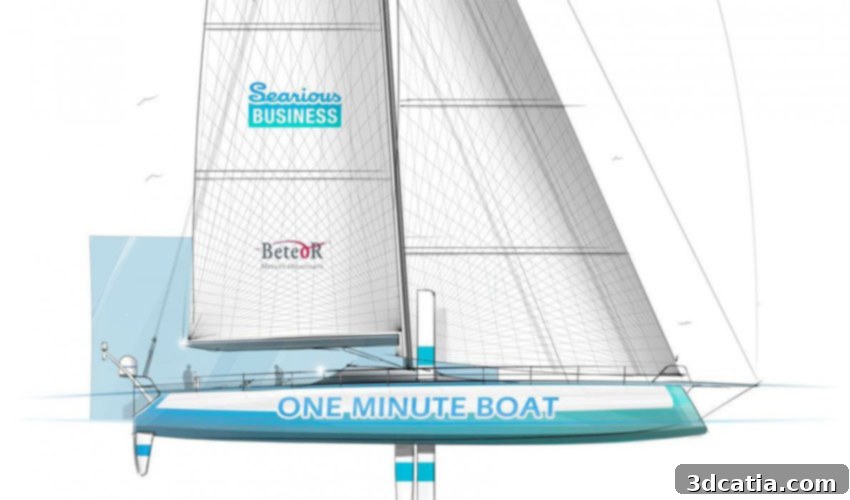
Among the pioneers in this field is Searious Business, a Dutch non-profit organization dedicated to combating ocean pollution. They are championing a bold and inspiring project: the 3D printing of a sailboat entirely from plastic waste collected from our oceans. While still in its early stages, this ambitious endeavor holds the promise of inspiring widespread change and highlighting the incredible potential of recycled materials. We recently had the opportunity to speak with Andrew Hall, a key figure behind this remarkable initiative, who shared insights into the project’s origins, its underlying philosophy, and the crucial issues it aims to address.
An Interview with Andrew Hall: Pioneering Sustainable 3D Printing
3DN: Andrew, could you please introduce yourself and explain your connection to 3D printing and sustainable innovation?
Hello, I’m Andrew Hall, and my professional life revolves around consulting, where I assist organizations, leaders, and teams navigate complex change. My academic journey began with studies in materials science and metallurgy, which instilled in me a deep understanding of how materials behave and can be transformed. I am a staunch advocate for the power of technology as a force for good, believing that when combined with human ingenuity, there are very few problems we cannot overcome. From this perspective, 3D printing stands out as one of the most exhilarating technological advancements in the realm of materials processing in recent history. Its capacity to revolutionize both manufacturing and recycling processes is immense, offering unprecedented opportunities for innovation and sustainability. I fundamentally view today’s landfills not as waste repositories, but as vast untapped mines – sources for the raw materials of tomorrow. The potential for transformative progress in this area is truly boundless and inspiring.
Andrew Hall, a passionate advocate for sustainable technology.
3DN: The idea of a 3D-printed yacht from plastic waste is truly groundbreaking. How did this extraordinary project come to fruition?
The genesis of this ambitious project sparked during my initial meeting with Willemijn Peeters, who is not only the Ocean Ambassador of the Netherlands but also the visionary CEO of Searious Business. Our conversation quickly converged on the dire state of our world’s oceans. It became painfully clear that we, as industrialized societies, have, for too long, treated these vital ecosystems as nothing more than a global sewer. This relentless cycle of wanton destruction, negligence, and unchecked pollution is actively poisoning the very cradle from which all life on Earth originally emerged. It’s an alarming paradox that as land-dwelling creatures, we appear largely oblivious to the profound consequences of our collective actions on the marine environment.
One of the most concerning and relatively recent phenomena contributing to this crisis is the staggering influx of non-degradable plastics into the world’s oceans. An astonishing 20,000 kilograms of plastic enter our oceans every single minute, creating vast gyres of debris and microplastic contamination. These plastics, stemming from our daily waste, pose an existential threat to marine life, entangling and suffocating countless species, and introducing toxic chemicals into their food chains. Alarmingly, these harmful plastics eventually find their way back into the human food chain, contributing directly to a range of serious health issues, including decreased fertility rates and other chronic conditions.
It’s particularly frustrating when you consider the journey of millions of disposable plastic bottles. These bottles are produced by reputable, ethical companies, yet the critical recycling infrastructure is fundamentally broken. Instead of being effectively recycled into new, useful products, this valuable material – which is also inherently harmful if mismanaged – is simply dumped. Its place is then taken by virgin material, derived from our rapidly dwindling and increasingly scarce fossil fuel reserves. We extract oil from the ground, contribute to environmental pollution through its processing, manufacture plastics for countless packaging applications, and then, with alarming regularity, dispose of the majority of it. Our generous oceans have absorbed enough; they are unequivocally sending a signal that they have reached their limit.
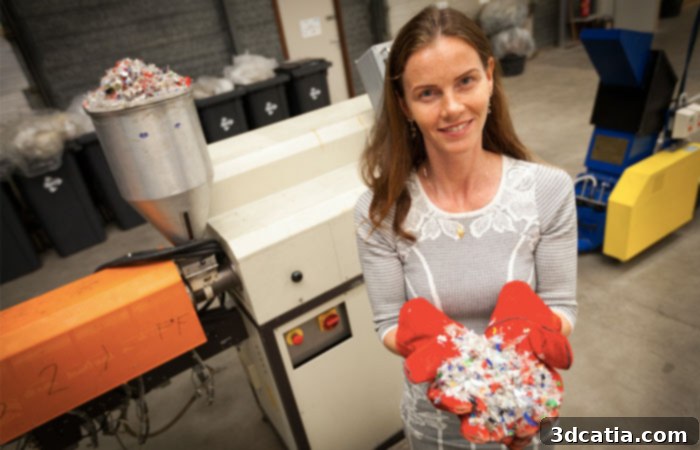
Willemijn Peeters, CEO of Searious Business, a leading voice against ocean plastic pollution.
This stark reality ignited our determination to do something impactful with this pervasive plastic waste. Our goal is to unequivocally demonstrate to the world that virtually anything, even something as complex and demanding as a yacht, can be meticulously crafted from recycled materials. The message is simple yet profound: if it’s possible to engineer and construct a functional yacht from discarded plastics, then the possibilities for other products are truly limitless. This project serves as a powerful symbol of what can be achieved when innovation meets environmental responsibility, pushing the boundaries of what we perceive as waste and transforming it into a resource for the future.
3DN: Why did Searious Business specifically choose to turn to 3D printing for this ambitious undertaking?
While there are numerous technologies capable of transforming plastic waste into a variety of new and intriguing products—such as twine, fabrics, and various structural elements—our decision to embrace 3D printing for this particular project was strategic and multifaceted. A core dilemma we constantly face is how to create truly durable and necessary items that genuinely serve societal needs, rather than simply generating more “stuff” that might inevitably end up contributing to the growing ocean waste problem. Searious Business has been actively collaborating with a diverse network of partners, diligently working to convert this discarded waste into high-value products that can re-enter the economy in a meaningful way.
However, we recognized that technology alone, no matter how advanced, isn’t sufficient to drive the systemic change required. We need to build significantly more momentum for widespread adoption and behavioral shifts. Our mission extends beyond technological solutions; it critically involves changing human behavior and fostering stronger partnerships with industrial companies. By integrating more responsible and sustainable packaging solutions into their operations, these companies can not only reduce their environmental footprint but also enhance their brand value, demonstrating a genuine commitment to sustainability.
To concretely illustrate our vision and the practical application of our approach, we partnered with the innovative company Lay3rs. They successfully 3D printed a highly detailed model of our ‘one-minute boat’ using recycled PET plastic. This physical representation served as a powerful testament to the viability of our concept. We proudly unveiled this model at the “Plastic Ocean” event, held last September at Eindhoven’s prestigious Parktheater. The reception was overwhelmingly positive, garnering significant attention and validating our belief in the potential of 3D printing as a transformative tool for plastic waste, showcasing how it can create both tangible products and inspire crucial dialogue around circular economy principles.
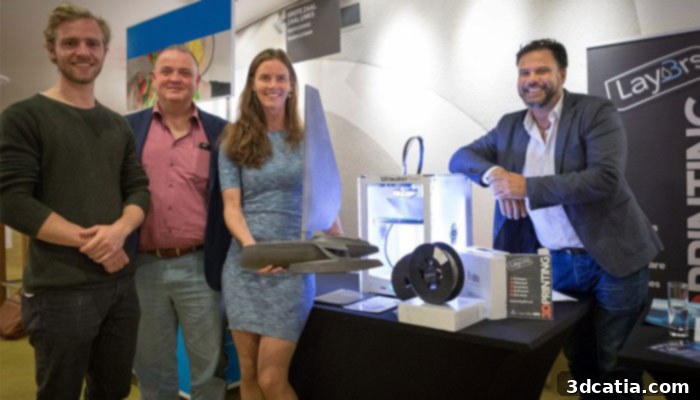
The striking model of the ‘one-minute boat,’ 3D printed by Lay3rs using recycled materials.
3DN: With such a promising start, what are the envisioned next steps for the 3D-printed sailboat project?
We possess the technological capabilities to quite literally flip the problem on its head. Instead of grimly envisioning countless plastic bottles submerging into our seas, we want the world to imagine a plastic bottle confidently sailing *on* the sea! Our immediate goal is to assemble a robust consortium of leading companies and experts, united by the shared vision of constructing a full-scale boat entirely from plastic waste. This ambitious undertaking will require diverse capabilities, bringing together specialists in waste handling and collection, advanced chemical processing to transform raw plastic waste into usable filaments, innovative weaving techniques for certain components, expertise in large-scale 3D printing, and naturally, profound knowledge in naval design and boat building. The synergy of such a consortium will be crucial in tackling the engineering challenges involved.
Once the consortium is established, the plan is to meticulously design and build a functional prototype. This prototype will serve as a tangible proof-of-concept, demonstrating the feasibility and durability of a vessel made from recycled materials. Following the successful creation of the prototype, we aim to strategically market the compelling idea of an international ocean race featuring these uniquely built recycled plastic boats. We envision approaching major global brands with strong environmental commitments, such as Coca-Cola and Unilever, to sponsor and participate in this groundbreaking event. There is nothing quite as effective as a competitive, high-profile event to capture the public imagination and stir up human passion and engagement for a worthy cause.
Symbolically, we envision this pioneering boat having a displacement of precisely 20,000 kilograms – representing the shocking amount of plastic entering our oceans every single minute. We intend to name it ‘One Minute’. This name carries a dual significance: it’s a stark reminder of the relentless pace of plastic pollution, but also a call to action. We would ask our sponsors and the public to simply ‘think for just one minute’ about the monumental scale of the problem and the potential for collective action. While a minute is a fleeting moment, if we can successfully crowd-fund this initiative and engage enough individuals to contribute their ‘one minutes’ – whether through financial support, advocacy, or volunteerism – these individual efforts will swiftly accumulate, creating a powerful wave of change that can truly make a difference.
3DN: Andrew, do you have any final words you’d like to share with our readers regarding this initiative?
Indeed. Our oceans, covering more than two-thirds of the Earth’s surface, are an intrinsic part of our shared heritage and literally embrace us all. The impact of plastic pollution transcends borders and affects every corner of our planet. Our proposed ocean race, featuring these recycled plastic vessels, would ideally circumnavigate the entire globe. This journey would serve as a powerful, live testament, spreading an urgent and unambiguous message: it’s time to collectively turn off the tap of waste flowing into our oceans. This isn’t just a race; it’s a global campaign for awareness, innovation, and ultimately, for the survival of our marine ecosystems and the health of our planet.
What are your thoughts on this inspiring initiative by Searious Business to combat plastic waste through 3D printing? We encourage you to share your perspectives and ideas in a comment below or join the conversation on our Facebook and Twitter pages! Don’t forget to sign up for our free weekly Newsletter to receive all the latest news, breakthroughs, and insights in the world of 3D printing directly in your inbox. Together, we can champion sustainable solutions and make a lasting impact.