
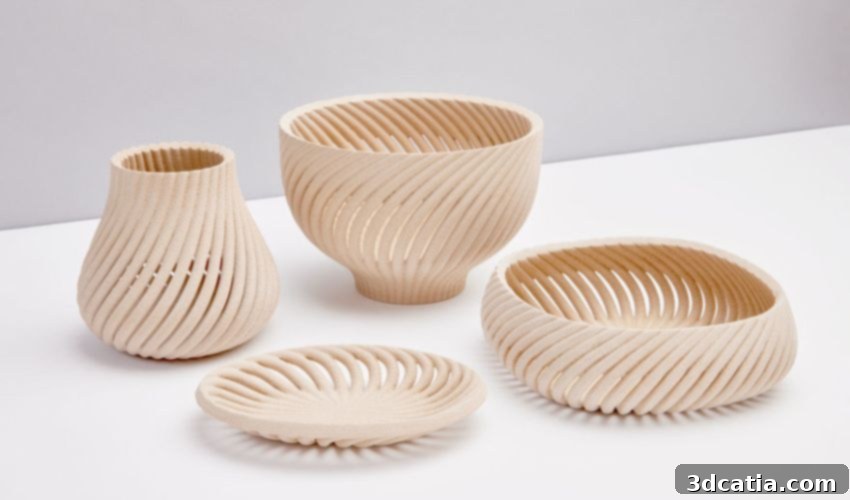
Forust 3D: Pioneering Sustainable Wood Manufacturing Through Advanced 3D Printing
In a world increasingly focused on sustainable practices, US-based Forust 3D stands at the forefront of innovation, dedicated to transforming the wood industry through high-volume, affordable, and reliable wood 3D printing. The company’s core mission revolves around leveraging the inherent efficiency and precision of the binder jetting process to create strong, lightweight, and visually appealing wood components. A key differentiator in their approach is the utilization of two ubiquitous wood waste materials – sawdust and lignin – as primary printing materials. This ingenious method not only revalues discarded resources but also positions Forust 3D as a significant contributor to responsible material value chains, ultimately paving the way for achieving net-zero carbon emissions in manufacturing.
The environmental impetus behind Forust 3D’s work is particularly profound. According to alarming company statistics, an estimated 15 billion trees are felled globally each year to meet the demands of paper production, housing construction, and furniture manufacturing. This extensive deforestation generates an staggering 84 million tons of wood waste sawdust annually. While a portion of this waste is currently recycled and repurposed into lower-value products like particleboard or wood pellets for energy generation, the vast potential for recycling these valuable byproducts remains largely untapped. Forust 3D recognizes this immense opportunity, seeing beyond mere waste disposal to unlock a future where wood waste can be transformed into high-quality, desirable products, offering previously unimagined possibilities for resource utilization and environmental conservation.
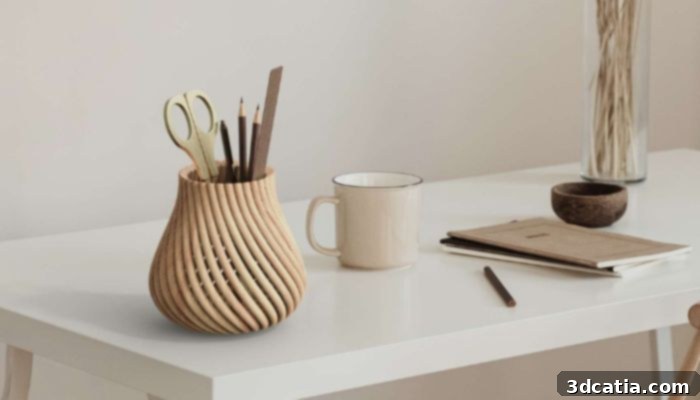
Photo Credits: Forust 3D – Showcasing innovative designs crafted from recycled wood materials.
Additive Manufacturing’s Role in a Circular Wood Economy
Forust 3D is at the vanguard of applying high-speed additive manufacturing techniques to grant these discarded natural resources a valuable second life. By harnessing advanced 3D printing, the company produces robust, aesthetically pleasing, and remarkably environmentally friendly wood products from what was once considered industrial waste. The pioneering manufacturing process at the heart of Forust 3D’s operations was initially developed by Desktop Metal, a leading entity in the additive manufacturing space, which recognized the immense potential and subsequently acquired Forust in 2021. This strategic acquisition propelled the technology forward, solidifying its foundation on using industrial sawdust waste as a versatile 3D printing material for mass production across diverse sectors. From bespoke furniture and architectural elements to consumer goods and even luxury car interiors, Forust 3D is redefining what’s possible with wood, opening up new avenues for sustainable design and manufacturing on an industrial scale.
The Binder Jetting Advantage: Precision, Scale, and Sustainability
The backbone of Forust 3D’s production capabilities lies in its deployment of both small and large format binder jetting printers. This strategic utilization of varied printer sizes grants the company unparalleled flexibility, enabling the production of items across a vast spectrum of scales. Smaller printers are ideally suited for rapid prototyping and batch production of specialized or custom items, while the larger industrial-grade machines are engineered for high-volume, mass production, meeting the demands of large-scale manufacturing projects. The binder jetting process itself is elegantly simple yet incredibly effective. It commences with the precise application of fine sawdust particles onto a build plate, forming a thin layer. Subsequently, the machine’s advanced inkjet nozzles meticulously traverse over this material, strategically distributing lignin – a natural polymer found in wood – which acts as both a powerful binder and an ink to achieve desired visual effects, including intricate wood grain patterns. This intelligent use of lignin is one of the most remarkable and environmentally beneficial features of Forust 3D’s printing process. Crucially, it eliminates the need for additional synthetic adhesives, as the lignin inherently present in the wood waste serves as the binding agent, further enhancing the eco-friendliness and natural composition of the final product.
This innovative approach to material science and additive manufacturing allows Forust 3D to create products that are not only structurally sound but also possess an authentic wood aesthetic. By leveraging lignin and sawdust, the process ensures that the resulting material is truly a composite of natural wood, maintaining the desirable properties of wood while circumventing many of the traditional manufacturing limitations. This commitment to using natural waste products minimizes the environmental footprint, reduces reliance on virgin resources, and actively contributes to a circular economy, demonstrating a viable pathway towards genuinely sustainable industrial practices.
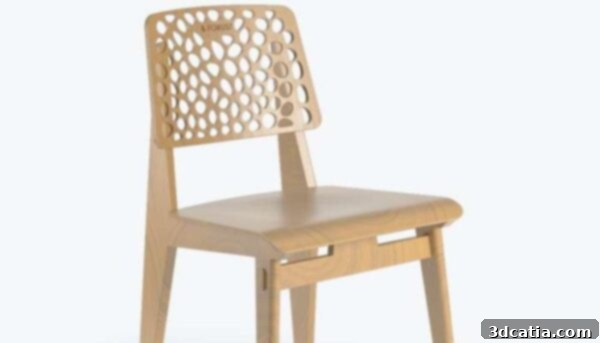
Photo Credits: Forust 3D – Demonstrating the realistic wood grain simulation achieved through 3D printing.
Unleashing Design Freedom and Aesthetic Excellence with 3D Printed Wood
Forust 3D’s binder jetting process offers more than just sustainable material usage; it unlocks unprecedented capabilities in design and aesthetics. The technology provides the ability to print not only perfectly grainless, smooth wood surfaces for a modern, minimalist look but also to implement a groundbreaking technology that realistically simulates authentic wood grain patterns throughout the entire product. This advanced simulation capability can make the final 3D-printed wood product virtually indistinguishable from natural wood, offering the warmth and texture sought after in traditional woodworking without the associated environmental costs or manufacturing constraints. This particular feature holds immense appeal for designers, architects, and product developers. It empowers them to conceive and create complex organic shapes, intricate geometries, and highly customized designs that would be exceedingly difficult, prohibitively expensive, or even entirely impossible to achieve using conventional wood manufacturing techniques. The freedom to manipulate wood at a granular level opens up a new frontier for creativity, allowing for truly unique and innovative products that push the boundaries of form and function in furniture, art, and industrial design.
Beyond aesthetics, this technological leap contributes significantly to functional design. Components can be engineered with internal structures optimized for strength-to-weight ratio, or with features that facilitate assembly or integration into larger systems. This precise control over material deposition and internal architecture is a hallmark of additive manufacturing, and Forust 3D has masterfully adapted it for wood. The ability to create complex internal structures while maintaining an authentic wood exterior means that products can be lighter, stronger, and more efficient in their material use. This represents a paradigm shift for industries that rely on wood, offering a path to reduce material waste, simplify supply chains, and enable on-demand manufacturing of highly customized parts.
Forust 3D’s innovation marks a pivotal moment in both additive manufacturing and sustainable resource management. By transforming wood waste into valuable, high-performance products, the company is not only addressing critical environmental challenges but also demonstrating the vast potential of a circular economy. This visionary approach showcases how technological advancements, when aligned with ecological responsibility, can create new industries, foster design ingenuity, and build a more sustainable future for manufacturing worldwide.
What are your thoughts on Forust 3D’s groundbreaking innovation and its potential impact on sustainable manufacturing? We’d love to hear your perspective! Let us know in a comment below or join the conversation on our LinkedIn, Facebook, and Twitter pages! Don’t forget to sign up for our free weekly Newsletter here to receive the latest 3D printing news straight to your inbox! You can also find all our compelling videos on our YouTube channel for more insights into the world of additive manufacturing.
*Cover Photo Credits: Forust 3D – Highlighting the aesthetic and environmental benefits of 3D printed wood products.