

Revolutionary Ultrastrong Titanium Alloy Developed by Monash University Through Advanced 3D Printing
In the dynamic landscape of modern manufacturing, continuous research and development into advanced materials stand as a cornerstone of innovation. This is particularly true for high-stakes sectors like aerospace, automotive, and biomedical engineering, where the demand for materials that are simultaneously lightweight and exceptionally strong is paramount for critical component fabrication. The field of material research, specifically tailored for additive manufacturing (AM) processes, is experiencing exponential growth, driving breakthroughs that were once thought impossible. In a significant development, engineers at Monash University have recently leveraged cutting-edge 3D printing techniques to engineer an ultra-strong commercial titanium alloy, paving the way for groundbreaking applications across a multitude of essential industries.
Titanium, renowned for its exceptional strength and corrosion resistance, has long been a material of choice for demanding end-use parts. However, the true marvel often lies in its alloys. Titanium alloys, formed by blending titanium with other metals, offer a tailored suite of enhanced properties, including superior flexibility, remarkable strength, and improved malleability. Their unparalleled strength-to-weight ratio makes them incredibly valuable, especially where mass reduction is critical without compromising structural integrity. Despite their current high performance, the quest to further improve these alloys is ceaseless. This ongoing pursuit for material excellence was highlighted in the groundbreaking study titled “Ultrastrong nanotwinned titanium alloys through additive manufacturing.” In this research, the dedicated team of engineers demonstrated how the strategic application of additive manufacturing could yield a titanium alloy boasting the highest specific strength (strength-to-weight ratio) ever recorded for this class of material, setting a new benchmark in advanced metallurgy.
Titanium, both in its pure and alloy form, is used for applications in a variety of fields including aerospace thanks to its high strength-to-weight ratio (photo credits: Lupus in Saxonia, CC BY-SA 4.0 , via Wikimedia Commons)
Harnessing Additive Manufacturing for Superior Titanium Alloys
Developing advanced titanium alloys is, by no means, a simple or straightforward endeavor. It typically necessitates a series of intricate and energy-intensive techniques, such as precision casting and elaborate thermomechanical processing. These conventional methods are often time-consuming and costly, presenting significant barriers to rapid innovation and widespread adoption. While 3D printing has been explored for manufacturing parts and even custom alloys, commercially available alloys produced through these methods have frequently fallen short of desired mechanical properties. This challenge spurred the researchers at Monash University, led by the distinguished Professor Aijun Huang and Dr. Yuam Zhu, to pioneer a novel approach. By expertly utilizing 3D printing, they were able to precisely manipulate the microstructure of a commercial titanium alloy, achieving an unprecedented level of mechanical performance that far surpasses traditional methods and previous additive manufacturing attempts.
The innovative methodology employed by the Monash team centered on leveraging the unique characteristics of additive manufacturing to exploit phenomena like thermal cycling and rapid solidification. This precise control over the material’s thermal history during the printing process was key to unlocking its hidden potential. Specifically, the β-titanium alloy, known commercially as Beta-C, with a precise composition of Ti-3.63Al-8.03V-6.02Cr-4.03Mo-4.00Zr (in weight percent), was selected for this study. Powders of this commercial alloy were meticulously melted and deposited layer by layer using laser powder bed fusion (LPBF). This advanced 3D printing technique allowed for exquisite control over the solidification process. Following the printing phase, the resulting specimens were subjected to a targeted post-heat treatment at two distinct temperatures. This carefully calibrated thermal processing further refined the alloy’s internal structure. Rigorous testing subsequently confirmed that this additive manufacturing and post-treatment strategy significantly enhanced the strength of the titanium alloys. The researchers are optimistic that this revolutionary approach could be generalized and applied to a broad spectrum of titanium alloys, yielding similar improvements in mechanical properties across the board.
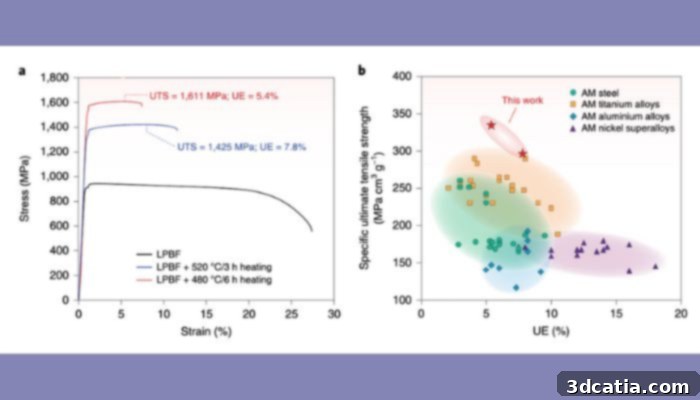
The tensile mechanical response of commercial Beta-C titanium alloys produced by LPBF and post-heat treatments (photo credits: Monash University)
Elaborating on the profound implications of their findings, Professor Huang stated, “Traditionally, achieving the exceptionally high strengths required for certain critical applications in titanium alloys has demanded complex casting and laborious thermomechanical processing. Our research has revealed that additive manufacturing, through its inherently unique processing capabilities, can create ultrastrong and remarkably thermally stable parts directly from commercial titanium alloys. This means these components can potentially be implemented into service with minimal further modification.” He further emphasized the striking performance metrics achieved: “Following a straightforward post-heat treatment applied to a readily available commercial titanium alloy, we have successfully attained adequate elongation combined with tensile strengths exceeding an astounding 1,600 MPa. This represents the highest specific strength recorded among all 3D printed metals to date.” This monumental achievement is largely attributed to the successful engineering of novel, ultrafine microstructures within the alloy, including beneficial nanotwins, which effectively impede dislocation movement and enhance overall strength. Professor Huang concluded, “This groundbreaking work not only establishes a new benchmark but also fundamentally paves the way for fabricating structural materials with previously unattainable unique microstructures and exceptional properties, opening up vast possibilities for broad industrial applications.”
The ramifications of this research extend far beyond the immediate development of a stronger titanium alloy. The Monash team anticipates that their detailed findings will offer invaluable insights into the fundamental principles of strengthening mechanisms and dislocation engineering within the broader field of physical metallurgy. Understanding how these intricate microstructures contribute to such extraordinary mechanical performance will undoubtedly accelerate future materials innovation. Furthermore, a significant practical advantage of this new method is its cost-effectiveness. By combining 3D printing with a relatively simple post-heat treatment, the overall processing cost for producing materials with comparable strength is drastically reduced when compared to traditional, more complex manufacturing routes. This cost reduction, coupled with enhanced performance, positions this technology as a game-changer for industries requiring high-performance, lightweight components. The full details of this pioneering research can be accessed by downloading the complete paper HERE, providing an in-depth look at the scientific methodology and results.
What are your thoughts on this exciting development in titanium alloy manufacturing? Do you foresee this impacting the aerospace or medical industries significantly? Share your perspectives in a comment below or engage with us on ourLinkedIn,Facebook, andTwitter pages! And to stay abreast of the latest advancements in additive manufacturing, don’t forget to sign up for our free weeklyNewsletter here, delivering the most current 3D printing news directly to your inbox! For more visual content, explore all our videos on our dedicatedYouTube channel.
*Cover Photo Credits: Monash University