

Revolutionizing Copper 3D Printing: How Green Laser Technology Unlocks New Possibilities in Additive Manufacturing
Metal additive manufacturing (AM), commonly known as metal 3D printing, is rapidly transforming industries across the globe. From aerospace and marine to electronics and automotive, this innovative technology enables the creation of highly complex, lightweight, and incredibly durable parts that were previously impossible to produce with traditional manufacturing methods. Among the vast array of metals, copper stands out as an indispensable material due to its exceptional properties. Renowned for its excellent electrical and thermal conductivity, impressive resistance to atmospheric and marine corrosion, high ductility, and significant toughness, copper is one of the most widely utilized metal materials in modern engineering and technology.
Despite copper’s superior characteristics, manufacturing components from it, especially through additive manufacturing techniques like traditional Laser Powder Bed Fusion (LPBF), presents significant hurdles. Pure copper inherently possesses a very low absorption rate for infrared lasers – typically less than 10%. This fundamental material property creates a major impediment for conventional LPBF systems that rely on infrared wavelengths. To compensate for this low absorption, high-power infrared lasers are often employed, but this approach frequently leads to excessive vaporization and material spattering. These undesirable effects critically compromise the quality and integrity of the final printed part, resulting in reduced material density, increased porosity, and diminished thermal and electrical conductivity, thereby undermining the very reasons copper is chosen. Furthermore, the high reflectivity of copper, often exceeding 90% for infrared light, poses a substantial risk of damaging the delicate optical components of the 3D printer, leading to costly maintenance and downtime.
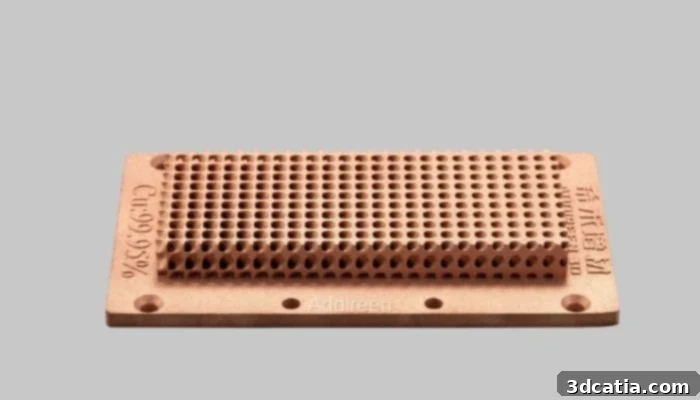
IGBT Heat Sink Copper Base Plate, Pure Copper
It is precisely these long-standing challenges that Addireen, a pioneering Chinese manufacturer, has decisively addressed. By leveraging cutting-edge green laser technology, Addireen’s industrial metal 3D printers are capable of overcoming the inherent limitations associated with infrared lasers when processing highly reflective materials like copper. Their advanced machines can consistently produce pure copper parts with an astonishing density of 99.8% and achieve a minimum wall thickness of just 0.08mm. This remarkable precision and material quality represent a significant leap forward, drastically enhancing the performance and design possibilities of copper components and truly unlocking copper’s full potential in metal additive manufacturing.
The Unparalleled Advantages of Green Laser Technology in Additive Manufacturing
The fundamental difference that sets green laser technology apart lies in its interaction with highly reflective metals. A green laser, operating at a shorter wavelength compared to an infrared laser, exhibits a significantly higher absorption rate on copper and its alloys. This enhanced absorption is critical for efficient and stable melting of the material. As illustrated in the provided graph depicting absorption rates, green lasers are demonstrably more effective at melting not only copper but also other highly reflective and thermally conductive materials such as gold and platinum. Consequently, LPBF technology based on green lasers can achieve unparalleled quality and efficiency in the 3D printing of pure copper and various copper alloys.
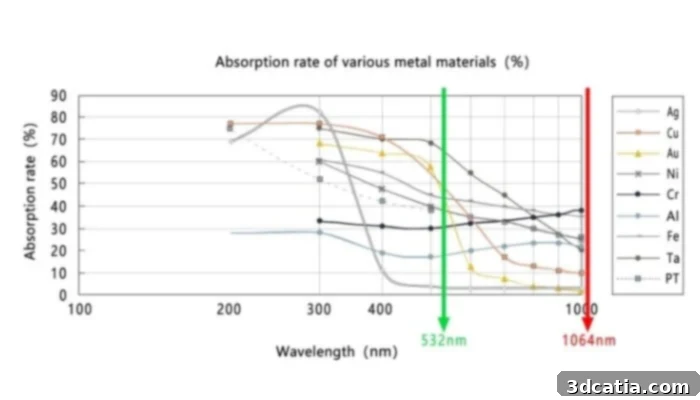
Absorption rate of different metals
Addireen’s commitment to innovation is exemplified by its adoption of high-power, single-mode continuous fiber green lasers. These sophisticated lasers offer a suite of advantages that collectively contribute to superior additive manufacturing outcomes. The shorter wavelength of green light fundamentally alters how the laser energy is absorbed by the material, leading to a more stable and controlled melt pool. Coupled with high beam quality and exceptional stability, these lasers produce finer focused spots, which in turn enable greater forming efficiency and superior part quality. This translates into higher printing resolution, allowing for the creation of intricate designs and components with exceptionally fine features. Furthermore, the inherent characteristics of green lasers provide a significantly larger process window for the additive manufacturing of pure copper, copper alloys, gold, and platinum, making the process more robust and reliable. Beyond these benefits, green laser 3D printing substantially expands the range of materials that can be successfully processed using LPBF technology, opening new avenues for advanced material development and application.
To concretize these advancements, Addireen has introduced a series of green laser metal 3D printing devices, including the XH-M160G, M350G, and M100G. These machines are engineered to deliver high-efficiency, high-quality, and high-precision 3D printing specifically for pure copper parts. The metallographic images of printed pure copper parts consistently demonstrate a dense, uniform microstructure, indicative of the superior material properties achieved. These components exhibit the capability to withstand water pressures greater than 5 MPa, boast electrical conductivity close to 100% IACS (International Annealed Copper Standard), and possess a thermal conductivity of approximately 390 W/(m·K). Such values are on par with, or even exceed, those of conventionally manufactured copper. A truly impressive feature is the ability to achieve a minimum wall thickness of just 0.08 mm, enabling unprecedented design freedom for lightweight structures and highly efficient heat exchange geometries.
Metallographic Image of Pure Copper Printed Parts
Transforming Industries with Green Laser Copper Additive Manufacturing
The practical implications of Addireen’s green laser metal 3D printing equipment are far-reaching, with wide adoption already seen across critical industries. In **aerospace**, the technology enables the production of complex, lightweight components like advanced engine nozzles (such as those printed in CuCrZr), heat exchangers with intricate internal cooling channels, and other mission-critical parts where thermal management and weight reduction are paramount. For **new energy vehicles (NEVs)**, this innovation is vital for manufacturing high-performance battery cooling plates, optimized busbars, and efficient charging components that demand high electrical and thermal conductivity combined with complex geometries for space optimization.
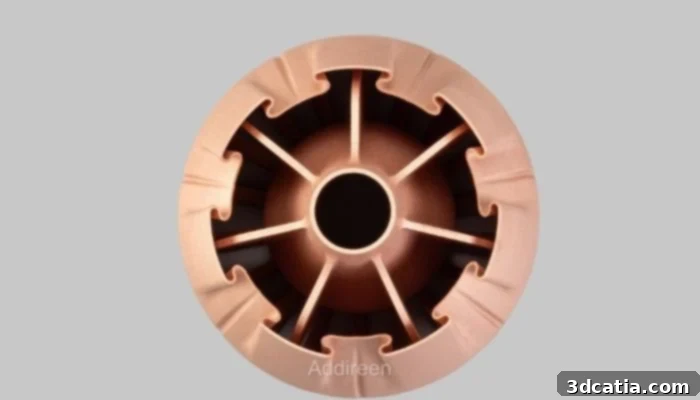
Engine nozzle model printed in CuCrZr
The **semiconductor industry** benefits immensely from the ability to produce highly efficient heat sink components with incredibly fine features, crucial for managing the intense heat generated by modern, high-performance chips. Similarly, in **induction heating coils**, the precision and design freedom offered by green laser AM allow for optimized coil geometries with integrated cooling channels, significantly improving efficiency and lifespan. Lastly, for **high-speed communication devices**, where miniaturization and efficient thermal management are key, copper parts with precise internal structures and excellent conductivity are essential for components like RF antennae and waveguides.
Addireen: A Pioneer in Advanced Metal Additive Manufacturing Solutions
Established in 2023, Addireen has swiftly emerged as a trailblazer, pioneering green laser-based metal 3D printing in China. The company’s success is underpinned by a highly experienced team with nearly 18 years of expertise in advanced laser technologies. This deep technical knowledge has enabled them to develop sophisticated short-wavelength and multi-wavelength laser systems, specifically engineered for the precise printing of not only highly reflective metals like copper, gold, and platinum, but also refractory metals and conventional alloys. This broad capability positions Addireen as a versatile partner for a wide range of industrial applications.
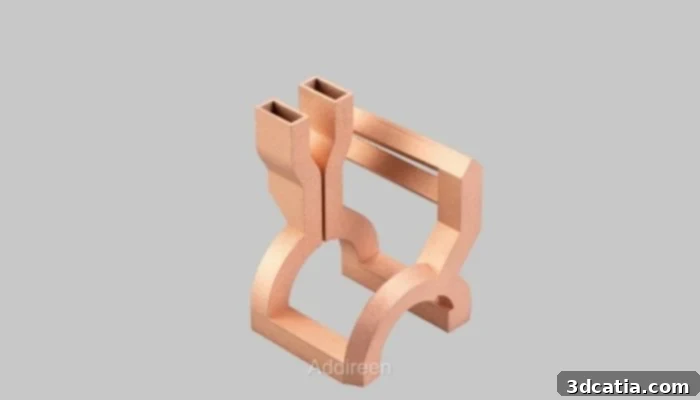
High-Frequency Induction Heating Coil, Pure Copper
Addireen offers a portfolio of three distinct machine models, each equipped with their advanced green laser technology. These systems consistently deliver parts with 99.8% density and an impressive minimum wall thickness of 0.08mm. The print volumes provided by these machines are varied, ranging from a compact Ø100 x 100mm to a substantial 350 x 350 x 500mm, designed to meet diverse industrial needs, from prototyping to mass production. For instance, the XH-M100G is ideally suited for printing precious metals such as silver, gold, and platinum, achieving incredibly fine laser spot sizes as small as 15 microns. This level of precision is crucial for intricate structures often found in jewelry or specialized electronics. Conversely, the M350G model is specifically designed for high-volume production, offering a larger build envelope to maximize throughput and efficiency for industrial-scale applications.
The efficacy and reliability of Addireen’s green laser solutions have been rigorously tested and successfully adopted across numerous critical sectors. Their technology is actively contributing to advancements in aerospace, enhancing the performance and efficiency of aircraft components. In the energy sector, Addireen’s solutions are pivotal for new applications requiring high conductivity and complex geometries. The communications industry leverages these systems for next-generation devices, while the transportation sector benefits from improved component design and functionality in both traditional and new energy vehicles. This broad adoption underscores the transformative impact of green laser metal 3D printing.
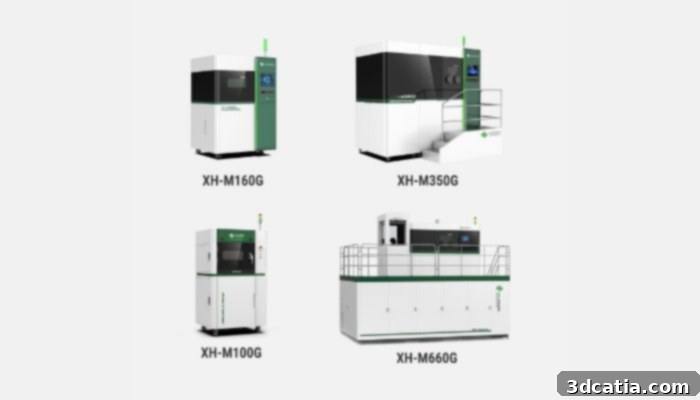
The range of solutions from Addireen
Addireen succinctly summarizes the monumental shift brought about by their technology: “Green laser 3D printing not only enables efficient and high-quality printing of pure copper and copper alloys but also fundamentally expands the range of materials that can be printed using LPBF technology. It provides an ideal solution for highly reflective and difficult-to-melt materials, while also enabling more efficient and precise printing of conventional metal materials.” This statement encapsulates the core value proposition of green laser technology – a pathway to advanced material processing and manufacturing capabilities previously unattainable. To delve deeper into Addireen’s innovative solutions and explore their full potential, you can find more information HERE.
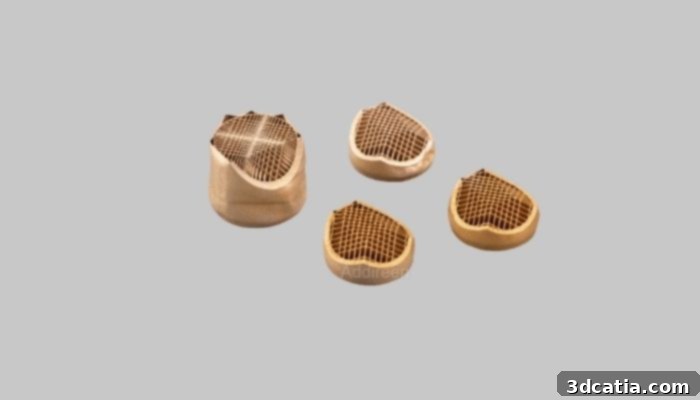
Ultra-Thin Wall Heat Dissipation Fins printed in CuSn10
What are your thoughts on Addireen’s groundbreaking green laser solutions and their impact on metal additive manufacturing? We invite you to share your insights in a comment below or join the discussion on our LinkedIn, Facebook, and Twitter pages! Don’t miss out on the latest advancements and sign up for our free weekly Newsletter here, delivering the most current 3D printing news straight to your inbox! You can also explore all our informative videos on our YouTube channel for more in-depth content.
*Credits of all the pictures: Addireen