

Unveiling China’s Dominance: A Deep Dive into the Additive Manufacturing Market
In recent years, the global landscape of additive manufacturing has witnessed an undeniable and significant surge in Chinese participation. This growth is particularly evident with the emergence of numerous manufacturers offering a diverse range of 3D printing solutions, from highly accessible, small-scale FDM (Fused Deposition Modeling) machines tailored for individual users and educational institutions, to more robust industrial systems capable of processing advanced, high-performance thermoplastics. China’s strategic focus and inherent manufacturing prowess have positioned it as an exceptionally promising market for 3D printing technology, a fact underscored by robust statistical data.
According to a comprehensive study published by the International Data Corporation (IDC), China currently commands a substantial 12.9% of global spending in the additive manufacturing sector. In 2019 alone, the country’s investment in this burgeoning industry was estimated at a remarkable $2.9 billion, encompassing expenditures across machinery, materials, specialized software, and related services. More impressively, the IDC firm projects China to be the fastest-growing nation in the 3D printing market over the next five years, forecasting an astounding annual growth rate of 21.6%. Such aggressive growth trajectories highlight the critical importance of understanding the key players and dynamics within this vibrant market. This article aims to provide an insightful overview of China’s principal 3D printer manufacturers, examining their contributions across all prominent additive manufacturing technologies.
A compelling indicator of China’s manufacturing strength in this domain is the fact that an estimated 48% of the country’s current 3D printing revenues are generated directly from the sale of 3D printers themselves. This figure stands in stark contrast to other major markets, where hardware sales constitute a smaller portion of overall revenue (e.g., 37% for Europe and 33% for the United States). This emphasizes that Chinese manufacturers are not merely consumers but essential producers and innovators driving the global market forward. Our extensive research has identified 24 primary players within this ecosystem, encompassing a broad spectrum of offerings. This includes manufacturers specializing in accessible desktop solutions, such as Anet3D, renowned for its small, budget-friendly kit machines, alongside industrial powerhouses like IEMAI 3D and INTAMSYS, whose sophisticated machines are engineered for compatibility with demanding, high-performance thermoplastics crucial for advanced applications.
Geographical analysis reveals a clear concentration of these manufacturers. Unsurprisingly, the vast majority are strategically located in eastern China, a region that hosts the bulk of the nation’s population and industrial infrastructure. Specifically, the provinces of Guangdong and Shanghai collectively account for an impressive 50% of the manufacturers we have identified in the infographic below, cementing their status as key innovation hubs for additive manufacturing.
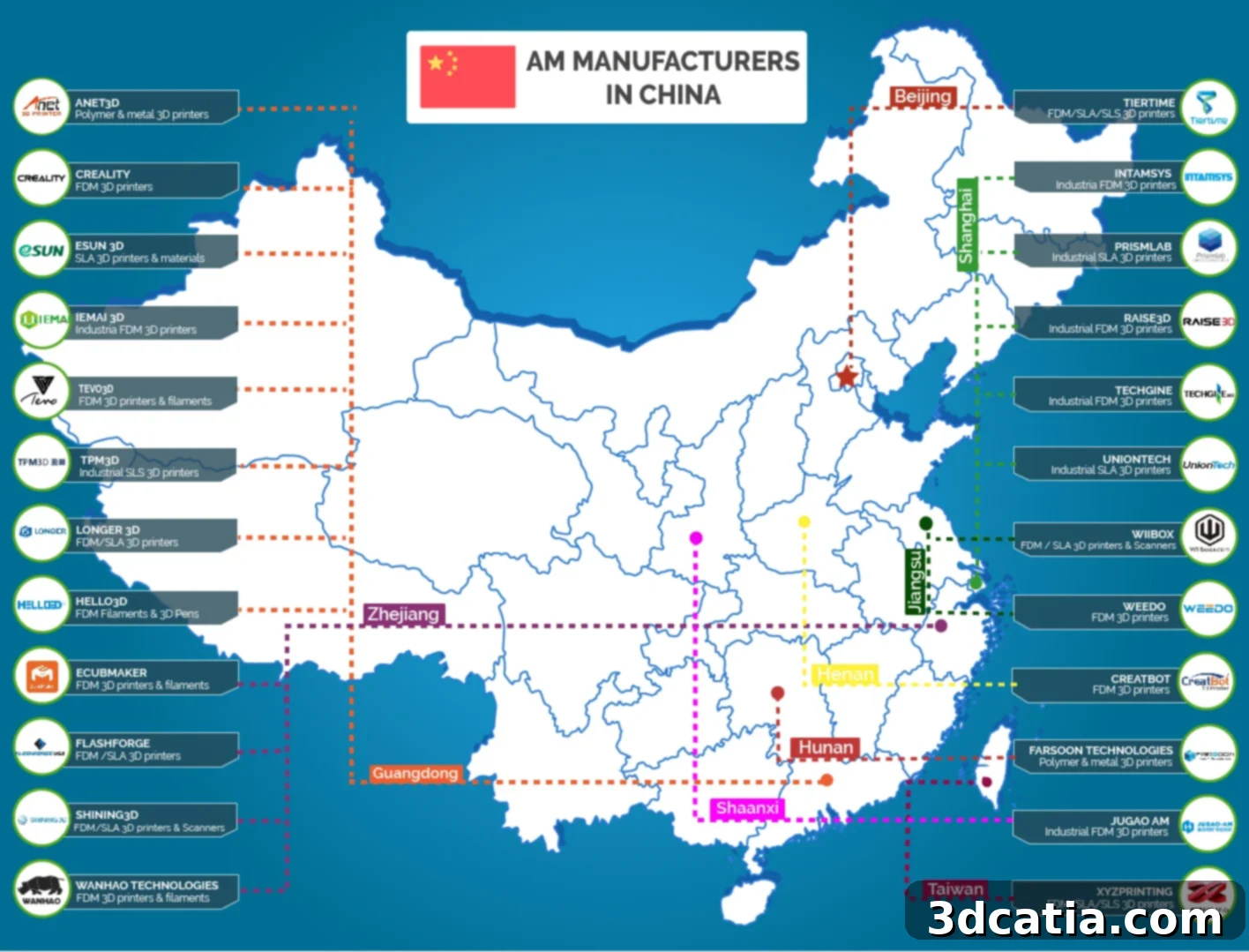
A closer look at the technological focus of these companies shows that the majority specialize in FDM (Fused Deposition Modeling) and/or SLA (Stereolithography) 3D printing solutions. These technologies cover a wide range of applications, from personal desktop use to rigorous industrial environments. Prominent historical players in this space include well-established companies such as Shining3D, Wanhao, Raise3D, and Flashforge, all of whom have contributed significantly to the maturation of the Chinese 3D printing market. The market is particularly characterized by the availability of a wide array of very affordable Chinese solutions, with many entry-level kit machines priced well under $500. The phenomenal success of brands like Creality, with its Ender series, and Tevo 3D, exemplifies this trend towards accessible and user-friendly hardware. Furthermore, China has long placed a strong emphasis on the education sector, actively encouraging schools and universities to integrate small office-grade 3D printers directly into their classrooms and curricula, fostering a new generation of users and innovators.
While FDM and SLA dominate in sheer numbers, the market for Selective Laser Sintering (SLS) 3D printers in China, though smaller, is critically important and seeing significant innovation. In this segment, it’s impossible to overlook the pioneering efforts of Farsoon Technologies, a company that has developed a comprehensive industrial range of SLS machines, establishing itself as a global leader. Beyond Farsoon, a few other companies are beginning to make inroads into this specialized market. Notably, XYZprinting, based in Taiwan, broadened its portfolio by announcing new industrial SLS solutions, signaling a growing interest and investment in this high-precision technology.
Beyond polymer-based printing, the landscape of metal 3D printer manufacturers is also evolving in China, with notable players like Farsoon Technologies (which also offers metal solutions) and Weedo contributing to this advanced segment. The IDC report further corroborates this trend, predicting a rising number of sophisticated metal 3D printing solutions being developed across China, particularly in powder bed fusion systems. This development is excellent news for critical sectors such as aerospace and defense, which represent the two largest users of 3D printing technology within China. The increased availability of advanced metal additive manufacturing capabilities will enable these industries to design and produce complex, high-performance finished parts more efficiently and rapidly, directly impacting national innovation and competitiveness.
Charles Han, CEO and co-founder of INTAMSYS, a leading Chinese manufacturer of high-performance 3D printers, elaborates on this potential, stating: “China has the largest manufacturing volume in the world. Our active development in certain sectors, such as aerospace and automotive, as well as the increasingly personalized demands of consumers, will lead to a much greater demand for the Chinese additive manufacturing market.” This perspective underscores the unique confluence of a vast existing manufacturing base and rapidly evolving consumer and industrial needs driving the market forward.
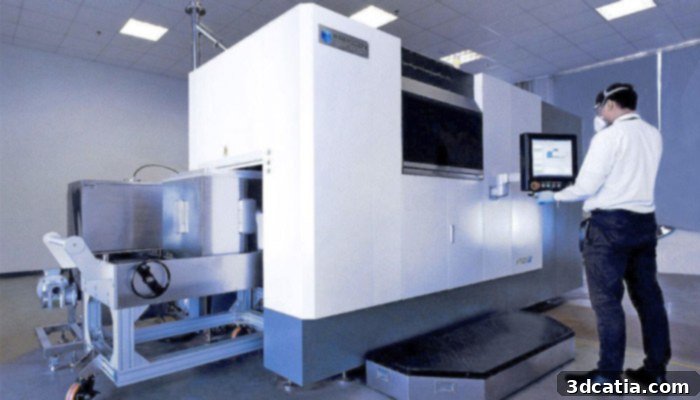
Farsoon Technologies is a prominent player offering both SLS solutions and metal 3D printers, showcasing broad capabilities in industrial additive manufacturing.
Given these dynamic market conditions and the rapid pace of technological development, it is highly probable that we will see additional key players emerge and expand their operations, warranting updates to our manufacturer infographic in the coming year. Anthony Huang, Director of XYZprinting China, provides further insights into the distinctive characteristics of this market:
“The Chinese market exhibits a huge demand that is not typically found in other countries. As a direct result, significant capital investments from the government, private companies, and research institutes will undoubtedly accelerate the pace of the 3D printing industry in China. Furthermore, the country benefits from a mature and highly efficient production and related supply chain, which will propel the development of 3D printing to a high level of intelligent manufacturing. This unique combination of factors is considerably more difficult to replicate in other countries.”
This expert opinion highlights China’s strategic advantages, including robust government backing and an unparalleled industrial ecosystem. Moreover, the findings of a study recently published by EY further validate this promising trend: the adoption rate of additive manufacturing by Chinese companies reached an impressive 78% in 2019. This places China as the second-largest adopter of 3D technologies globally, trailing only South Korea, which recorded an 81% adoption rate, cementing China’s critical role in the global shift towards advanced manufacturing paradigms.
In conclusion, China’s additive manufacturing market is not just growing; it is profoundly shaping the global industry. With a potent combination of ambitious innovation, strategic investment, a vast manufacturing base, and high adoption rates, China is set to continue its ascent as a dominant force in 3D printing, driving both technological advancements and market expansion worldwide.
What are your thoughts on the hardware additive manufacturing market in China and its global implications? We invite you to share your insights in a comment below or join the discussion on our Facebook and Twitter pages! Don’t forget to sign up for our free weekly Newsletter to receive all the latest news and updates in 3D printing delivered directly to your inbox!