
Weekly 3D Printing Innovations: Discover Top Additive Manufacturing Breakthroughs and Their Impact
Welcome to our weekly roundup of the most groundbreaking developments in the world of 3D printing and additive manufacturing! Each week, we scour the landscape of technological innovation to bring you the top five videos showcasing incredible advancements. These aren’t just fascinating clips; they represent significant strides in various fields, from healthcare to industrial production, and even personal safety. Our goal is to highlight how 3D printing continues to redefine possibilities, offering solutions that were once considered science fiction. We invite you to explore these exciting innovations, share your thoughts in the comments below, or engage with us on 3Dnatives’ Facebook or Twitter account. Prepare to be inspired by the relentless pace of progress in additive manufacturing!
Top 1: Revolutionizing Breast Cancer Treatment with 3D Printing
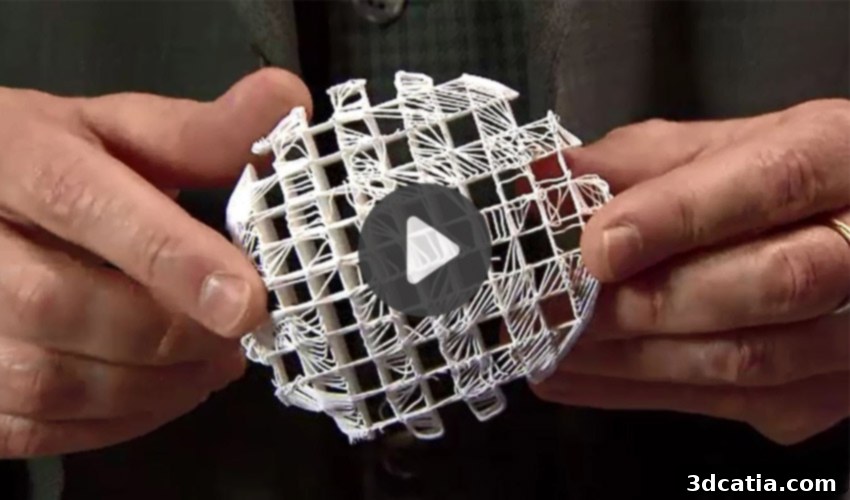
One of the most profound applications of 3D printing technology is its potential to transform medical treatments, and this week’s top innovation offers a beacon of hope for breast cancer patients. In Australia, researchers are pioneering a novel approach to breast reconstruction using 3D printed scaffolds, making treatments more effective and potentially less invasive. A dedicated professor from the University of Queensland has been instrumental in this breakthrough, creating personalized 3D printed scaffolds that perfectly match the patient’s breast shape. These sophisticated structures are designed to be implanted into the body, where they are then filled with the patient’s own stem cells. The stem cells work in conjunction with the scaffold to gradually rebuild the breast tissue, aiming for a more natural and integrated reconstruction compared to traditional methods.
This innovative solution holds immense promise. It has already undergone successful testing on animals, demonstrating its viability and potential for human application. Experts anticipate that this technology could be available for clinical use within the next four years, marking a significant leap forward in personalized medicine and regenerative therapies. The ability to create patient-specific implants not only enhances the aesthetic outcome but also minimizes the risks associated with conventional surgical procedures. This initiative aligns with other cutting-edge efforts in the medical field, such as the development of advanced robotic tools for treating breast cancer, showcasing how additive manufacturing is at the forefront of healthcare innovation.
Top 2: The Future of Cycling Safety: Customizable 3D Printed Helmets
Safety equipment is undergoing a quiet revolution thanks to 3D printing, and nowhere is this more evident than in the realm of cycling helmets. A talented group of students from the University College of London (UCL) has unveiled a groundbreaking new 3D printed helmet design that promises to redefine cyclist protection. This isn’t just an incremental improvement; it’s a fundamental reimagining of helmet construction, moving beyond the limitations of traditional manufacturing methods that have dominated the industry since the 1960s.
The core innovation lies in the helmet’s unique honeycomb structure, meticulously engineered through additive manufacturing. This advanced internal lattice is specifically designed to optimize energy absorption during an impact, providing superior protection compared to conventional foam liners. Furthermore, the power of 3D printing allows for unparalleled customization: each helmet can be precisely tailored to the individual cyclist’s head shape. This personalized fit not only enhances comfort but critically improves safety by ensuring maximum contact and support, thereby distributing impact forces more effectively. The lightweight nature of 3D printed materials, coupled with the optimized internal geometry, also contributes to a lighter helmet without compromising structural integrity.
For cyclists, this breakthrough represents a significant leap forward. It addresses long-standing issues of fit, ventilation, and overall protection, offering a truly revolutionary piece of gear. As awareness of cycling safety grows, these customized, high-performance 3D printed helmets could become the new standard, providing unprecedented levels of protection and comfort for riders everywhere. This student-led project is a testament to the transformative potential of 3D printing in developing safer, more efficient personal protective equipment.
Top 3: Boosting Foundry Efficiency with Robotic Additive Manufacturing
In the industrial sector, particularly within the challenging environment of foundries, speed, precision, and efficiency are paramount. Traditional methods for creating molds and cores can be time-consuming, labor-intensive, and limited in design complexity. This week, we highlight a significant advancement in industrial additive manufacturing that directly addresses these challenges: the Robotic Additive Manufacturing system developed through a powerful collaboration between Viridis3D and EnvisionTec.
This innovative system integrates a highly capable ABB industrial robot, known for its precision and versatility, with a specialized print head designed by these pioneering companies. The operational principle involves the print head accurately projecting a mixture of sand and a powdered binder. Through a sophisticated layer-by-layer process, this combination rapidly creates intricate and robust parts specifically for the foundry industry. This binder jetting process allows for the production of complex sand molds and cores directly from CAD data, eliminating the need for traditional pattern making, which can be both expensive and time-consuming.
The advantages of this robotic additive manufacturing system are substantial. It significantly accelerates the production cycle, enabling foundries to create finished parts much faster than with conventional methods. Furthermore, the automation provided by the ABB robot ensures consistent quality and allows for the fabrication of geometries that would be impossible or prohibitively expensive to produce with traditional tooling. This leads to greater design freedom, reduced lead times, and ultimately, a more efficient and cost-effective production workflow for metal casting operations. By embracing robotic additive manufacturing, the foundry industry is poised for a major overhaul, moving towards a future of agile and highly precise manufacturing processes. The video below offers a compelling look at this cutting-edge technology in action, demonstrating its seamless operation and impressive capabilities.
Top 4: Enhancing Patient Recovery with Flexible 3D Printed Orthotics
For patients requiring orthotic devices, comfort, custom fit, and efficacy are critical for successful recovery and improved quality of life. Traditional orthotics often fall short, being rigid, uncomfortable, and difficult to precisely tailor to individual anatomical needs. Addressing these limitations head-on, the American company OT4 has emerged as a leader in developing flexible orthoses that dramatically improve the patient experience and accelerate recovery. Their approach integrates two powerful modern technologies: 3D scanning and 3D printing.
What sets OT4 apart from many other companies is their holistic utilization of this digital workflow. Patients undergo precise 3D scanning, capturing the exact contours and specific requirements of their affected limbs. This highly detailed data then feeds directly into the 3D printing process, allowing for the creation of orthotics that are perfectly customized to the individual’s anatomy. A key enabler of this flexibility and comfort is the choice of material: OT4 primarily uses PA 11, a high-performance polyamide known for its excellent mechanical properties, including remarkable flexibility, durability, and a lightweight feel. These characteristics translate into several significant benefits for patients, including enhanced comfort, reduced skin irritation, and superior biomechanical support. The lighter weight and custom fit encourage greater patient compliance, which is crucial for effective rehabilitation and faster, more comfortable recovery.
OT4 leverages advanced HP technology, specifically HP’s Multi Jet Fusion 3D printing platforms, to produce these sophisticated devices. HP’s technology allows for rapid production of complex geometries with consistent material properties, providing OT4 with the necessary tools to scale their innovative solutions and offer clients unparalleled freedom in their recovery journey. This fusion of advanced scanning, specialized materials, and state-of-the-art printing is fundamentally transforming the design and delivery of orthotic solutions, setting a new standard for personalized medical devices.
Top 5: Makerbot Teaser – Anticipation Builds for a New FDM 3D Printer
The 3D printing community is abuzz with excitement as American manufacturer Makerbot, a well-known name in the desktop FDM (Fused Deposition Modeling) segment, has released a tantalizing teaser for an upcoming new 3D printer. This strategic move puts Makerbot back in the spotlight, hinting at a significant evolution in their product line. The teaser, while short on details, has successfully generated considerable anticipation among enthusiasts and professionals alike.
The new product is officially slated for revelation on December 11th. While specific features remain under wraps, the teaser strongly suggests that this new machine will utilize Fused Deposition Modeling technology, a popular method that builds objects layer by layer by extruding heated thermoplastic filament. What’s particularly noteworthy, and a key point of speculation, is the appearance of what seems to be a dual extruder system. The inclusion of two extruders would be a game-changer for Makerbot’s offerings, potentially enabling multi-material printing, allowing users to combine different colors or material properties within a single print, or to utilize soluble support structures for more complex geometries and cleaner finishes. This feature significantly enhances design freedom and usability for a wider range of applications, from intricate prototypes to functional parts.
The lack of concrete details only fuels the speculation: Will it boast a larger build volume? Faster print speeds? Enhanced connectivity? Improved material compatibility beyond their current ecosystem? Whatever the specifics, Makerbot’s teaser signals their continued commitment to innovation and their ambition to solidify their position in the competitive desktop and professional 3D printing market. We are eagerly awaiting the official announcement and will be sure to bring you all the latest information as soon as it’s revealed, ensuring you’re among the first to know about this exciting new machine.
This week’s collection of innovations truly underscores the transformative power of additive manufacturing. From offering new hope in the fight against breast cancer to creating safer cycling gear, enhancing industrial efficiency with robotics, and developing incredibly comfortable orthotics, 3D printing continues to push boundaries across diverse sectors. The teaser from Makerbot also reminds us that the pace of innovation in hardware development is far from slowing down. These advancements are not just technological marvels; they are tangible solutions making a real difference in people’s lives and industries worldwide.
Did you find this week’s TOP 5 videos as inspiring as we did? We love hearing from our community! Feel free to drop a comment below and share your thoughts on these incredible breakthroughs, or join the conversation on our Facebook and Twitter pages. And to ensure you never miss out on the latest and most exciting news from the dynamic world of 3D printing, don’t forget to sign up for our free weekly Newsletter. Get cutting-edge updates, exclusive insights, and essential industry news delivered straight to your inbox every week!