
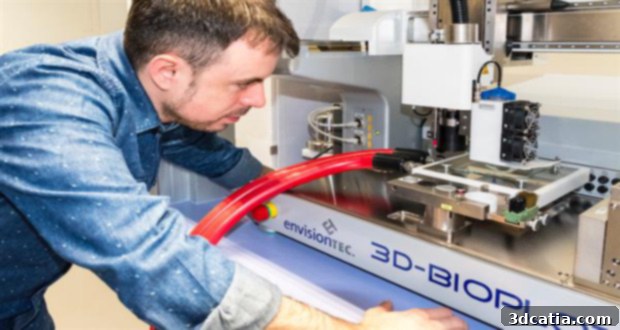
Revolutionizing 3D Printing: The Dawn of Sustainable Cellulose Nanocrystal Ink
In a groundbreaking leap towards more sustainable manufacturing, the Swiss Federal Laboratories for Materials Science and Technology (Empa) have unveiled an innovative ecological ink derived from one of nature’s most abundant building blocks: cellulose. This pioneering research marks a significant milestone, potentially ushering in an era of truly environmentally friendly inks for additive manufacturing, promising to reshape industries from biomedicine to consumer goods with a greener footprint.
The collaborative effort behind this remarkable development involved leading researchers, including Dr. Gilberto Siqueira and Dr. Tanja Zimmermann from Empa’s Laboratory for Applied Wood Materials, alongside esteemed colleagues from Harvard University and ETH Zurich. Together, their interdisciplinary expertise culminated in a novel technology that propels 3D printing onto an even more sustainable trajectory, addressing critical environmental concerns associated with traditional petroleum-based materials.
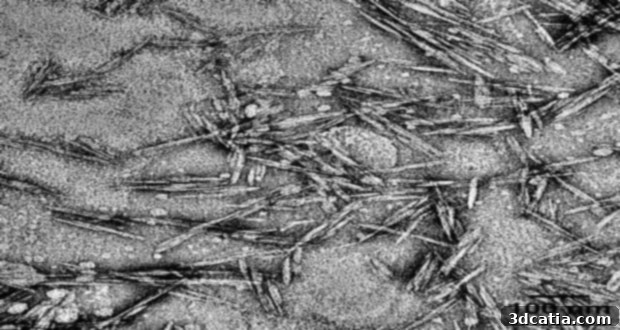
The cellulose nanocrystals under a microscope
The Genesis of Green Ink: Harnessing Cellulose Nanocrystals
At the heart of this eco-friendly innovation lies a fundamental component: cellulose nanocrystals (CNCs). Cellulose itself is the primary structural polysaccharide in the cell walls of green plants, making it the most abundant organic polymer on Earth. Found in vast quantities within wood, cotton, and other plant fibers, cellulose is a glucose-packed structure known for its robust mechanical properties and biocompatibility. However, cellulose does not naturally exist in a readily printable, crystalline form suitable for advanced applications.
To overcome this, the Empa researchers embarked on a meticulous process to isolate the highly ordered, crystalline regions of cellulose. They identified specific parts of the cellulose structure where the cellulose fibrils – the slender, tiny fibers that make up the polymer – exhibited a more organized and tightly packed arrangement. Once these crystalline domains were located, the team applied a controlled acid treatment. This chemical process selectively breaks down the less organized, amorphous regions of cellulose, leaving behind purified nanocrystals. The result was a suspension of tiny, rod-shaped structures, each measuring approximately 120 nanometers in length and 6.5 nanometers in diameter – a scale critical for engineering advanced material properties.
“The places with a higher degree of order appear in a more crystalline form. And it is these sections, which we can purify with acid, that we require for our research,” explained Dr. Siqueira, highlighting the precise scientific approach required to unlock cellulose’s potential at the nanoscale. These nanocrystals possess exceptional strength-to-weight ratios and high surface areas, making them ideal candidates for advanced material formulations.
Engineering Challenges and Innovative Solutions for Printable Ink
Developing a novel ink for 3D printing is fraught with technical challenges, particularly when working with natural polymers. One of the most significant hurdles faced by the Empa team was achieving the perfect rheological consistency – the flow and deformation properties – necessary for successful extrusion through a 3D printer nozzle. The ink needed to be sufficiently “thick” or viscous to maintain its printed shape immediately after deposition, preventing collapse before it could harden, yet fluid enough to be smoothly pushed through the fine nozzle. This delicate balance of shear-thinning behavior (thinning under shear stress during extrusion) and sufficient yield stress (holding its shape at rest) is paramount for precise additive manufacturing.
The researchers encountered setbacks in their initial trials. An early attempt using a purely water-based ink formulation, while seemingly straightforward due to cellulose’s hydrophilic nature, resulted in an unacceptably fragile and brittle structure. Such a material would lack the mechanical integrity required for any practical application, rendering the printed objects useless. This highlighted the need for a more robust binding matrix to consolidate the cellulose nanocrystals.
Undeterred, the team pivoted their strategy and ingeniously decided to incorporate the CNCs into a polymer-based mixture. This decision was counter-intuitive in theory, as most synthetic polymers are typically water-repellent or hydrophobic, while cellulose is distinctly hydrophilic, meaning it readily attracts water. The conventional wisdom suggested these two components would struggle to mix homogeneously and bond effectively. However, through careful formulation and processing, the researchers achieved a remarkable breakthrough. They discovered that by combining the CNCs with specific polymers, the resulting ink could be successfully 3D printed. Crucially, the material hardened effectively under UV radiation, a common curing mechanism in modern 3D printing. This UV-curing capability transformed the liquid ink into a solid, robust product with all the desired mechanical and structural properties. This serendipitous success, despite theoretical incompatibility, underscores the power of empirical research and innovative material science.
Unleashing Biomedical Potential and Beyond
The successful development of this cellulose-based 3D printing ink opens vast possibilities, particularly in the critical field of biomedicine. Thanks to its unique microstructural properties, the printed material exhibits outstanding mechanical characteristics, making it an ideal candidate for a range of biomedical applications and implants. The original article even features an image of a jaw bone printed using this cellulose-based ink, showcasing its potential for intricate and functional anatomical structures.
Beyond its impressive mechanical performance, this pioneering ink offers several compelling advantages that make it particularly attractive for medical uses. Firstly, it is biologically safe for the human body, an absolute prerequisite for any implantable material. Cellulose is naturally biocompatible, meaning it does not provoke adverse immune responses or toxicity within living tissues. This property significantly reduces risks associated with implants and prostheses, paving the way for safer and more integrated medical devices. Secondly, the ink is derived from a renewable resource. Unlike many petroleum-based plastics used in traditional manufacturing, cellulose is sustainably harvested from plants, offering an inexhaustible and eco-friendly supply chain. This aligns perfectly with the growing global demand for sustainable and biodegradable materials in healthcare.
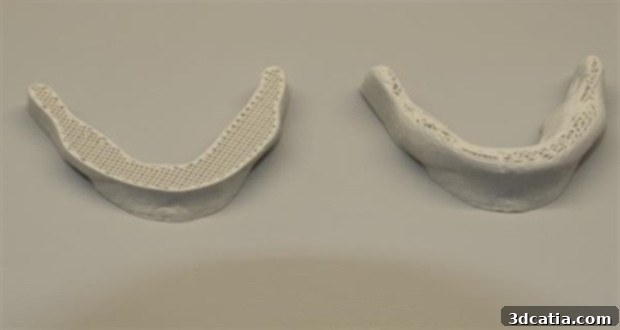
A jaw bone printed using the cellulose based ink
“The most important area of application for me is in biomedicine,” reiterated Dr. Siqueira, underscoring the team’s primary focus. “For example, in implants or prostheses.” The potential extends to various medical devices, including bone scaffolds, cartilage repair patches, drug delivery systems, and even custom prosthetics, where the ability to precisely tailor shape and mechanical properties to individual patient needs is invaluable. The inherent biodegradability of cellulose-based materials also holds promise for transient implants that can gradually degrade as the body heals, eliminating the need for subsequent surgical removal.
The Future is Green: Impact and Ongoing Development
The implications of Empa’s cellulose nanocrystal ink extend far beyond biomedicine. This breakthrough represents a significant step towards a circular economy in manufacturing, reducing reliance on fossil fuels and mitigating environmental pollution. The abundance, renewability, and biodegradability of cellulose make it an ideal candidate for a wide array of sustainable products in various sectors, from packaging and electronics to textiles and automotive components.
Today, the dedicated researchers, alongside a new generation of enthusiastic students, are continuing to refine and expand the capabilities of their revolutionary ink. Their ongoing efforts are focused on exploring novel formulations and processing techniques to unlock new applications for this versatile 3D printing material. This includes investigating its potential for smart materials, functional composites, and perhaps even advanced architectural elements. The collaborative spirit fostered between Empa, Harvard, and ETH Zurich exemplifies how interdisciplinary research and international partnerships are crucial for driving innovation in sustainable technologies. As the world increasingly seeks green alternatives, this cellulose-based ink stands as a testament to the power of biomaterials science to create a more sustainable future for additive manufacturing.
Watch the printing in action:
Be sure to check out their insightful paper detailing their findings here.
What are your thoughts on this revolutionary environmentally friendly 3D printing ink? We’d love to hear your perspectives! Share your comments below, or connect with us on our Facebook and Twitter pages. Don’t miss out on the latest advancements in additive manufacturing – sign up for our free weekly newsletter to get all the cutting-edge news delivered straight to your inbox!