

Patrick Jouin’s TAMU Chair: A Sustainable 3D-Printed Revolution in Generative Design
At the prestigious Design Week in Milan, French visionary designer Patrick Jouin captivated the international design community with the unveiling of his latest masterpiece: the TAMU chair prototype. This groundbreaking creation is more than just a piece of furniture; it represents a profound step forward in sustainable design, innovative manufacturing, and the harmonious integration of technology and nature. The TAMU chair stands out for its remarkable ability to fold completely flat and its construction using advanced 3D printing technologies, which dramatically minimizes material consumption. Its distinctive geometric form, deeply inspired by the intricate elegance found in natural structures, is a testament to what additive manufacturing technologies uniquely enable.
The realization of the TAMU chair’s complex and organic-inspired design was made possible through a strategic collaboration with the French technology giant Dassault Systèmes. Leveraging their powerful 3Dexperience platform, Jouin was able to delve into the realm of generative design, translating the fluid and efficient processes observed in nature into mathematical algorithms. This approach allowed him to explore countless design iterations, each optimized for strength, material efficiency, and aesthetic appeal. Jouin explicitly states that nature served as the primary and most profound source of inspiration. Much like the interconnectedness found in natural ecosystems, where each element contributes to a functional and coherent whole, the TAMU chair’s design embodies a similar holistic philosophy.
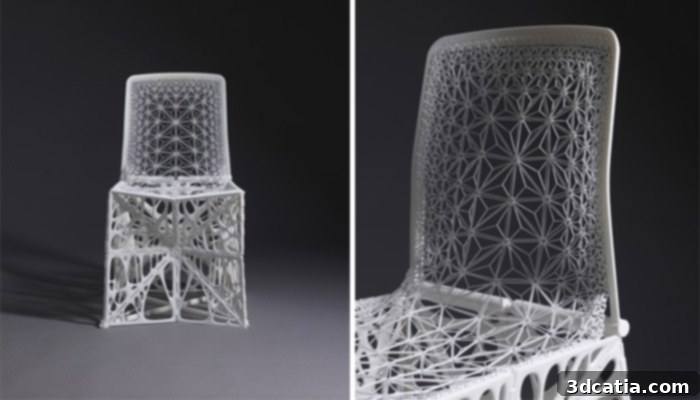
Credits: Patrick Jouin
Unlocking Nature’s Blueprints Through Generative Design
Generative design is a revolutionary approach where designers, instead of directly modeling a part, input design goals, parameters, and constraints into a software system. The software then autonomously explores thousands or even millions of possible design solutions, testing and iterating to find the optimal outcome. For the TAMU chair, this meant specifying requirements like lightweight construction, structural integrity, material type, and the ability to fold. Patrick Jouin’s innovative application of this technology allowed him to mimic biological growth patterns and structural optimizations found in trees, bones, or cellular structures. This process is inherently more efficient than traditional design methods, often yielding designs that are lighter, stronger, and use significantly less material.
Jouin eloquently explains the paradigm shift embedded within his TAMU design philosophy: “In the past, designers were inspired by ‘organic’ as a style, but what is completely new is that designers are now inspired by the organic process itself and how to imitate it.” This statement highlights a critical evolution in design thinking. Rather than merely replicating superficial aesthetics, Jouin seeks to understand and integrate the underlying principles of nature’s engineering. This means studying how nature achieves maximum efficiency with minimal resources, how it creates structures that are both robust and flexible, and how it fosters interconnectedness. By translating these fundamental processes into mathematical algorithms, Jouin pushes the boundaries of design beyond mere form to embrace functional intelligence.
Sustainable Manufacturing: Efficiency from Concept to Creation
The environmental footprint of manufacturing is a growing concern, and Jouin’s approach offers a compelling solution. He critiques conventional manufacturing practices, stating: “In manufacturing, one has fallen into the habit of producing more material than necessary. But with the help of innovative digital technologies, today we are able to produce with much more efficiency and less waste, and that already in the design process.” This emphasis on efficiency beginning at the design stage is crucial for true sustainability. By using generative design in conjunction with 3D printing, the TAMU chair exemplifies a process where material is placed only where it is functionally required, resulting in minimal waste and optimal resource utilization. This contrasts sharply with subtractive manufacturing methods (like carving or milling) that often generate significant material scrap.
The Role of Additive Manufacturing
Additive manufacturing, or 3D printing, is the cornerstone technology that makes the TAMU chair’s innovative design feasible. Unlike traditional manufacturing methods that often require costly molds or complex assembly, 3D printing builds objects layer by layer directly from a digital design. This allows for unparalleled geometric freedom, enabling the creation of intricate, organic, and lightweight structures that would be impossible or prohibitively expensive to produce otherwise. For the TAMU chair, 3D printing ensures that the finely tuned generative design can be accurately translated into a physical object, embodying the complex algorithmic patterns inspired by nature. Furthermore, the ability to print on demand and with optimized material usage contributes significantly to a more sustainable production cycle, reducing both waste and logistical overhead.
Patrick Jouin: A Pioneer in 3D-Printed Furniture
Patrick Jouin and his design agency are not newcomers to the revolutionary potential of 3D printing. With a remarkable 15-year history of exploring and pushing the boundaries of these technologies, Jouin stands as a true pioneer in the field of digital fabrication and furniture design. His long-term commitment underscores a profound belief in the transformative power of additive manufacturing. As early as 2004, a time when 3D printing was far from mainstream in design, Jouin introduced his groundbreaking “SOLID” collection. This series marked the world’s first collection of 3D-printed furniture, cementing his reputation as an innovator and a visionary. The SOLID collection demonstrated that 3D printing was not just for prototypes but could be a viable method for producing functional and aesthetically compelling furniture, setting a precedent for future designers and manufacturers.
Jouin’s work, including the TAMU chair, continues to inspire and redefine what is possible in design. His studio consistently demonstrates how cutting-edge technology, when guided by a deep understanding of natural principles and a commitment to sustainability, can yield products that are not only beautiful and functional but also environmentally responsible. His legacy is one of continuous exploration, pushing beyond conventional limits to create designs that are both innovative in their genesis and impactful in their implications for a greener future. You can find more information about Patrick Jouin and his illustrious design studio HERE. For those interested in discovering more cutting-edge furniture designs that leverage the power of additive manufacturing, our comprehensive ranking of 3D-printed furniture offers further insights.
The Future of Furniture: Innovation, Sustainability, and User Experience
The TAMU chair, with its unique foldable design, minimalist aesthetic, and eco-conscious production, hints at a future where furniture is not only visually appealing but also intelligent, adaptable, and sustainable. The ability for a chair to fold completely flat offers unparalleled convenience for storage and transportation, addressing the needs of modern, often compact living spaces. This functionality, combined with the lightweight yet robust nature achieved through generative design and 3D printing, makes the TAMU chair an exemplar of how design can solve practical problems while adhering to high environmental standards. It challenges the traditional notion of furniture as static objects and instead proposes a dynamic, responsive design that integrates seamlessly into contemporary lifestyles. This blending of form, function, and responsible manufacturing is what makes the TAMU chair a significant milestone in furniture design.
The dialogue sparked by creations like the TAMU chair extends beyond aesthetics. It opens up conversations about material science, circular economy principles, and the role of designers in shaping a more sustainable world. As additive manufacturing technologies continue to evolve, becoming faster, more affordable, and capable of processing a wider range of sustainable materials, the possibilities for designers like Patrick Jouin are limitless. We can anticipate more furniture and consumer products that are not only custom-made and highly efficient but also designed for disassembly, repair, and recycling, closing the loop on material lifecycles. The TAMU chair is a clear signal that the future of design lies at the intersection of technological prowess, ecological mindfulness, and human-centric functionality.
What do you think of this pioneering chair and the innovative approach of Patrick Jouin? Share your thoughts and join the conversation on our Facebook and Twitter pages! Don’t forget to sign up for our free weekly Newsletter, to receive all the latest news in 3D printing delivered directly to your inbox and stay ahead of the curve in additive manufacturing innovations!