
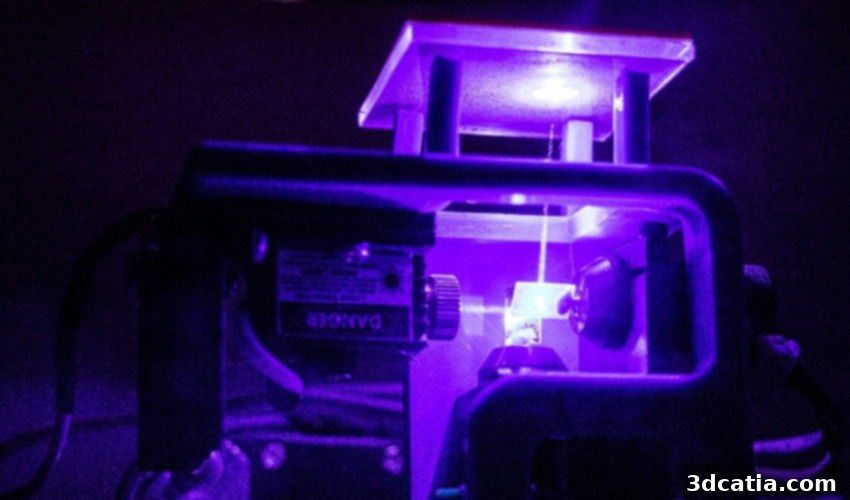
Revolutionizing Additive Manufacturing: Columbia University’s Breakthrough with Inverted SLS for Multi-Material 3D Printing
Selective Laser Sintering (SLS) technology stands as a cornerstone of additive manufacturing, renowned for its ability to produce complex, high-performance plastic components with excellent mechanical properties. In this widely adopted process, a laser selectively fuses powdered plastic particles layer by layer, building parts from the ground up. Despite its numerous advantages, a significant limitation has long curtailed the full potential of SLS: the inability to seamlessly integrate multiple materials within a single print. This constraint has restricted designers and engineers to monochromatic, single-material components, hindering the creation of truly functional and integrated systems that are commonplace in conventional manufacturing. However, a groundbreaking innovation from researchers at Columbia University is poised to shatter these barriers, introducing an ingenious “inverted SLS” process. By re-imagining the fundamental architecture of SLS – positioning the laser to point upwards instead of downwards and replacing the traditional powder bed with transparent glass plates – this novel approach promises to unlock true multi-material capabilities, opening new frontiers for sophisticated 3D printed objects, from top to bottom.
Driven by a profound conviction in the transformative power of additive manufacturing, a dedicated team of mechanical engineering innovation professors embarked on a mission to address the inherent bottlenecks of existing selective laser sintering technology. Their investigations highlighted two primary drawbacks that have significantly impeded the widespread industrial adoption of SLS. Firstly, the fundamental inability to mix different materials within a single print cycle severely restricts the functional complexity of the printed parts. As Hod Lipson, one of the leading researchers, eloquently puts it: “How many products are made of just one material? The limitations of printing in only one material has been haunting the industry and blocking its expansion, preventing it from reaching its full potential.” This constraint means that any multi-material product requires post-printing assembly, adding time, cost, and potential points of failure. Secondly, the conventional SLS process, which buries the nascent part within a homogenous powder bed, makes it impossible to monitor the print in real-time. Unlike technologies such as fused deposition modeling (FDM), where the extrusion process is often visible, detecting errors or anomalies during an SLS print has been historically challenging. The traditional method involves depositing a uniform layer of polymer powder, which the laser then selectively fuses at precise points dictated by the 3D model. Once a layer is complete, another uniform layer of powder is deposited, and the process repeats. The critical impediment here is that it’s impossible to introduce a powder different from the preceding one – for instance, you cannot alternate between a layer of nylon and then a layer of TPU using conventional SLS methods, limiting functional integration.
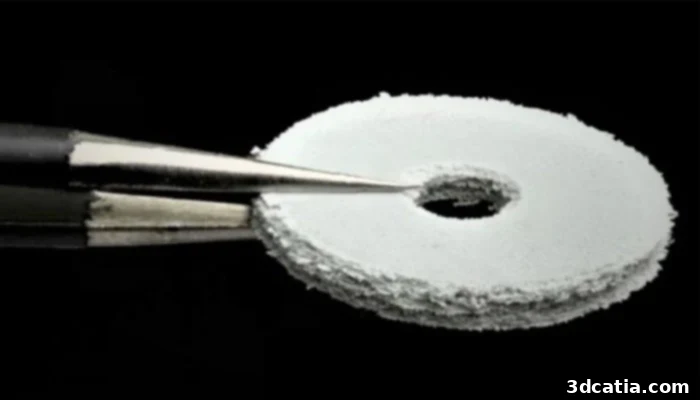
One of the samples 3D printed with TPU, showcasing the precision and potential of the inverted SLS process (Image credits: Columbia University)
John Whitehead, the lead author of the pivotal study, further elaborated on the critical monitoring challenge, stating: “Moreover, in a standard 3D printer, because each of the successive layers placed down are homogeneous, the unfused material obscures your view of the object being printed, until you remove the finished part at the end of the cycle. This means that a print failure won’t necessarily be found until the print is completed, wasting time and money.” This lack of real-time feedback translates directly into significant material waste, extended lead times, and increased operational costs, as potentially flawed parts are only discovered after hours or even days of printing. To comprehensively address these two formidable obstacles – the single-material constraint and the inherent opacity of the print process – the Columbia University researchers ingeniously conceived and implemented a radical reversal of the entire SLS methodology, thus birthing the “inverted SLS” paradigm.
How the Inverted SLS Process Works: A Paradigm Shift in 3D Printing
The innovative inverted SLS process fundamentally re-engineers the Selective Laser Sintering architecture to overcome its traditional limitations. Instead of relying on a conventional, opaque powder bed, the Columbia University researchers opted for transparent glass plates. These plates serve as individual repositories, each meticulously coated with a distinct plastic powder, allowing for the strategic introduction of multiple materials. Crucially, the lasers are positioned underneath these transparent plates, pointing upwards – a stark contrast to the downward-pointing lasers of conventional 3D printers. The printing platform, rather than descending into a deep powder bed, is carefully lowered onto the surface of a glass plate, making contact with the thinly spread powder layer. As the platform makes contact, the upward-firing laser precisely heats and sinters the designated areas of the powder, forming a new layer of the 3D model. Once a layer is selectively fused, the platform slowly rises, lifting the solidified material away from the glass plate. The ingenious aspect of this design is that the system can then move to a different transparent plate, coated with an entirely different plastic powder. This allows for the sequential layering of diverse materials, enabling unprecedented multi-material compositions within a single, integrated part. Furthermore, because the printing occurs from the bottom upwards against a transparent surface, the process allows for real-time visual monitoring of each layer as it forms, providing crucial feedback and allowing for potential error detection during the build process, thereby mitigating waste and improving success rates.
This revolutionary approach signifies a monumental leap forward for additive manufacturing. As Lipson notes, the potential applications are vast and transformative: “This technology has the potential to print embedded circuits, electromechanical components, and even robot components. We think this will expand laser sintering towards a wider variety of industries by enabling the fabrication of complex multi-material parts without assembly. In other words, this could be key to moving the additive manufacturing industry from printing only passive uniform parts, towards printing active integrated systems.” The ability to embed different functionalities – electrical conductivity, varying mechanical properties, or even sensing capabilities – directly into a single 3D printed object without the need for post-processing assembly is a game-changer. This paves the way for the creation of next-generation smart devices, advanced medical implants, highly integrated aerospace components, and sophisticated robotics that are lighter, more robust, and significantly more functional than anything achievable with current single-material SLS techniques. The shift from passive, homogenous components to active, integrated systems is not merely an improvement but a fundamental paradigm shift in how products can be designed and manufactured.

Another sample 3D printed from nylon and TPU, demonstrating the successful integration of different polymer types
To comprehensively demonstrate the formidable capabilities and groundbreaking possibilities of this new inverted SLS process, the Columbia University team successfully produced several compelling prototypes. In one notable demonstration, they meticulously 3D printed a first sample comprising 50 distinct layers of thermoplastic polyurethane (TPU) powder, achieving a total thickness of 2.18 mm with an impressive average layer height of 43.6 microns. This showcases the precision and control achievable with the inverted method for single-material prints. Even more impressively, they also fabricated a second, multi-material sample, seamlessly combining both nylon and TPU. This intricate part featured an average layer height of 71 microns, providing irrefutable proof of concept for the process’s ability to integrate disparate polymer types within a single build. These successful demonstrations validate the inverted SLS system’s capacity to deliver fine detail and robust multi-material functionality. Building on this solid foundation, the researchers are now actively pursuing even more ambitious goals. Their ongoing work focuses on exploring the complex combination of plastic resins with various metals, an endeavor that promises to unlock an entirely new class of materials. This advanced research aims to design and fabricate parts with significantly enhanced mechanical strength, improved electrical conductivity, and superior chemical resistance – properties crucial for high-performance applications across aerospace, automotive, medical, and electronics industries. This vision aligns with the broader objective of pushing additive manufacturing beyond mere prototyping, towards the direct production of truly functional, multi-component end-use products. The integration of plastics and metals could revolutionize fields requiring lightweight yet strong structures, embedded sensors, or advanced thermal management. For a deeper dive into this pioneering research, interested parties can visit the official Columbia University engineering website HERE or gain visual insights by watching the accompanying video below, which further illustrates the inverted SLS process in action:
What are your thoughts on the groundbreaking inverted SLS process and its potential to redefine multi-material 3D printing? Do you envision this technology accelerating the development of highly integrated, functional components across various industries? We invite you to share your insights and opinions in a comment below, or join the conversation on our Facebook and Twitter pages! Don’t miss out on the latest advancements and news in the world of additive manufacturing; sign up for our free weekly Newsletter and receive all the essential updates straight to your inbox!