
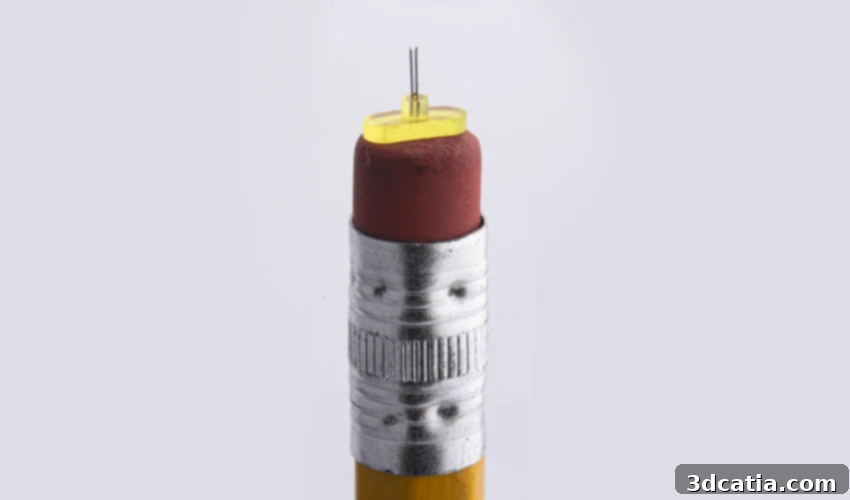
Revolutionizing Skin Cancer Diagnosis: IMcoMET’s Advanced Microneedle Technology Powered by Boston Micro Fabrication’s 3D Microprinting
In the ongoing fight against cancer, particularly prevalent forms like skin cancer, innovative solutions are crucial for early detection and effective personalized treatment. At the forefront of this medical advancement is IMcoMET, a dynamic startup based in Rotterdam. Specializing in cutting-edge diagnostics, IMcoMET is pioneering a novel approach to improve dermatological diagnosis by precisely extracting interstitial fluid, a rich source of critical biomarkers, directly from the skin. This sophisticated method is designed to significantly propel biomedical research forward, ultimately leading to more accurate and personalized solutions for patients.
Achieving this ambitious goal requires equally advanced technological capabilities. IMcoMET has strategically partnered with American manufacturer Boston Micro Fabrication (BMF), leveraging their state-of-the-art 3D microprinting solutions. Thanks to BMF’s exceptional 3D printers, IMcoMET has been able to develop and refine its groundbreaking microneedle technology. This partnership enables the extraction of interstitial fluid with unparalleled precision and localization, marking a significant leap in medical sector diagnostics and personalized care.
The Limitations of Traditional Diagnostics and the Promise of Interstitial Fluid
For decades, the majority of diagnostic analyses performed on the human body have relied heavily on blood samples. While blood tests are indispensable for many medical conditions, they often involve invasive techniques, causing discomfort and sometimes anxiety for patients. Furthermore, the results can occasionally be inconclusive due to factors like coagulation, which can alter biomarker integrity and lead to delayed or inaccurate diagnoses. This inherent limitation has driven researchers to explore alternative biological fluids that might offer clearer, less invasive insights into health and disease.
Among these alternative fluids, dermal interstitial fluid has emerged as a particularly promising candidate. This vital fluid circulates in the spaces between tissue cells, acting as a crucial medium for nutrient transport and waste removal, and critically, it incorporates a vast array of biomarkers. These biomarkers, including proteins, DNA, and exosomes, reflect the metabolic and pathological state of surrounding tissues, offering a more direct snapshot of localized conditions, such as those associated with skin cancer, compared to systemic blood samples. The ability to access and analyze interstitial fluid accurately and non-invasively represents a paradigm shift in diagnostic potential.
Addressing the Challenges of Microneedle Technology
The extraction of interstitial fluid is most commonly performed using microneedles – microscopic needles designed to penetrate only the superficial layers of the skin, minimizing pain and invasiveness. The market offers a diverse range of microneedle types, including hollow, porous, solid, and dissolvable designs, each with specific applications and advantages. However, a significant challenge associated with many existing microneedle technologies is the limited volume of liquid they are able to extract in a single application. Most conventional microneedles, when inserted into the skin, do not yield a sufficient quantity of fluid for comprehensive analysis. This often necessitates the use of multiple needles or repeated insertions to accumulate the desired volume, a process that is neither convenient nor pleasant for the patient and can compromise sample quality.
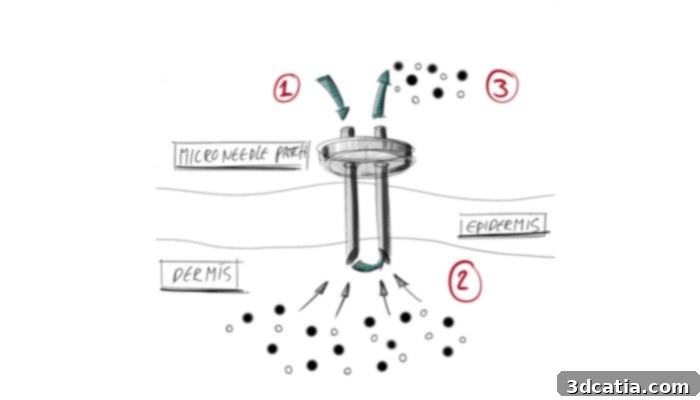
IMcoMet’s patented technology in action, showcasing the precision extraction process.
This is precisely where the innovative approach of IMcoMET comes into play. The Rotterdam-based startup identified this critical gap in diagnostic capabilities and set out to develop a next-generation device. The primary objective was to engineer a precise, minimally invasive system capable of extracting a sufficient volume of interstitial fluid in a single, highly localized application. This breakthrough promises to enhance patient comfort, streamline diagnostic procedures, and provide clinicians with more reliable data for early and accurate skin cancer detection and other dermatological conditions.
IMcoMET’s M-Duo Technology: A Breakthrough in Biomarker Extraction
The first generation of microneedles developed by IMcoMET, known as M-Duo Technology, represented a significant advancement, even though it was initially produced using traditional manufacturing methods. This ingenious system is designed around two microneedles, which are precisely linked to two separate tubes. These tubes, in turn, connect to a micro peristaltic pump, forming a sophisticated, closed-loop extraction mechanism. Operating in a synchronized pair, one needle injects a carrier fluid into the skin’s interstitial space, while the other simultaneously aspirates the fluid. This continuous, paired action creates a localized, dynamic loop, ensuring constant fluid circulation and efficient collection.
The liquid drawn into the system is therefore a carefully controlled mixture of the carrier fluid and the dermal interstitial fluid, rich with invaluable biomarkers. IMcoMET’s innovative M-Duo Technology allows for the detection of a comprehensive range of biomarkers, including critical soluble molecules such as exosomes, various proteins, and fragments of DNA. These molecular signatures are crucial for understanding cellular health and disease progression, offering a potent tool for early and non-invasive cancer detection and other dermatological diagnoses.
Alexandre Motta, CTO of IMcoMET, elaborated on the technology’s capabilities: “M-Duo Technology extracts all soluble molecules around the needle insertion point, providing a highly localized and comprehensive biomarker profile. Our initial device is currently undergoing rigorous clinical trials, demonstrating its efficacy and safety. However, we are relentlessly pushing the boundaries of innovation and now aim to go one step further. Our next objective is to design an even smaller, more advanced device that will enable us to sample even deeper tissue layers with enhanced precision, further expanding its diagnostic potential.”
The Miniaturization Imperative: Overcoming Micro-Engineering Challenges
The pursuit of enhanced diagnostic capabilities and increased patient comfort naturally led IMcoMET to a crucial challenge: miniaturization. While the M-Duo Technology demonstrated remarkable effectiveness, reducing the device’s size while simultaneously increasing its precision presented formidable engineering hurdles. Firstly, the tubes connecting the microneedles to the peristaltic pump require a specific minimum diameter to ensure efficient fluid flow, which inherently places a lower limit on overall device size. Secondly, for the paired needle system to function optimally and create the precise localized fluid loop, the two microneedles must be positioned incredibly close to each other – ideally, separated by a mere 20 microns (0.02 millimeters).
Achieving this level of proximity and intricate channel design meant creating two independent, parallel fluid channels within a minuscule component. Traditional manufacturing methods struggled to meet these stringent requirements without compromising precision, material integrity, or cost-effectiveness. The question became: how could IMcoMET achieve such extreme miniaturization and micron-level precision without sacrificing the reliability and functionality of their groundbreaking technology? This pivotal challenge required a manufacturing partner with capabilities far beyond conventional techniques.
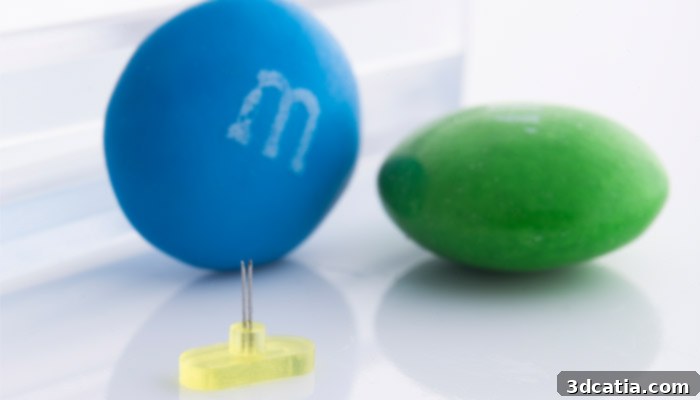
BMF’s 3D-printed device, showcasing the intricate detail possible with micro-stereolithography.
Boston Micro Fabrication: The Key to Unlocking Micro-Scale Precision
It was at this critical juncture that IMcoMET discovered the transformative potential of Boston Micro Fabrication’s (BMF) advanced 3D microprinting technology. BMF specializes in Projection Micro Stereolithography (PµSL), an additive manufacturing process uniquely suited for fabricating incredibly small, high-resolution components with exceptional accuracy. PµSL technology leverages a UV light source to cure liquid resin layer by layer, but unlike conventional stereolithography (SLA), it does so with microscopic precision. This allows BMF to achieve astonishingly high print resolutions, ranging between 2 and 50 microns, and maintain ultra-tight tolerances of between 10 and 25 microns – a level of detail that is virtually impossible with traditional manufacturing or even other advanced 3D printing methods.
BMF’s PµSL technology proved to be the ideal solution for manufacturing the intricate cap that securely holds IMcoMET’s microneedles in place. This tiny yet crucial component is a marvel of micro-engineering. It seamlessly integrates two hair-thin channels, each precisely 100 microns in diameter, positioned an astounding 20 microns apart. These channels are strategically oriented in a V-shape within the cap, ensuring that the connecting tubes can be routed efficiently and independently, each on its respective side, maintaining optimal fluid dynamics for the M-Duo system. The ability of BMF’s technology to produce such fine features with consistent quality was a game-changer for IMcoMET’s miniaturization efforts.
Alexandre Motta enthusiastically confirms the impact of this collaboration: “Thanks to BMF’s technology, we gained unprecedented control over our microneedle design. We can now precisely adjust our needles as we wish – for example, varying the depth of insertion with micron-level accuracy – and thus create detailed maps of the interstitial liquid composition at different skin layers. This capability is invaluable for targeted diagnostics.” He also expressed strong confidence regarding the device’s future in larger-scale production. The efficiency of BMF’s microprinters allows for the simultaneous manufacturing of multiple caps on a single print plate, ensuring that the path to commercialization and broader patient access is both feasible and cost-effective.
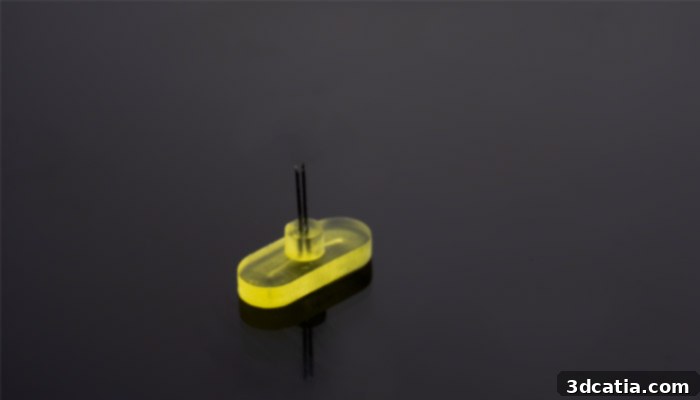
The cap, precisely manufactured by BMF, includes two perfectly aligned microneedles, demonstrating the intricate design capabilities.
Motta concludes: “Boston Micro Fabrication’s PµSL technology is simply ideal for the precision and resolution we demand, especially where the conventional SLA process falls short. Furthermore, it offers a distinct advantage in terms of affordability compared to alternatives like nanoimprinting, while also enabling rapid scale-up of production. It’s an excellent strategic choice for IMcoMET, and we are already actively developing other innovative projects in close collaboration with the talented BMF teams.”
The Future of Personalized Skin Cancer Diagnostics and Beyond
The synergy between IMcoMET’s biomedical vision and BMF’s advanced 3D microprinting capabilities heralds a new era in personalized medicine and diagnostics. This innovative microneedle technology promises to revolutionize the early detection of skin cancer by providing a minimally invasive, highly precise, and efficient method for biomarker analysis. Patients will benefit from less discomfort, quicker results, and more accurate diagnoses, paving the way for earlier intervention and more tailored treatment plans. Beyond skin cancer, the potential applications for this interstitial fluid extraction technology are vast, extending to the detection of other localized diseases, drug monitoring, and even personalized drug delivery systems.
The ability to map interstitial liquid at varying depths opens up new avenues for understanding disease progression and tissue microenvironments in unprecedented detail. This not only enhances diagnostic accuracy but also contributes invaluable data to biomedical research, accelerating the development of new therapies. As IMcoMET continues to innovate with BMF’s support, we can anticipate a future where early disease detection is less invasive, more informative, and fundamentally personalized to each individual’s unique biological profile. This collaboration stands as a testament to how cutting-edge additive manufacturing can directly empower medical breakthroughs, ultimately improving patient outcomes globally.
Interested in exploring BMF’s groundbreaking microprinting solutions for your own precision engineering or medical applications? Do not hesitate to contact their expert teams directly by clicking HERE.
What are your thoughts on the innovative diagnostic device developed by IMcoMET? We invite you to share your perspectives in a comment below, or engage with us on our LinkedIn, Facebook, and Twitter pages! To stay informed about the latest advancements in 3D printing and medical technology, don’t forget to sign up for our free weekly newsletter here, delivering the most relevant news straight to your inbox! You can also discover all our insightful videos and interviews on our dedicated YouTube channel.
*All Photo Credits: Boston Micro Fabrication