

GE and COBOD Lead Decarbonization Efforts with Revolutionary 3D Printed Wind Turbine Foundations
In a significant stride towards global decarbonization, GE prominently showcased COBOD’s cutting-edge 3D concrete printing technology at the recent Climate Summit. This pivotal event, hosted by President Biden, brought together leaders from 16 nations responsible for a staggering 80% of both global carbon emissions and the world’s gross domestic product (GDP). Alongside these heads of state, a select group of influential civil society and business leaders were in attendance, including Danielle Merfeld from GE. During her presentation, Merfeld illuminated GE’s multifaceted initiatives aimed at accelerating decarbonization worldwide. Her address highlighted groundbreaking advancements from GE Renewable Energy, detailing their latest technologies, strategic investments, and innovative research projects. A key highlight was the integration of COBOD’s advanced solution for 3D printing wind turbine foundations using high-performance concrete, signaling a transformative approach to renewable energy infrastructure development. This collaboration underscores a shared commitment to sustainable practices and positions additive manufacturing as a critical tool in combating climate change.
The journey towards this innovation began in 2019 when GE unveiled the world’s first 3D printed wind turbine tower. Following this pioneering trial, GE continued to advance the project through a vital collaboration with LafargeHolcim, a global leader in building materials. Henrik Lund-Nielsen, the visionary founder and General Manager of COBOD, expressed immense pride and confidence in their technology’s potential within the wind energy sector. “We have always believed in the immense possibilities of our technology and 3D concrete printers in the wind turbine sector, and GE presenting it to world leaders emphatically demonstrates that our confidence is widely shared,” Lund-Nielsen stated. He added, “We are incredibly proud to be the inventors and manufacturers of the technology and printers that made it possible to produce the first ever 3D printed concrete wind turbine tower bases for GE in cooperation with LafargeHolcim.” This early success laid the groundwork for further advancements, proving the viability and significant advantages of using additive manufacturing for such critical infrastructure. The ability to print these massive structures on-site reduces transportation costs, improves material efficiency, and allows for the creation of taller, more efficient wind turbines, which are crucial for harnessing stronger winds at higher altitudes and increasing energy output.
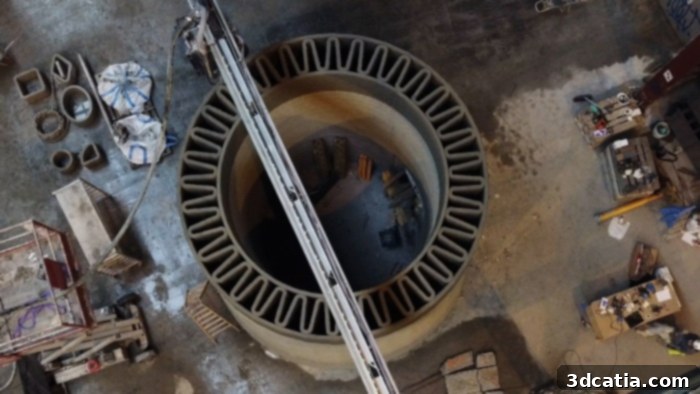
Top view of one of COBOD’s 3D printed turbine towers. (Photo credit: COBOD)
One of the most remarkable achievements illustrating the rapid evolution of this technology is the dramatic reduction in printing time. While the inaugural 3D printed tower required three weeks to complete, COBOD subsequently managed to print the second tower in a mere three days, despite using a significantly larger volume of material. This exponential leap in productivity highlights the rapid learning curve and optimization inherent in additive manufacturing processes. Jakob Jorgensen, Head of Projects & Implementation at COBOD, elaborated on this breakthrough: “We had predicted that the second time we 3D printed a wind turbine tower, our productivity would see a massive improvement. We observed a similar phenomenon in 2019 when we 3D printed a copy of Europe’s first ever 3D printed building, the BOD building, achieving a 20-fold improvement in speed. We expected such multi-fold faster printing this time too, simply because so much is learned from the initial attempt that can be refined and optimized during subsequent iterations.” Jorgensen continued, expressing his surprise at the scale of the improvement: “However, the fact that we could truly print the second tower, a 10-meter concrete structure, in just three days, while also very significantly increasing the volume of printed material, was even a bit surprising to us.” This rapid acceleration in production speed is not merely an engineering feat; it has profound implications for the widespread adoption of 3D printed wind turbine foundations. Faster construction means quicker deployment of renewable energy projects, leading to a more agile and efficient transition away from fossil fuels. It also makes the technology more economically attractive, potentially driving down the cost of wind energy and accelerating global decarbonization efforts. The ability to scale production quickly addresses one of the key challenges in meeting ambitious climate targets.
The achievements in wind turbine construction are just one facet of COBOD’s remarkable recent success story. The company’s 2020 annual accounts, for instance, revealed not only a substantial profit but also an impressive growth rate of almost 100% compared to 2019. This financial robustness underscores the increasing demand and commercial viability of 3D concrete printing technology. The momentum continued into 2021, with COBOD demonstrating an astonishing 200% increase in order intake during the first three months of the year, relative to the same period in 2020. This surge in orders reflects a growing confidence among industry players in COBOD’s solutions and the broader potential of additive construction. Earlier in the year, the company also made headlines with the announcement that one of its printers had successfully been used to 3D print India’s first two-story, 3D printed house. This groundbreaking project showcased the versatility of COBOD’s technology, proving its applicability beyond industrial infrastructure to residential and commercial building sectors. It represents a significant step forward in addressing housing shortages and promoting sustainable construction practices in emerging economies. These diverse feats – from rapidly building wind turbine bases to constructing multi-story homes – certainly foreshadow COBOD’s expected prosperity for 2021 and the years to come, solidifying its position as a leading innovator in the additive construction industry. The company’s expansion into various applications signals a maturation of 3D concrete printing technology, moving from experimental projects to commercially scalable and impactful solutions.
The integration of 3D printing into the construction of wind turbine foundations by industry giants like GE, in collaboration with pioneers such as COBOD, represents a pivotal moment in the global effort to combat climate change. This innovative approach promises not only to accelerate the deployment of renewable energy infrastructure but also to redefine the economics and sustainability of large-scale construction. By leveraging the precision and efficiency of additive manufacturing, these partnerships are paving the way for taller, more robust, and more cost-effective wind turbines, ultimately enhancing the world’s capacity for clean energy generation. The rapid advancements in printing speed, coupled with the proven financial success and diversified applications of COBOD’s technology, underscore a future where sustainable construction is not just an aspiration but a tangible reality. As global leaders continue to seek solutions for decarbonization, the synergy between advanced manufacturing and renewable energy technologies will undoubtedly play a crucial role in shaping a greener future.
For more comprehensive information on COBOD’s innovative technologies and projects, you can visit their official website HERE. We encourage you to share your perspectives: What are your thoughts on GE’s strategic plans and their collaboration with COBOD in addressing the urgent climate crisis through 3D printed wind turbine foundations? Your insights are valuable! Please let us know in a comment below or engage with us on our social media platforms: Facebook,Twitter, andLinkedIn pages. Stay updated with all the latest developments in additive manufacturing by signing up for our free weeklyNewsletter here, delivering the freshest 3D printing news straight to your inbox!
*Cover photo: Biden at summit by Evan Vucci, Associated Press