
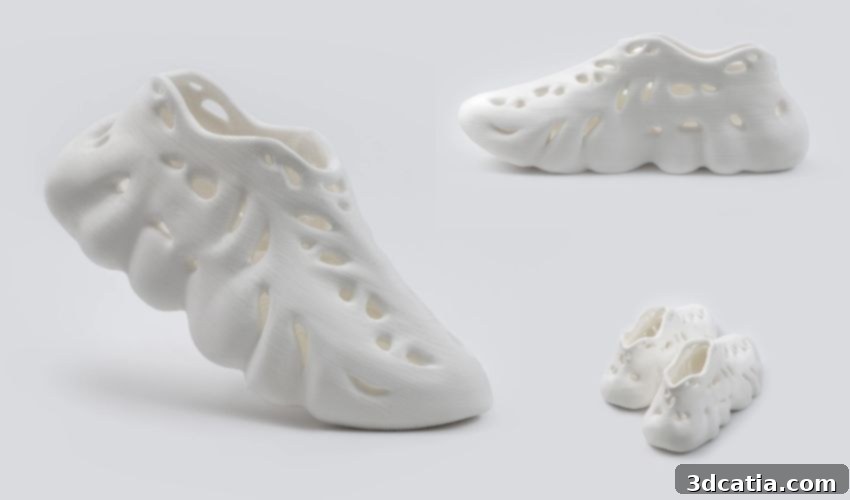
ELASTIUM: Pioneering the Future of Sustainable 3D Printed Foam Footwear
The landscape of footwear manufacturing has undergone a dramatic transformation thanks to the advent of additive manufacturing, a technology that was once confined to rapid prototyping but has now found its stride in consumer products. While the concept of 3D printing first emerged in the late 1970s, its integration into the footwear industry is a relatively recent, yet revolutionary, development. It was in 2014 that adidas spearheaded this shift with their groundbreaking Futurecraft 3D printed midsoles, marking a pivotal moment for the industry. Since then, 3D printing has rapidly gained traction, with global giants like Reebok, Nike, Puma, and New Balance all embracing and investing heavily in this innovative technology. The latest entrant poised to make a significant impact in this burgeoning market of 3D printed shoes is ELASTIUM, a dynamic startup based in the United Arab Emirates (UAE). This ambitious company is set to redefine expectations within the footwear industry with its pioneering foam sneakers. Founded by engineer and tech entrepreneur Robert Karklinsh, ELASTIUM is driven by a bold vision: to disrupt the colossal $500 billion footwear market by offering fully 3D printed footwear crafted entirely from 100% recyclable foam materials, championing both innovation and sustainability.
What truly distinguishes ELASTIUM from many other 3D printed footwear startups is its sophisticated approach, which moves beyond reliance on basic materials and conventional technologies. ELASTIUM ingeniously combines intricate lattice structures with advanced foam compositions to engineer sneakers that are not only sustainable and highly personalized but also deliver an unparalleled level of comfort. The core of ELASTIUM’s innovation lies in its use of low-density thermoplastic elastomer (TPE) foams, meticulously fabricated into intricate lattice structures. These materials are processed using a proprietary granulate extrusion 3D printing technology, a method that allows for precise control over material placement and structural integrity. This cutting-edge manufacturing approach ensures that ELASTIUM sneakers are remarkably soft to the touch and exceptionally comfortable for everyday wear, while simultaneously offering superior cushioning and resilience. These performance attributes are designed to rival, and in many cases surpass, those found in high-performance sneakers produced by established and renowned brands like Nike and Adidas, setting a new benchmark for what sustainable footwear can achieve.
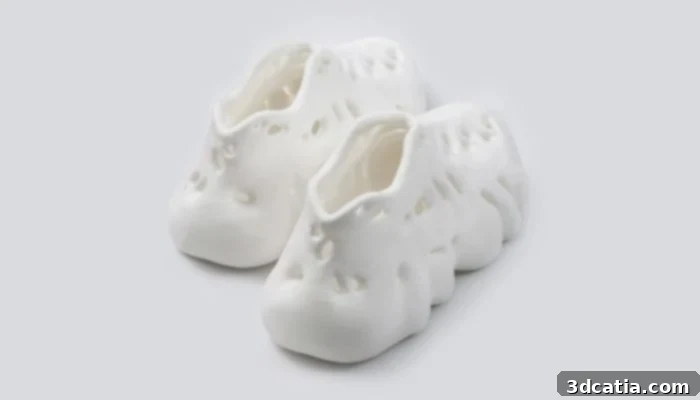
Made from a proprietary fused granulate fabrication (FGF) process, ELASTIUM’s revolutionary foam shoes will be available in 13 different colors at an accessible price point of $250 per pair, offering both innovation and style.
A cornerstone of ELASTIUM’s competitive edge is its proprietary fused granulate fabrication (FGF) foam 3D printing technology. This advanced manufacturing process is engineered to significantly reduce material costs, a critical factor in making innovative footwear more accessible. Unlike traditional methods that might rely on expensive specialized filaments, ELASTIUM’s FGF technology efficiently utilizes industry-standard raw materials supplied in granular form. This strategic choice of material form not only drives down production expenses but also enables a wider range of material sourcing options. Furthermore, this cost-effectiveness is a key differentiator that sets ELASTIUM apart from other foam 3D printing processes available in the market. The versatility of their FGF technology extends to its ability to print with a wide range of material densities, allowing for customized comfort, support, and durability tailored to specific footwear designs and user needs. This adaptability opens up new avenues for product innovation and personalized consumer experiences, solidifying ELASTIUM’s position as a leader in next-generation footwear manufacturing.
Beyond their revolutionary production methods, ELASTIUM’s sneakers are distinguished by their advanced high-performance thermoplastic foam, which delivers a suite of desirable attributes for the modern consumer. These innovative shoes are remarkably lightweight, ensuring minimal fatigue during extended wear, and possess an exceptional softness that conforms comfortably to the foot. Their inherent resilience means they retain their shape and cushioning properties over time, offering lasting performance. Furthermore, ELASTIUM sneakers are designed for convenience, being entirely machine washable, which simplifies maintenance and promotes hygiene – a significant advantage over many traditional or even other 3D printed footwear options. While some 3D printed footwear manufacturers might rely on basic, unfoamed materials, ELASTIUM takes a superior approach by combining high-quality Thermoplastic Polyurethane (TPU) foams with intelligently designed lattice structures. This synergy creates sneakers that are not only incredibly comfortable but also exceptionally durable, suitable for wearing with or without socks, catering to a wide range of preferences and activities. Complementing their material innovation, the company also embraces cutting-edge AI-inspired design methodologies. The inaugural model, known as ELASTIUM-1, showcases a sophisticated mono-material construction. The initial conceptual design for this shoe was generated by artificial intelligence, leveraging complex algorithms to explore novel geometries and ergonomic forms. This AI-generated foundation was then meticulously refined and optimized by a skilled footwear designer using advanced 3D modeling software, ensuring that the final product embodies both futuristic aesthetics and practical wearability.
The Transformative Step Toward 3D Printing in Footwear
The traditional shoe manufacturing process, largely unchanged for decades, is plagued by inefficiencies, high capital investment, and significant environmental unsustainability. This archaic model typically involves lengthy design cycles, complex supply chains spanning continents, and labor-intensive assembly lines. The environmental toll is particularly staggering: an estimated 22 out of every 23 billion pairs of shoes produced globally each year ultimately end up in landfills. There, these non-biodegradable materials can take hundreds, if not thousands, of years to decompose, contributing massively to global waste accumulation and pollution. ELASTIUM is fundamentally changing this narrative by redefining footwear production through the power of 3D printing. The company’s innovative additive manufacturing technology facilitates rapid, on-demand, and highly localized manufacturing. This paradigm shift dramatically reduces lead times, minimizes the need for extensive warehousing, and allows for production closer to the consumer, drastically cutting down on transportation emissions. By enabling localized production, ELASTIUM’s approach is inherently more sustainable and remarkably efficient compared to conventional methods. Moreover, ELASTIUM aims to democratize the entire footwear industry. By providing an accessible platform for individual creators, independent designers, and emerging brands, the company envisions a future where designing and producing footwear is as straightforward and widespread as publishing an application on an app store, fostering unprecedented creativity and entrepreneurship.
This pioneering manufacturing approach embodies sustainability and caters to an on-demand economy, effectively eliminating numerous stages inherent in traditional footwear production. Gone are the laborious and resource-intensive requirements for mold making, the intricate processes of cutting and sewing various components, the extensive use of adhesives for gluing, and the vast spaces needed for storage of materials and finished products. By bypassing these steps, ELASTIUM not only significantly reduces overhead costs but also achieves a substantial decrease in carbon emissions associated with manufacturing and logistics. Furthermore, a core tenet of ELASTIUM’s environmental commitment is the material itself: all ELASTIUM sneakers are crafted from 100% recyclable TPU foam. This choice ensures that at the end of their lifecycle, the shoes can be collected, processed, and repurposed into new pairs, thereby fostering a true circular economy model within the footwear industry and minimizing waste. Adding another layer of innovation to their launch strategy is the introduction of Non-Fungible Tokens (NFTs). ELASTIUM-1 sneakers will be offered as highly coveted limited-edition physical pairs, but crucially, also as accompanying NFTs. These digital tokens grant their owners unique rights, including the ability to order and reorder physical pairs of the ELASTIUM-1, even long after the initial production volume has sold out. This groundbreaking concept of digital ownership empowers NFT holders to effectively become stakeholders in the design, granting them the flexibility to trade their digital rights on secondary markets and seamlessly transfer their digital asset into tangible, physical footwear. This fusion of cutting-edge manufacturing with blockchain technology marks a significant leap forward in consumer engagement and product ownership, creating a novel bridge between the digital and physical realms. For those eager to delve deeper into ELASTIUM’s vision and products, the original source can be found HERE.
The advent of the world’s first fully 3D printed foam shoe from ELASTIUM represents a truly monumental step forward in footwear innovation, sustainability, and consumer engagement. This groundbreaking development challenges conventional manufacturing paradigms and hints at a future where personal expression, environmental responsibility, and advanced technology converge seamlessly. What are your thoughts on this revolutionary approach to footwear? We invite you to share your insights and opinions in a comment below, or engage with us on our LinkedIn, Facebook, and Twitter pages! Don’t miss out on the latest advancements and news in the 3D printing world—be sure to sign up for our free weekly Newsletter here, delivering the freshest updates straight to your inbox! You can also explore our extensive collection of videos and demonstrations on our dedicated YouTube channel, where innovation comes to life.
*All photo credits: ELASTIUM