

Revolutionizing Music Education: AVIVA Pioneers Affordable 3D Printed Violins
For millennia, music has resonated deeply within the human experience, evolving alongside civilization itself. From ancient chants to complex symphonies, instruments have been the conduits of these sonic expressions. While musical forms have diversified dramatically, the fundamental nature of many instruments and their construction methods have often remained remarkably consistent. Consider the violin, an instrument whose elegant design and rich timbre have captivated audiences for centuries. Traditionally, the creation of a violin is a painstaking art, requiring masterful craftsmanship passed down through generations. These time-honored techniques are revered, producing instruments of unparalleled beauty and sound. However, this dedication to tradition often comes with a significant cost, creating barriers for aspiring musicians. In a groundbreaking move that bridges age-old artistry with cutting-edge technology, the AVIVA Young Artists Program has recently unveiled an innovative solution: high-quality, durable, and remarkably low-cost violins produced through 3D printing. This initiative promises to democratize access to music education, making the dream of playing a violin attainable for a far wider audience.
The prohibitive cost of violins is an undeniable hurdle for many aspiring musicians and educational institutions. Professional-grade violins can command prices ranging from $2,000 to an astounding $10,000, and exceptionally rare or historically significant instruments can fetch millions at auction. Even basic student violins, often considered entry-level, typically start at $1,000 or more, a sum that can be financially out of reach for numerous families and school music programs. This financial burden often forces passionate students to forgo learning the instrument altogether, or significantly limits the number of instruments a school can provide to its pupils. Recognizing this systemic barrier to music education, the AVIVA Young Artists Program has stepped forward with a visionary approach, leveraging additive manufacturing to dismantle these economic constraints and open up the world of strings to a new generation.
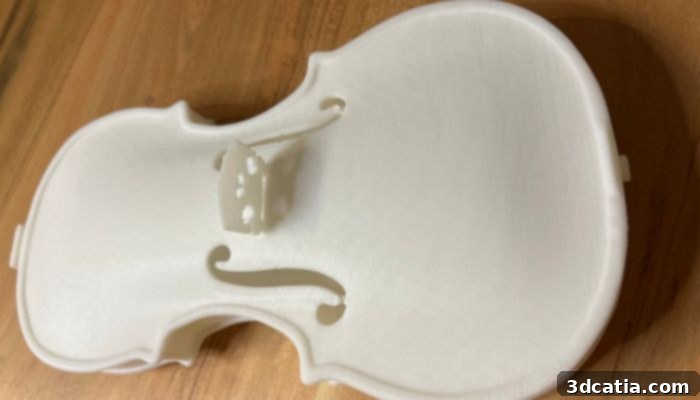
The body of the 3D printed violin, demonstrating the precise craftsmanship possible with additive manufacturing (photo credits: AVIVA Young Artists)
The AVIVA Young Artists Program began its journey in 2012, initially conceived as an experimental venture to connect with underserved communities through the first-ever virtual Suzuki-based music program. Over the past decade, this pioneering initiative has flourished, evolving into the premier web-based young artists program for violinists across the globe. AVIVA’s mission extends beyond mere instruction; it is deeply committed to fostering a global community united by music, while simultaneously championing growth and innovation within the field. Their development of the 3D printed violin is not merely a technological feat but a direct manifestation of this core mission, embodying their dedication to making music education more accessible, sustainable, and forward-thinking for students worldwide.
The revolutionary 3D printed violin made its highly anticipated debut at the Acoustical Society of America’s Conference on December 6th, 2022. This unveiling was not just a showcase of technological prowess but a demonstration of a fully functional musical instrument that performed remarkably well, all while being produced at an astonishingly low cost compared to its traditional counterparts. The cost of 3D printing each violin body was a mere $7, with additional assembly costs bringing the total to under $30 per instrument. When juxtaposed with the typical price tag of $500 or more for even the most basic beginner violins, this represents an unprecedented reduction in price. Such a drastic cost difference has profound implications, promising to make these beautiful instruments, and the enriching experience of playing them, dramatically more accessible to a much broader segment of the population, particularly in educational settings where budget constraints are often severe.
So, what are the specifics of this innovative 3D printed violin? According to an official press release from the Acoustical Society of America, the body of the instrument is meticulously crafted from a specialized plastic polymer material. This material was chosen not only for its printability but also for its acoustical properties, designed to mimic the resonant tone traditionally associated with acoustic violins. This careful material selection ensures that the instrument doesn’t just look like a violin but sounds like one too. For the neck and fingerboard – critical components that directly interact with the musician’s hands – smooth ABS plastic is employed. This choice prioritizes player comfort and durability, crucial for students who will spend countless hours practicing. Interestingly, early testers and acoustical analyses indicate that the resulting 3D printed violin produces a distinct sound profile: a darker, more mellow tone compared to many traditionally crafted instruments. This unique sonic quality opens up new avenues for musical expression and performance.
While the 3D printed violin is not yet commercially available, it has already undergone rigorous testing, proving its capabilities as a legitimate musical instrument. In a significant early iteration, Mary-Elizabeth Brown, the visionary director of the AVIVA Young Artists Program, showcased the instrument’s potential by performing Harry Stafylakis’ concerto “Singularity.” This particular piece holds special significance as it was explicitly composed to be played on 3D printed instruments, pushing the boundaries of contemporary music and instrumental innovation. Brown’s performance underscored not only the instrument’s playability but also its capacity to inspire new musical works, blurring the lines between technology and artistic creation. The success of this performance offers a compelling glimpse into the future of instrument design and musical performance.
Reflecting on this groundbreaking initiative, Mary-Elizabeth Brown succinctly articulates the core objectives and aspirations:
“Our goals were to explore the new sound world created by using new materials, to leverage the new technology being used in other disciplines, and to make music education sustainable and accessible through the printing of more durable instruments. The next step is to explore design modifications as well as efforts to lower the costs of production while making such instruments more widely available, especially in the realm of education.”
Brown’s statement encapsulates a multi-faceted vision. The exploration of a “new sound world” highlights the artistic potential unlocked by novel materials and manufacturing processes. Unlike traditional instruments, where material properties are largely fixed, 3D printing allows for precise control over internal geometries and material composition, potentially leading to unprecedented acoustical characteristics and unique timbres. This opens exciting possibilities for composers and performers to experiment with sounds previously unattainable. Furthermore, “leveraging new technology being used in other disciplines” underscores the interdisciplinary nature of this innovation. 3D printing has revolutionized fields from aerospace to medicine, and its application in instrument making demonstrates how advancements in one area can profoundly impact another, fostering cross-sector learning and development. The ability to iterate designs rapidly and cost-effectively, a hallmark of additive manufacturing, means that instrument makers can experiment with different geometries and materials much faster than with traditional methods, leading to quicker advancements and optimizations.
The emphasis on making “music education sustainable and accessible through the printing of more durable instruments” speaks directly to the core mission of the AVIVA program. Durability is a key factor, particularly in educational environments where instruments endure considerable wear and tear. Wooden instruments are susceptible to changes in humidity, temperature, and accidental damage, often requiring costly repairs. 3D printed plastic instruments, by contrast, can be significantly more robust and less sensitive to environmental fluctuations, potentially reducing maintenance costs and extending the lifespan of the instruments in schools and community programs. This inherent durability contributes directly to the sustainability of music education initiatives, allowing precious resources to be allocated towards teaching and performance rather than constant repair or replacement.
Looking ahead, the program’s “next step is to explore design modifications as well as efforts to lower the costs of production while making such instruments more widely available, especially in the realm of education.” This outlines a clear roadmap for continuous improvement and broader impact. Design modifications, facilitated by the flexibility of 3D printing, could lead to instruments ergonomically tailored for different age groups or physical needs, further enhancing accessibility. Continued research into material science and printing techniques will undoubtedly drive down production costs even further, making the instruments even more affordable. The ultimate goal is widespread availability, with a particular focus on integrating these instruments into educational curricula. Imagine a future where every child in a school can afford to learn the violin, unburdened by the financial constraints that have historically limited access to orchestral music. The AVIVA Young Artists Program is not just creating violins; they are shaping a more inclusive and innovative future for music education globally.
You can find out more in the comprehensive press release from the Acoustical Society of America HERE. What do you think of these innovative 3D printed violins and their potential to transform music education? Share your thoughts with us in a comment below or join the conversation on ourLinkedIn,Facebook, andTwitter pages! Don’t forget to sign up for our free weeklyNewsletter herefor the latest 3D printing news straight to your inbox! You can also find all our videos on ourYouTube channel, where we explore the cutting edge of additive manufacturing.
*Cover Photo Credits: AVIVA Young Artists