
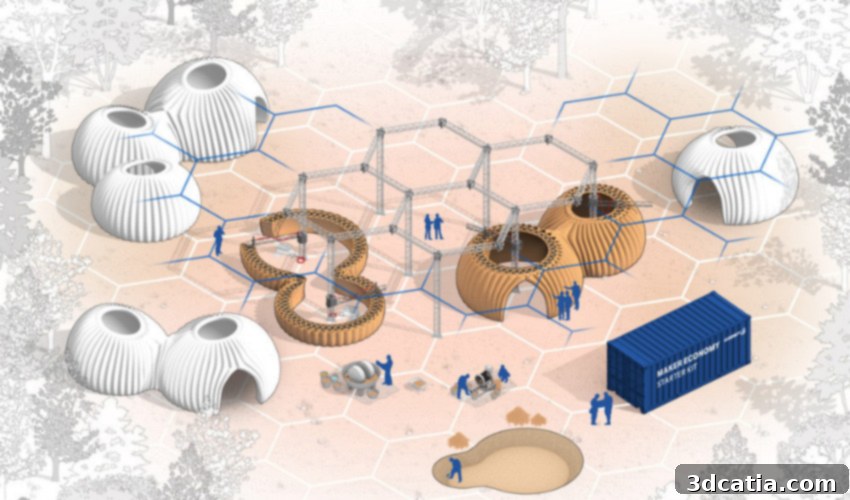
WASP’s TECLA Eco-Habitat: Pioneering Sustainable 3D Printed Homes with Local Earth
In a significant stride towards circular housing models, WASP (World’s Advanced Savings Project), a visionary Italian 3D printing company, recently concluded the construction phase of their groundbreaking TECLA eco-habitat. This innovative project, meticulously engineered by WASP and thoughtfully designed by Mario Cucinella Architects, represents a paradigm shift in sustainable construction. TECLA aims to revolutionize how we build, utilizing entirely recyclable materials sourced directly from the local terrain. The entire structure was brought to life using the Crane WASP, WASP’s advanced 3D printer specifically developed for the construction sector, marking a monumental step forward in eco-friendly building practices.
While 3D printing in construction is increasingly recognized as a more environmentally conscious alternative to conventional methods, its sustainability has often been debated due to the prevalent use of materials like concrete. However, projects like the TECLA eco-habitat offer a compelling vision, demonstrating how the potent medium of construction 3D printing, combined with natural, locally sourced materials, can effectively address both the global housing crisis and pressing ecological challenges. To delve deeper into the TECLA project, the intricacies of printing with soil, and the current landscape of sustainable construction and 3D printed houses, we engaged in an insightful discussion with Alberto Chiusoli, a distinguished Building Engineer and Computational Designer at WASP.
WASP: Driving Innovation in Sustainable 3D Printed Architecture
Alberto Chiusoli introduced himself as a Building Engineer and Computational Designer at WASP, holding a degree in Building Engineering and Architecture from the Alma Mater Studiorum, University of Bologna, Italy. His career path includes notable collaborations with Carlo Ratti Associati in Torino as a technical designer and with ecoLogicStudio in London, culminating in his current impactful role at WASP. At WASP, the core mission is to construct innovative architectural components using sustainable materials, pushing the boundaries of what is possible in eco-friendly building.
WASP, an acronym for World’s Advanced Saving Project, was established in 2012 in Massa Lombarda, Italy. The company specializes in designing and manufacturing high-quality 3D printers that are not only made in Italy but are also distributed globally. WASP’s extensive range of 3D printers is conceived to address a myriad of fundamental human needs, encompassing food, housing, health, energy, employment, art, and culture. The inspiration behind WASP is drawn from the potter wasp, a remarkable insect that instinctively builds its complex nests using materials readily available from its immediate surroundings. This natural marvel fueled WASP’s ambition: to develop large-scale 3D printers capable of constructing houses from natural, locally abundant materials, striving for a near-zero environmental impact. Their overarching goal is to create healthy, low-impact residences that actively contribute to generating energy, food, and wealth for their inhabitants.
A testament to their innovative spirit, WASP successfully built GAIA in 2018, recognized as the first house entirely 3D printed using raw earth and agricultural waste. Building upon this pioneering success, WASP embarked on its latest formidable challenge: TECLA. This novel eco-habitat is a showcase of circularity, constructed exclusively with reusable and recyclable materials harvested directly from the local environment. Leveraging the Crane WASP—the company’s most recent advancement in on-site 3D printed construction—TECLA signifies a transformative leap forward in the ongoing quest for truly eco-friendly housing solutions.

Alberto Chiusoli is a Building Engineer and Computational Designer at WASP.
The Crane WASP: Advancing On-Site 3D Printing for Sustainable Housing
The Crane WASP represents the pinnacle of WASP’s technological evolution in the field of on-site construction. This advanced system was instrumental in the successful creation of Gaia in 2018, the inaugural housing module constructed entirely from raw earth. The development of the Crane WASP 3D printing system over recent years has been driven by a grander vision: to serve as a pivotal component of the Maker Economy Starter Kit project. This ambitious project envisions a portable container equipped with essential technologies for establishing self-construction sites globally, leveraging the immense potential of digital manufacturing to empower communities.
The design philosophy behind the Crane WASP 3D printer draws significant inspiration from the familiar construction crane. However, it integrates a highly sophisticated numerical control system, meticulously developed to optimize the 3D printing of diverse building materials. The Crane WASP fundamentally redefines the entire construction paradigm, from the initial building phase through to the final installation. In today’s rapidly evolving 3D printing construction market, many key players primarily concentrate on concrete printing. In stark contrast, WASP firmly champions the profound value of sustainability and technological advancement, believing that true progress should consistently serve the greater good of humanity by providing accessible, eco-friendly housing solutions.
3D Printing: A Catalyst for Sustainable Construction Standards
From WASP’s perspective, 3D printing stands out as an exceptionally valuable tool for sustainable construction due to its inherent precision and control. As an advanced construction process, 3D printing necessitates meticulous management of the chemical and physical parameters of raw earth. This involves continuous monitoring of workability ranges throughout the printing process, precise control over the rheology of the mixture, and a keen understanding of the material’s behavior once it is laid. This level of oversight is crucial for achieving consistent and robust structures.
The synergistic combination of digital design and 3D printing technology enables the realization of remarkably high construction standards, often surpassing those achieved through traditional building practices such as pisè or adobe. When raw earth is expertly extruded through a 3D printer, it transforms into an extraordinarily sustainable building material. This sustainability is evident not only in its minimal environmental footprint but also in its inherent architectural characteristics. The ability to precisely shape and structure raw earth digitally allows for complex geometries and optimized structural integrity, pushing the boundaries of what is traditionally achievable with natural earth construction. This technological integration ensures that the resulting structures are not only eco-friendly but also meet stringent modern building requirements for safety, durability, and aesthetic appeal.
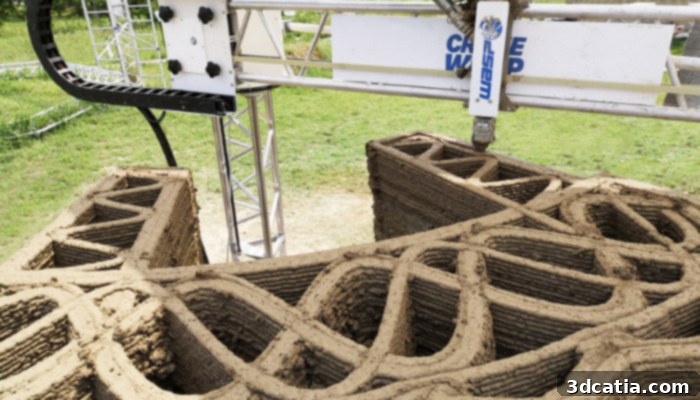
TECLA was 3D printed using multiple Crane WASP printers and soil.
Mastering Soil 3D Printing: Overcoming Challenges to Mainstream Raw Earth Construction
The recent creation of the TECLA eco-habitat, which ingeniously utilized soil as its primary printing material, highlights both the immense potential and the inherent challenges of this innovative approach. At the very foundation of the raw earth working process lies the critical step of material extraction. The raw material, by nature, is highly heterogeneous, its composition varying significantly based on the specific mineralogical characteristics of the extraction site. This variability necessitates rigorous testing of the soil’s chemical and physical composition, including detailed evaluations of its clay, silt, and sand fractions, and subsequent correction for any missing components to achieve the desired blend.
Following the sampling process, the soil undergoes a crucial dry filtering phase. This involves the use of a rotating screen designed to eliminate stones larger than 9 mm, effectively homogenizing the granulometry of the dry mixture. This standardization is vital for ensuring the replicability and consistency of subsequent mixing operations. The mixing itself is performed using a wet pan mill, a rotating machine where water, binding and stabilizing agents, and natural fibers—such as rice husks and straw derived from the agricultural chain—are added. The muller’s action efficiently and rapidly produces a homogeneous and well-blended mixture, crucial for smooth extrusion.
Once fully mixed, the prepared earth is transported via continuous pumping systems to the extruder inlet. Here, specific sensors diligently regulate the flow and pressure, ensuring a constant and controlled delivery of material. The actual deposition of the material is then orchestrated by a helical screw, which precisely modulates the quantity of material and guarantees homogeneous layering, forming the structural elements of the building. The Crane WASP printer, a cornerstone of the Maker Economy Starter Kit, is designed to be accessible and can be acquired and deployed globally. WASP’s overarching objective is to democratize this knowledge and technology, empowering as many individuals as possible to have access to a dignified home, considering it a fundamental birthright. By refining these processes and making the technology more accessible, WASP aims to make soil 3D printing a mainstream, sustainable construction method worldwide.
Cultivating Sustainable Structures: A Holistic Approach to Future Construction
Transitioning to more sustainable structures requires far more than just technological advancements; it demands a profound cultural shift in our approach to architecture and urban development. Sustainable architecture, at its core, represents a comprehensive cultural approach that redefines our relationship with the built environment. True sustainable development, as defined, is not a static state of harmony but rather an ongoing process of dynamic change. This process dictates that the exploitation of resources, the direction of investments, the orientation of technological development, and institutional changes must all be meticulously aligned with future needs, extending beyond immediate requirements. It’s about building a legacy for generations to come, ensuring that our present actions do not compromise their ability to meet their own needs.
There is a growing and undeniable attention within the building sector towards the principles of environmental sustainability. This, combined with the transformative vision outlined in the 2030 Agenda for Sustainable Development, is slowly but steadily reshaping the fundamental approaches to both design and construction. This shift signifies a recognition that our built environment must be an integral part of a larger ecological system, not an antagonist to it. Investing in sustainable architecture is an act of foresight, a conscious acknowledgment that a life harmoniously tailored to both humanity and the environment is achievable only by diligently protecting our common good. This imperative begins with our most fundamental structures: our homes. By adopting sustainable practices, we not only mitigate environmental impact but also create healthier, more resilient, and ultimately more humane living spaces for everyone.
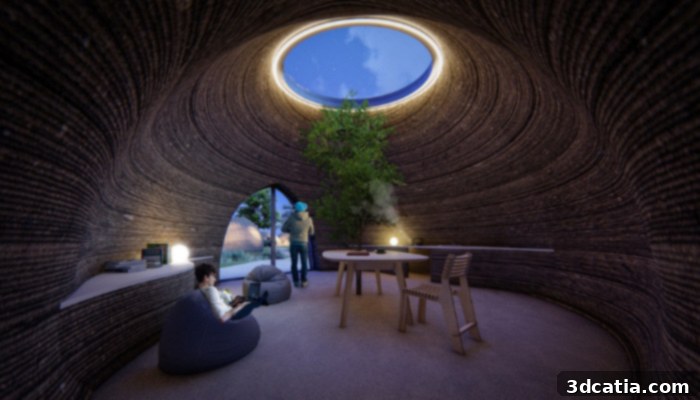
The TECLA eco-habitat is built using WASP 3D printers and local soil. Its design was inspired by the nests of the potter wasp.
WASP’s Vision for the Future: TECLA and Beyond
For the dedicated team at WASP, who have invested many years in this ambitious endeavor, TECLA represents the zenith of advanced research at the intersection of matter and technology. It is the culmination of an unparalleled challenge that has pushed the boundaries of printing geometry to its absolute physical limits. The TECLA project offers an unprecedented perspective for future buildings and new human settlements, powerfully demonstrating how the intrinsic value of local raw materials can be significantly amplified through sophisticated digital design and fabrication techniques.
The innovative double dome solution employed in TECLA’s design ingeniously serves multiple critical roles simultaneously: functioning as the primary structure, the protective roof, and the external cladding. This integrated design ensures that the house achieves exceptionally high performance across all aspects, from structural integrity to thermal insulation and aesthetic appeal. With the successful completion and demonstrated capabilities of projects like TECLA, WASP confidently asserts its readiness to make a tangible and significant difference in the global push for sustainable, accessible housing. The future of construction, built on local resources and digital innovation, is not just a dream but a rapidly approaching reality.
To discover more about WASP and their groundbreaking projects, please visit their official website HERE. What are your thoughts on 3D printing with soil as a viable and sustainable construction method for the future? We invite you to share your insights in the comments section below or engage with us on our Facebook, Twitter, and LinkedIn pages! For the latest 3D printing news delivered directly to your inbox, don’t forget to sign up for our free weekly Newsletter here.
All photo credits: WASP