
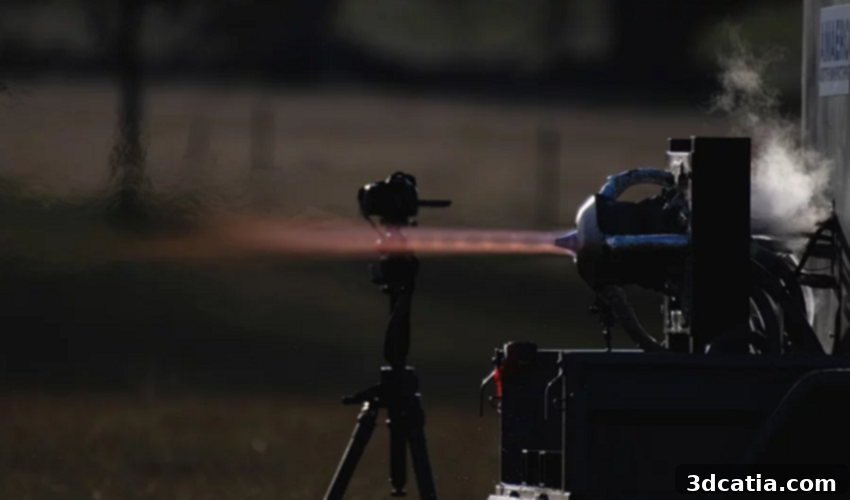
Monash University Pioneers 3D Printed Aerospike Rocket Engine for Enhanced Space Propulsion
In a groundbreaking achievement that could redefine the future of space travel, a dedicated team of engineers at Monash University in Melbourne, Australia, has successfully designed, assembled, and rigorously tested a functional 3D printed rocket engine. Accomplished in an astonishingly short timeframe of just four months, this innovative engine, dubbed Project X, represents a significant leap forward in aerospace technology. Its core design principle centers around an aerospike nozzle, a revolutionary concept that fundamentally reconfigures the exhaust system compared to more conventional rocket engines, promising enhanced efficiency and performance.
A nozzle is a critical component in rocket motors, responsible for shaping and expelling the combustion gases generated within the engine, thereby generating thrust. Traditional bell-shaped nozzles are optimized for specific atmospheric pressures, often achieving peak efficiency at a single altitude, typically sea level. In contrast, an aerospike nozzle offers a unique advantage: it maintains high propulsion efficiency across a wide range of altitudes, from sea level to the vacuum of space. This inherent adaptability means it consumes less propellant during ascent, leading to potentially significant cost savings and increased payload capacity for space missions. Project X stands as a testament to collaborative innovation, being the result of a powerful partnership between the expert engineers at Monash University and Amaero, an Australian aerospace startup renowned for its specialization in advanced additive manufacturing techniques. Together, they leveraged the transformative power of 3D printing to bring this complex rocket engine to life, quickly recognizing and exploiting the profound benefits offered by the aerospike design.
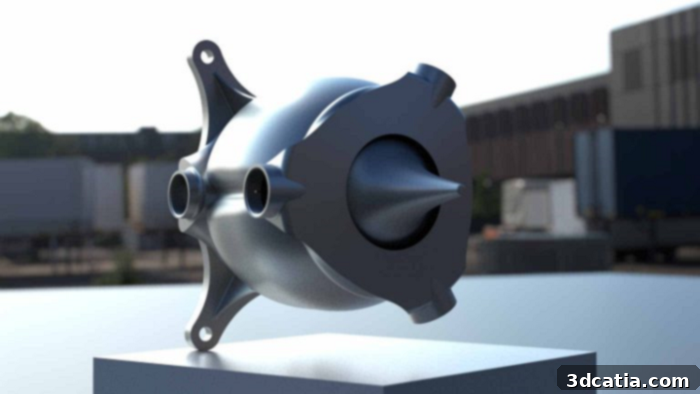
The front of the engine
The inherent efficiency of the aerospike design has long captivated aerospace engineers. Marten Jurg, a seasoned engineer with Amaero, articulates the problem with traditional systems: “Traditional bell-shaped rockets, as seen on the Space Shuttle, work at peak efficiency at ground level. As they climb through the atmosphere, the external pressure changes, causing the exhaust plume to spread out, which significantly reduces thrust efficiency. This phenomenon, known as over-expansion at lower altitudes and under-expansion at higher altitudes, means these engines are never truly optimal across the entire flight profile.” He continues, “The aerospike design, however, brilliantly addresses this by maintaining its efficiency throughout varying atmospheric pressures. The genius lies in its ability to adapt the exhaust flow, effectively compensating for external pressure changes. Despite its theoretical superiority, the aerospike has historically been incredibly challenging to manufacture using conventional techniques.” This manufacturing hurdle was the primary reason why aerospike technology, despite its clear advantages, remained largely confined to research and conceptual designs for decades. The intricate internal geometries and the robust materials required simply pushed the limits of traditional machining and fabrication methods. This is precisely where additive manufacturing, or 3D printing, enters as a game-changer. As Jurg highlights, “Using additive manufacturing, specifically metal 3D printing, we can create extraordinarily complex designs with precision that was previously unimaginable. We can then print these intricate structures, test them, tweak the design based on performance data, and rapidly reprint revised versions in a matter of days or weeks, rather than months or even years. This iterative design process is crucial for fast-paced innovation in rocket engine development.”
The fundamental difficulty in constructing aerospike nozzles stems from their unique geometry. Unlike a bell nozzle that expands gases outwards, an aerospike directs exhaust gases along a central spike or core. The structure of these ‘spikes’ – often a series of smaller combustion chambers arranged around a central ramp – must be meticulously supported and integrated within the engine’s exhaust system, enduring extreme temperatures and pressures. Achieving the precise internal cooling channels, fuel injectors, and structural integrity for such a complex shape through traditional casting, welding, or machining proved to be an insurmountable hurdle for large-scale production. The precision required for the internal channels that control the gas flow, essential for the aerospike’s altitude-compensating properties, is extraordinary. Any deviation could drastically reduce efficiency or even lead to engine failure.
To overcome these manufacturing challenges, the Monash University and Amaero team turned to Direct Metal Laser Sintering (DMLS), a cutting-edge additive manufacturing technology. DMLS involves using a high-powered laser to selectively melt and fuse metallic powders layer by layer, building up complex three-dimensional objects from a digital design. This method allowed the researchers to create the entire rocket motor, including its intricate aerospike nozzle, on an EOS M 280 machine. DMLS is particularly well-suited for aerospace applications due to its ability to produce parts with excellent material properties, including high strength-to-weight ratios and resistance to extreme temperatures – crucial for rocket engine components. The success of Project X has not only validated the feasibility of 3D printing advanced rocket propulsion systems but has also spurred the creation of a new startup: NextAero. This new venture is specifically aimed at bridging the gap between cutting-edge academic research and industrial application, with the mission of bringing this revolutionary 3D printed aerospike technology to the broader aerospace industry. NextAero intends to leverage the speed and design freedom offered by additive manufacturing to develop and commercialize a new generation of high-performance, cost-effective rocket engines, potentially democratizing access to space and making satellite launches more affordable and frequent.
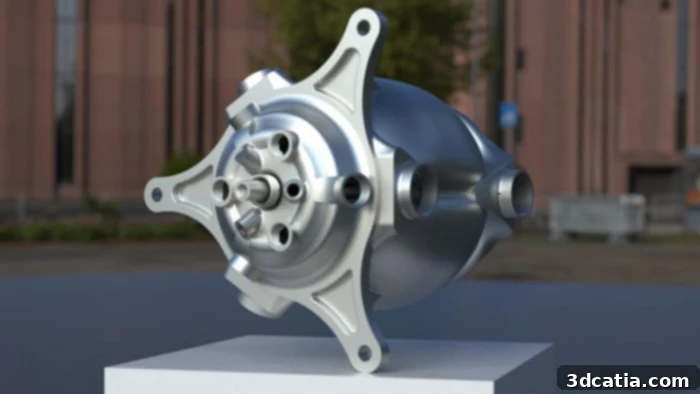
The back of the motor
The role of additive manufacturing in this development cannot be overstated. It has unequivocally played a crucial, transformative role, enabling the rapid creation of complex prototypes and functional models of their designs. This capability dramatically accelerates the entire engineering lifecycle, from initial concept to rigorous testing and subsequent improvement iterations. Traditional manufacturing processes often involve lengthy lead times for tooling, fabrication, and assembly, which can stretch development cycles over many months or even years. With 3D printing, engineers can go from a digital design to a physical part in days, allowing for continuous refinement and optimization. This rapid prototyping capability significantly de-risks the development process, as design flaws can be identified and corrected much earlier and more affordably. The ability to print complex internal geometries that are impossible to achieve with conventional methods has unlocked unprecedented design freedom, allowing engineers to create lightweight structures with integrated functionalities, such as optimized cooling channels or fuel injection systems, directly within the part.
The benefits of additive manufacturing are already being recognized and capitalized upon by major industrial groups across various sectors. Siemens, a global powerhouse in engineering, has successfully 3D printed advanced turbine blades, which are critical components in power generation and aviation engines. These 3D printed blades demonstrate superior performance characteristics, including improved efficiency and durability, thanks to their optimized internal structures made possible by additive manufacturing. Similarly, Pratt & Whitney, a leading manufacturer of aircraft engines, has integrated 3D printing technologies into its production processes to create various complex parts for its state-of-the-art aircraft engines. These applications range from intricate fuel nozzles to structural components, all benefiting from reduced weight, enhanced performance, and simplified supply chains. The success of Project X with its 3D printed aerospike engine further solidifies the position of additive manufacturing as a mature, indispensable technology for high-stakes, high-performance applications, particularly in the demanding aerospace sector. It paves the way for components that are not only lighter and stronger but also more fuel-efficient and adaptable, pushing the boundaries of what’s possible in propulsion technology and space exploration.
Looking ahead, the team behind Project X, through their new venture NextAero, is poised to make a significant impact on the global aerospace stage. They are scheduled to present their innovative 3D printed rocket engine at the prestigious International Astronautical Congress (IAC), which will be held from September 25 to 29 in Adelaide. This international forum, bringing together space agencies, industry leaders, academics, and researchers from around the world, will provide an unparalleled platform for NextAero to showcase the capabilities and potential of their aerospike engine. The presentation at IAC is expected to generate considerable interest, potentially attracting vital investment, partnerships, and further research collaborations that will be instrumental in scaling up this technology from prototype to commercial product. The implications of this development are profound: more efficient rocket engines could lead to lower launch costs, enabling more frequent space missions, facilitating the deployment of larger satellite constellations, and even making ambitious deep-space exploration missions more feasible. This Australian innovation demonstrates how advanced manufacturing techniques are not just optimizing existing technologies but are actively enabling entirely new paradigms in engineering and scientific exploration, promising a future where space access is more attainable and sustainable.
What are your thoughts on this incredible 3D printed rocket engine and its potential to revolutionize the aerospace industry? We invite you to share your insights, questions, and predictions in a comment below, or join the conversation on our Facebook and Twitter pages! Don’t forget to sign up for our free weekly Newsletter, which delivers all the latest news, innovations, and breakthroughs in the exciting world of 3D printing directly to your inbox!