
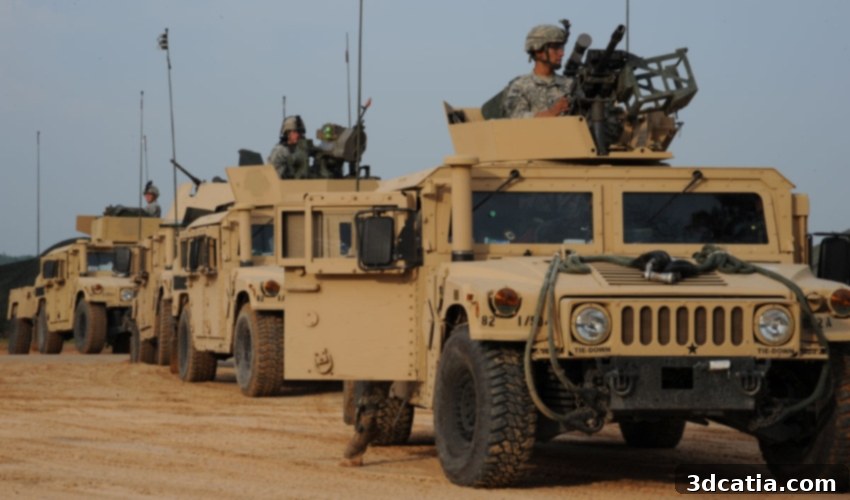
Revolutionizing Combat Vehicle Manufacturing: ASTRO America Spearheads U.S. Army’s Jointless Hull 3D Printing Initiative
In a monumental stride toward modernizing defense manufacturing, the Applied Science & Technology Research Organization, widely recognized as ASTRO America, recently announced its selection by the U.S. Army for the groundbreaking “Jointless Hull Project.” This ambitious initiative, facilitated through LIFT, a critical manufacturing innovation institute supported by the Department of Defense, aims to pioneer the development and deployment of a full-scale additive manufacturing tool. This cutting-edge technology will enable the production of combat vehicle hulls as single, monolithic components, marking a significant leap forward in military vehicle construction. The core objectives of this program are multifaceted: to drastically improve production speeds, substantially reduce manufacturing costs, decrease vehicle weight for enhanced maneuverability and fuel efficiency, and ultimately boost the performance and survivability of these crucial defense assets. By embracing large-scale additive manufacturing, the project seeks to redefine the paradigms of military vehicle design and production, ensuring American forces are equipped with the most advanced and resilient technology available.
The strategic importance of the Jointless Hull Project cannot be overstated, aligning perfectly with national efforts to bolster manufacturing capabilities and technological superiority. Nigel Francis, Chief Executive Officer and Executive Director of LIFT, underscored this alignment, stating, “As a national manufacturing innovation institute, we help advance technology from concept to use by the warfighter as quickly as possible.” He further emphasized LIFT’s broader mission: “Developing the ‘jointless hull’ is also aligned with our mission of driving American manufacturing into the future by connecting materials to processes and to the systems involved.” This highlights LIFT’s crucial role as a bridge between innovative research and practical application, ensuring that breakthroughs in materials science and manufacturing processes are swiftly translated into tangible benefits for the defense sector. The collaboration with ASTRO America and the U.S. Army exemplifies this commitment, bringing together expertise and resources to tackle one of the most challenging and impactful areas of military hardware development: the core structure of combat vehicles.
The Jointless Hull Project: improved production speeds, reduced production costs, reduced vehicle weight, greater vehicle performance and increased survivability. (Photo credit: ASTRO America)
The concept of printing a combat vehicle hull as a single, jointless component offers a multitude of transformative advantages. One of the primary benefits, consistently highlighted in discussions surrounding advanced additive manufacturing, is its profound potential to enhance supply chain efficiency and significantly decrease overall production costs. Traditional manufacturing of large structures like vehicle hulls involves numerous parts, complex assembly processes, and a vast network of suppliers, all contributing to potential bottlenecks and increased expenses. By consolidating these many components into a single, intricately designed print, the Jointless Hull Project promises to simplify the manufacturing pipeline dramatically. This not only reduces material waste and labor but also streamlines logistics and inventory management. Larry “LJ” Holmes, Principal Investigator at ASTRO America, succinctly articulated the scale of this ambition, explaining, “The mission is to develop a large-scale tool capable of producing single, jointless combat vehicle hulls at a near net size of 30ft x 20ft x 12ft in size.” He underscored the broader implications, stating, “Additive manufacturing at a massive scale holds the potential to transform the way vehicles are built for the military while reducing supply chain fragility.”
Beyond cost and supply chain improvements, the monolithic nature of these additively manufactured hulls brings unparalleled advancements in vehicle design and performance. Being a single, integrated structure, these hulls are inherently more robust and lighter than their traditionally assembled counterparts. The elimination of welds, fasteners, and other joint mechanisms removes inherent weak points, significantly improving the structural integrity and resistance to ballistic and blast impacts. This directly translates to enhanced survivability for the warfighters inside. Furthermore, additive manufacturing allows for revolutionary design freedom, enabling engineers to implement topology optimization – a design process that optimizes material distribution within a given space for maximum performance and minimal weight. This means less material can be used where it’s not critically needed, and more can be strategically placed to reinforce high-stress areas, resulting in a lighter vehicle without compromising strength. A lighter combat vehicle consumes less fuel, has greater range, improved speed, and is easier to transport, all while potentially carrying more payload or additional armor, thereby directly enhancing its overall combat performance and operational flexibility. These combined benefits represent a paradigm shift in how military vehicles are conceived, designed, and ultimately deployed.
The selection of ASTRO America for this monumental undertaking is a testament to their specialized expertise and seasoned team. Jason Gorey, ASTRO America’s Executive Director, clarified the practical and results-driven nature of the project. He concluded, “This is an ideal project for ASTRO America and its highly experienced team. This is not a research project for either hardware, software or materials. This is a direct implementation project where we scale existing but advanced methodologies to the required hull-scale size. We will be working with equipment vendors as well as system integrators to deliver on this project.” This statement underscores a critical distinction: the Jointless Hull Project isn’t about reinventing the wheel, but rather about scaling proven additive manufacturing technologies to an unprecedented size and application. This ‘direct implementation’ approach minimizes developmental risks and accelerates the timeline for delivering tangible results to the U.S. Army. ASTRO America’s strategy involves leveraging established partnerships with leading equipment vendors and experienced system integrators, ensuring that the necessary hardware, software, and material processes are robust enough to meet the stringent demands of military-grade combat vehicle production. This collaborative ecosystem is vital for translating advanced manufacturing concepts from laboratory settings into deployable, real-world defense solutions.
Implementing such a large-scale metal additive manufacturing project presents its own set of unique challenges. Producing structures of 30ft x 20ft x 12ft dimensions requires not only colossal 3D printers but also sophisticated process control to ensure material integrity, dimensional accuracy, and consistent quality across such vast components. The properties of the metal alloys used must meet rigorous military specifications for strength, ductility, and resistance to environmental factors. Furthermore, post-processing techniques, such as heat treatment and surface finishing, need to be perfected for these massive parts. However, the potential rewards far outweigh these engineering hurdles. Success in the Jointless Hull Project could pave the way for a new era of agile manufacturing within the defense industry, allowing for rapid prototyping of new vehicle designs, faster updates and modifications, and localized production capabilities that enhance national security by reducing reliance on vulnerable global supply chains. This initiative not only promises to transform combat vehicle production but also serves as a catalyst for broader innovation in heavy industry through additive manufacturing. For those interested in delving deeper into the specifics of this groundbreaking partnership and the U.S. Army’s vision, the full press release is available HERE.

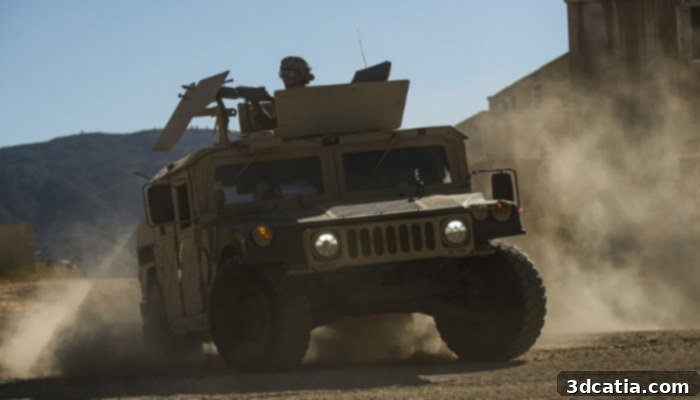
The U.S. military utilizes Humvee vehicles, for which robust hulls are a key component of construction, highlighting the critical role of hull integrity in combat readiness. (Photo credit: military.com)
The Jointless Hull Project represents a bold step forward in defense innovation, leveraging the transformative power of large-scale additive manufacturing to create more resilient, efficient, and advanced combat vehicles for the U.S. Army. This collaborative effort between ASTRO America, LIFT, and the Department of Defense is poised to significantly impact military readiness, operational capabilities, and the future of American manufacturing. By focusing on direct implementation and scaling existing advanced methodologies, the project aims to rapidly transition from concept to battlefield deployment, solidifying the nation’s leadership in cutting-edge defense technologies and manufacturing prowess.
What are your thoughts on the potential of the Jointless Hull Project and its implications for military vehicle production? We invite you to share your insights in a comment below or join the discussion on our Facebook, Twitter, and LinkedIn pages! To stay informed about the latest advancements in 3D printing and additive manufacturing, sign up for our free weekly Newsletter here, delivering the most important news directly to your inbox!
*Cover photo source military.com