
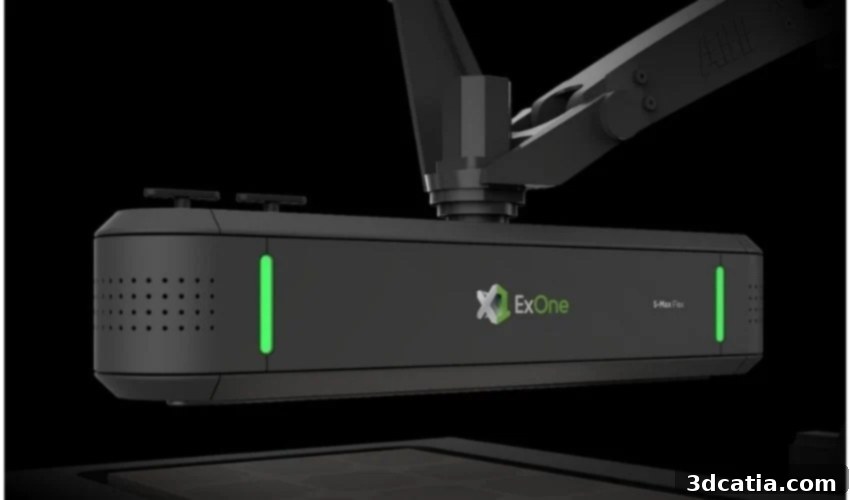
ExOne S-Max Flex: Democratizing High-Speed Sand 3D Printing for Foundries and Beyond
The landscape of additive manufacturing continues to evolve at an unprecedented pace, with strategic acquisitions and groundbreaking innovations constantly pushing boundaries. A prime example of this dynamic environment is ExOne, a pioneering name in binder jetting technology, which made significant headlines last year following its acquisition by industrial 3D printing leader Desktop Metal for an impressive $575 million. This strategic merger brought together two powerhouses, combining their extensive expertise and resources to accelerate the adoption of advanced manufacturing solutions.
Now, ExOne is once again in the spotlight, captivating the additive manufacturing market with the launch of its revolutionary new system: the S-Max Flex. Designed with a clear objective – to make sand 3D printing significantly more accessible – this innovative solution is a direct result of the shared experiences and synergistic collaboration between Desktop Metal and ExOne. At its core, the S-Max Flex leverages the patent-pending Single Pass Jetting (SPJ) process, a technological leap that promises to redefine efficiency and cost-effectiveness in sand binder jetting. According to both companies, this new technology is poised to deliver exceptionally high speeds for designing and producing complex parts, all while dramatically driving down production costs, thereby unlocking new possibilities for a wide array of industries.
The introduction of the S-Max Flex is a pivotal step for Desktop Metal in realizing its ambitious vision for Additive Manufacturing 2.0. This forward-looking paradigm aims to optimize industrial 3D printing across critical dimensions: speed, cost, and material availability, transitioning the technology from prototyping to true mass production. Ric Fulop, Desktop Metal’s visionary co-founder and CEO, articulates the strategic thinking behind the S-Max Flex: “We designed the all-new S-Max Flex from the ground up, leveraging SPJ technology with the idea of making premium sand 3D printing accessible to every foundry. This approach ensures that more companies can take advantage of the profound benefits of AM 2.0, such as distributed, local production, reduced lead times, and enhanced design freedom, ultimately helping them remain competitive and innovative for the long term.” This statement underscores the commitment to democratizing advanced manufacturing, enabling businesses of all sizes to harness the power of industrial 3D printing.
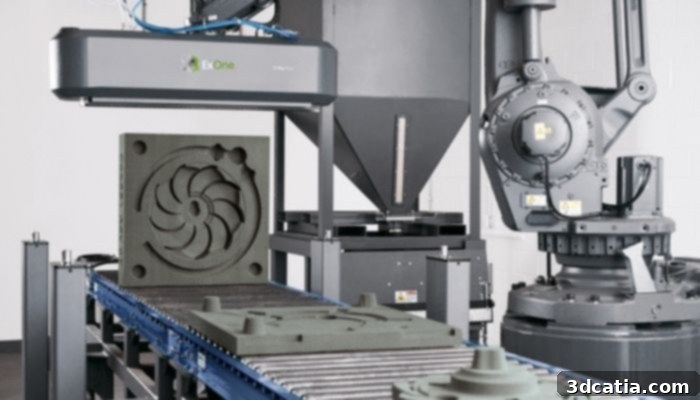
ExOne’s S-Max Flex is engineered to be an affordable and user-friendly solution, broadening access to advanced sand 3D printing. (Photo credits: Business Wire)
Revolutionizing Foundries with the S-Max Flex
For many years, foundries worldwide have recognized the immense potential of 3D printing technologies to rapidly design and produce complex molds and cores. However, the widespread adoption of these solutions has been historically hampered by significant barriers, primarily the prohibitively high cost and the complexity associated with many industrial-grade systems. This financial and operational hurdle has prevented numerous foundries, especially small to medium-sized enterprises, from fully capitalizing on the advantages offered by additive manufacturing.
This is precisely where ExOne’s S-Max Flex emerges as a game-changer. By offering an exceptionally affordable and remarkably efficient solution, ExOne aims to fundamentally democratize the use of additive manufacturing within the foundry industry. The S-Max Flex empowers foundries to overcome traditional limitations, enabling them to manufacture intricate sand molds and cores without the need for expensive, time-consuming traditional tooling. This capability alone represents a massive leap forward, as it drastically reduces lead times, eliminates the need for physical pattern storage, and provides unparalleled design freedom for engineers. Furthermore, by enabling localized, on-demand production, the technology effectively mitigates concerns related to global supply chain disruptions, a lesson learned painfully by many industries in recent years. This strategic shift towards agile, digital tooling has the potential to profoundly revolutionize the foundry industry in the coming years, making it more resilient, responsive, and innovative.
Unpacking the Technology: Speed, Volume, and Future Applications
The S-Max Flex is built upon the foundational strengths of ExOne’s renowned binder jetting expertise, enhanced by Desktop Metal’s innovative spirit. Central to its high performance is the patent-pending Single Pass Jetting (SPJ) process. Unlike conventional binder jetting systems that often require multiple passes to deposit binder and achieve desired part integrity, SPJ streamlines this process into a single, efficient sweep. This innovative approach dramatically boosts printing speed, translating into faster production cycles and increased throughput for foundries. The machine boasts an impressive printing speed of 115 liters per hour, setting a new benchmark for efficiency in its class.
Beyond its speed, the S-Max Flex also offers a generous build volume, measuring 1,900 x 1,000 x 1,000 mm. This large build envelope allows for the creation of sizable sand molds and cores, or even multiple smaller parts simultaneously, further optimizing production workflows. This combination of speed and volume positions the S-Max Flex as a highly productive asset for a diverse range of casting applications, from intricate prototypes to series production of industrial components.
While its immediate and primary application is within the foundry industry, providing an essential tool for metal casting, ExOne and Desktop Metal are looking far beyond this initial market. They envision a future where the S-Max Flex’s capabilities can be harnessed by other demanding sectors, fundamentally transforming their manufacturing processes. The automotive industry, for instance, could leverage sand 3D printing for rapid prototyping of complex engine blocks, lightweighting chassis components, or producing intricate tooling for specialty parts. The construction industry also presents vast opportunities, from creating large-scale, custom molds for unique architectural concrete elements to producing durable, geometrically complex components for infrastructure projects. Even the aerospace sector could benefit from highly customized tooling for composite part manufacturing or intricate core designs for specialized alloys. The versatility of sand 3D printing, now made more accessible by the S-Max Flex, suggests a broad spectrum of future applications, underscoring its potential as a truly transformative technology across various industrial landscapes.
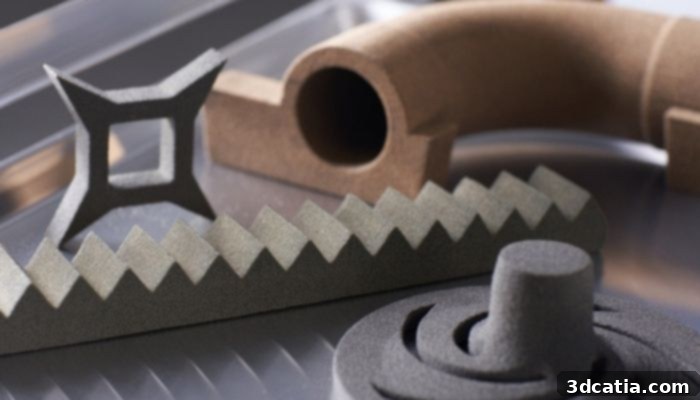
The S-Max Flex is capable of producing parts with exceptional surface quality and intricate details, crucial for high-performance casting. (Photo Credits: Business Wire)
Accessible Innovation for a Sustainable Future
The S-Max Flex represents more than just a new machine; it embodies a strategic shift towards making advanced additive manufacturing technology available to a broader audience. By reducing the entry barrier through affordability and ease of use, ExOne and Desktop Metal are empowering a wider range of businesses to embrace the benefits of digital manufacturing. This includes faster product development cycles, the ability to iterate designs quickly, reduced material waste through optimized geometries, and the flexibility to produce parts on demand without the constraints of traditional tooling. Furthermore, the ability to create complex internal geometries and lightweight structures often impossible with conventional methods opens up new design possibilities for engineers, leading to more efficient and higher-performing components.
This commitment to accessibility is crucial for accelerating the Additive Manufacturing 2.0 revolution, moving industrial 3D printing from niche applications to mainstream production. By equipping foundries with a powerful, yet cost-effective tool, the S-Max Flex ensures that these foundational industries can not only remain competitive but also lead the charge in innovation. Its robust capabilities, combined with the strategic vision of Desktop Metal and ExOne, position the S-Max Flex as a cornerstone technology for the next generation of industrial manufacturing, promising a future of distributed, sustainable, and highly efficient production across various sectors.
What are your thoughts on the S-Max Flex, the groundbreaking new sand 3D printing solution from Desktop Metal and ExOne? We invite you to share your insights in a comment below or connect with us on our LinkedIn, Facebook, and Twitter pages! Don’t miss out on the latest advancements in additive manufacturing – sign up for our free weekly Newsletter here to get the hottest 3D printing news delivered straight to your inbox. You can also explore all our informative videos and technology deep dives on our dedicated YouTube channel.
*Cover Photo Credits: ExOne