
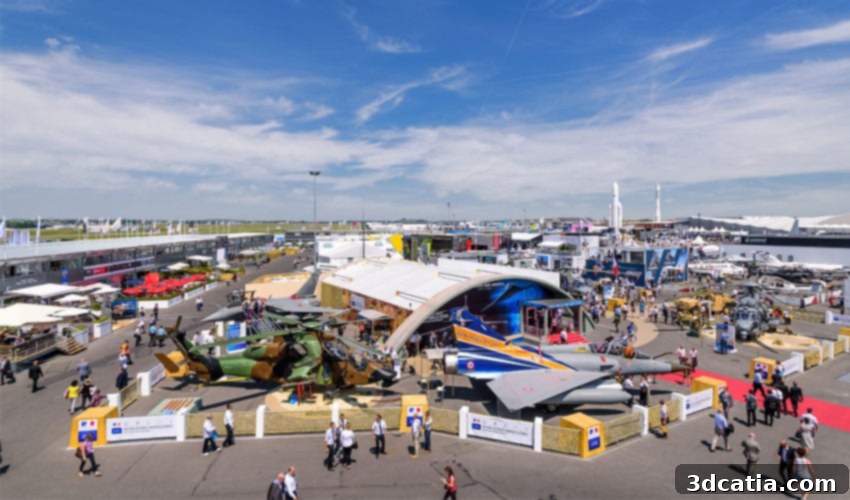
Revolutionizing Flight: A Deep Dive into Additive Manufacturing at the Paris Air Show 2019
The 53rd edition of the prestigious International Paris Air Show (SIAE 2019), hosted at the sprawling Parc des Expositions du Bourget, concluded its week-long spectacle yesterday, leaving an indelible mark on the global aerospace industry. From Monday, June 17th, thousands of participants, ranging from industry titans to emerging innovators, converged to explore the latest advancements shaping aviation and space exploration. Our dedicated team from 3Dnatives was privileged to attend this monumental event, immersing ourselves in the vibrant atmosphere and engaging with key players in the additive manufacturing sector. It is no secret that the aerospace industry stands as one of the earliest and most enthusiastic adopters of 3D printing technologies, seamlessly integrating them into its complex manufacturing processes. Consequently, our presence at the show was paramount, and today, we are thrilled to share our exclusive insights and comprehensive overview of the event’s most significant additive manufacturing revelations.
The profound impact and accelerating trajectory of additive manufacturing within aerospace are underscored by recent market analyses. In 2018, Research and Markets published a pivotal study on the aerospace additive manufacturing market, forecasting an impressive annual growth rate of 23.01% through 2021. This robust growth trajectory is a clear testament to the sector’s vibrant health and its increasing reliance on advanced manufacturing techniques. 3D printing technologies are not merely supplementary but are becoming indispensable for the aerospace sector due to their unparalleled ability to facilitate the creation of parts that are complex in geometry, unique in design, significantly lighter, and often more cost-effective. Over the past few years, continuous advancements in associated technologies, coupled with the development of cutting-edge materials, have empowered industry leaders to achieve unprecedented levels of competitiveness. This innovation has led to a dramatic expansion in the scope of applications, transforming everything from high-performance turbine blades and intricate rocket engine components to robust hub carriers and intricate internal structures. The sheer breadth of possibilities unlocked by additive manufacturing seems truly endless, pushing the boundaries of what is achievable in aerospace engineering.
The previous edition of the Paris Air Show had already set a high benchmark, drawing an impressive assembly of 2,381 exhibitors from 48 countries and attracting over 300,000 visitors, including 140,000 industry professionals. This year’s iteration proved to be another resounding success, captivating attendees with its scale and innovation. Our 3Dnatives team had the unique opportunity to experience firsthand the palpable excitement and groundbreaking developments showcased throughout the event. We observed approximately 30 exhibitors specifically presenting their diverse additive manufacturing solutions tailored for the demanding aerospace industry. Among the many compelling displays, Stratasys particularly caught our attention with their innovative aircraft cabin concept, which prominently featured a multitude of 3D printed parts. During our conversation, Eric Bredin, Managing Director at Stratasys, eloquently articulated the transformative potential of their technology, stating, “We can manufacture almost anything around the seats, except the seat itself. Our technology is incredibly interesting for manufacturers because it allows them to produce solid yet exceptionally light parts, primarily thanks to the advanced lattice-cell structure technology that we have meticulously developed. This capability translates into significant weight savings for airlines, which, in turn, directly reduces operational costs and enhances fuel efficiency – a critical advantage in today’s competitive aviation landscape.” This direct insight underscores how specialized design and material utilization are driving efficiency and innovation in aircraft interiors.
The Rise of Metal and High-Performance Materials in Aerospace Additive Manufacturing
Beyond innovative cabin components, the Paris Air Show 2019 highlighted the critical role of advanced materials, particularly metals, in aerospace additive manufacturing. Trumpf, a prominent 3D printer manufacturer renowned for its precision engineering, was a notable presence at the show, showcasing its cutting-edge metal additive manufacturing solutions. Leveraging its deep expertise in laser development, Trumpf demonstrated how its technology is enabling the creation of robust, high-performance metal components essential for modern aircraft and spacecraft. Metal remains the most widely utilized material in the aerospace industry, prized for its strength, durability, and resistance to extreme conditions. We observed a significant number of 3D printing service providers specializing in metal additive manufacturing, including industry leaders such as GMP Additiv, Erpro Group, Volum-e, Initial, and Spartacus3D. These companies are instrumental in providing specialized design, printing, and post-processing services, helping aerospace firms integrate complex metal parts into their supply chains efficiently.
In addition to metals, the demand for high-performance polymers is rapidly escalating within the aerospace sector. Materials such as PEKK and ULTEM are becoming increasingly popular due to their exceptional mechanical properties, which are often comparable to some metals, yet they offer the significant advantage of being considerably lighter. These polymers are engineered to withstand extreme temperatures, resist harsh chemicals, and exhibit excellent flame-retardant characteristics, making them ideal for applications ranging from internal ducting and structural brackets to electrical housings and specialized tooling. The filament manufacturer Armor 3D further underscored this trend by presenting its new aerospace-grade filament, PEI-9085, an advanced material designed to meet the rigorous safety and performance standards of the aviation industry. These material innovations are pivotal in achieving the dual goals of enhancing aircraft performance and reducing overall weight, which directly translates to improved fuel efficiency and lower operational costs. The image below vividly illustrates the impact of this approach, showcasing a hub carrier optimized by Sokaris Engineering and 3D printed by Erpro Group, achieving an impressive 30% weight savings through intelligent design and advanced material use.
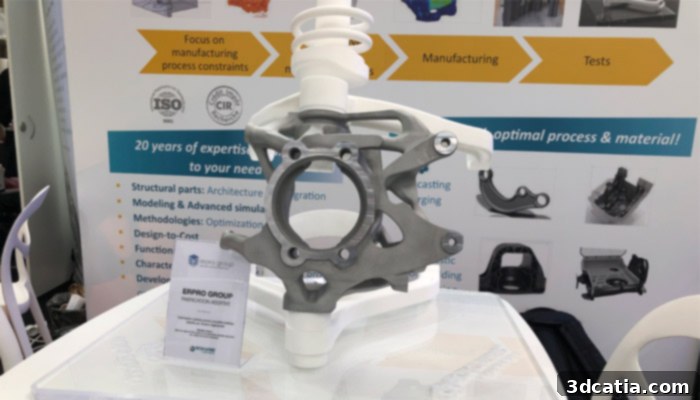
Hub carrier optimized by Sokaris Engineering and 3D printed by Erpro Group – both partners obtained 30% weight savings | Credits: 3Dnatives
Empowering Innovation: The Role of Software in Aerospace Additive Manufacturing
The Paris Air Show 2019 also cast a spotlight on the indispensable role of advanced software solutions in unlocking the full potential of 3D printing for aerospace. Additive manufacturing’s capabilities are inextricably linked to sophisticated design and engineering tools that can handle the complexity and precision required by the industry. Dassault Systèmes, a global leader in 3D design software, was prominently featured, showcasing its powerful 3DEXPERIENCE platform. This comprehensive platform serves as a collaborative environment for the entire product lifecycle, from initial conceptualization to final manufacturing and beyond. Notably, Airbus, a titan in commercial aircraft manufacturing, has partnered with Dassault Systèmes for over five years, leveraging the 3DEXPERIENCE platform to facilitate seamless collaboration across various disciplines, including 3D designs, intricate engineering simulations, manufacturing processes, and advanced intelligence applications for its aircraft. This partnership exemplifies how integrated software solutions are critical for managing the vast complexities of modern aircraft development and production.
Another significant software innovator present was CoreTechnologie, which introduced its specialized 4D_Additive CAD software. This tool is specifically designed to address the unique challenges and opportunities presented by additive manufacturing. The software’s capabilities include enabling the creation of highly optimized lightweight constructions, often incorporating complex lattice structures that maximize strength while minimizing material usage. Furthermore, it assists in generating intelligent support structures crucial for successful metal additive manufacturing, ensuring dimensional accuracy and preventing warping during the printing process. Such software is vital for design for additive manufacturing (DfAM), allowing engineers to fully exploit the design freedom offered by 3D printing to create parts that were previously impossible to manufacture using traditional methods. The ability to simulate and optimize these complex geometries before physical production significantly reduces design iterations, saves material, and accelerates the development cycle – all critical factors in the highly regulated and cost-sensitive aerospace industry. The advancements in software represent a foundational pillar for the continued growth and innovation of additive manufacturing in aviation.
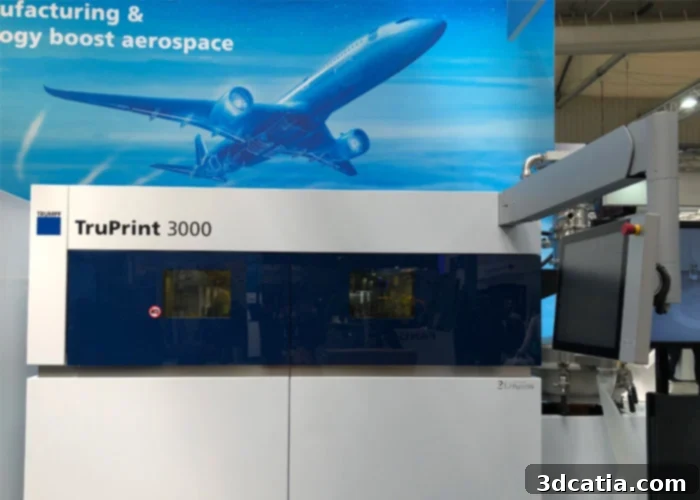
Trumpf 3D printer, presented at the show | Credits: 3Dnatives
Aviation and aerospace are undeniably two of the pioneering sectors for additive manufacturing, primarily because of their inherent demand for innovation, precision, and performance. Components in these industries are often unique, requiring highly specific adaptations to meet stringent operational and safety requirements. This level of customization and the need for tailor-made solutions make 3D printing an ideal manufacturing method. Moreover, aerospace is an industry characterized by some of the highest safety and certification standards globally. Every part, every process, and every material must undergo rigorous testing and qualification to ensure unwavering reliability and passenger safety. This is precisely why additive manufacturing technologies are poised to play an increasingly critical role and benefit this industry considerably. The ability to produce complex, high-performance parts with reduced weight, consolidated assemblies, and improved mechanical properties directly addresses many of aerospace’s core challenges. Furthermore, advancements in process control and material qualification are steadily paving the way for wider adoption in mission-critical applications.
The enthusiasm and innovation showcased at the Paris Air Show 2019 clearly indicate that additive manufacturing is not just a trend but a transformative force reshaping the aerospace landscape. We fully anticipate that the presence of 3D printing solutions and their associated technologies at future air shows will continue to grow exponentially, reflecting their deepening integration into every facet of flight and space exploration. From lighter, more fuel-efficient aircraft to advanced rocket components and on-demand maintenance parts, additive manufacturing is driving a new era of innovation. The continuous evolution of materials, machines, and software ensures that this technology will remain at the forefront of aerospace advancement for decades to come, enabling breakthroughs that were once thought impossible. The future of flight is indeed being 3D printed, piece by intricate piece.
What were your thoughts on the Paris Air Show 2019, particularly regarding the role of additive manufacturing? We would love to hear your perspectives! Share your insights and comments below, or engage with us on our Facebook and Twitter pages! And don’t forget to sign up for our free weekly Newsletter, to receive all the latest news and updates in the fascinating world of 3D printing delivered straight to your inbox!