
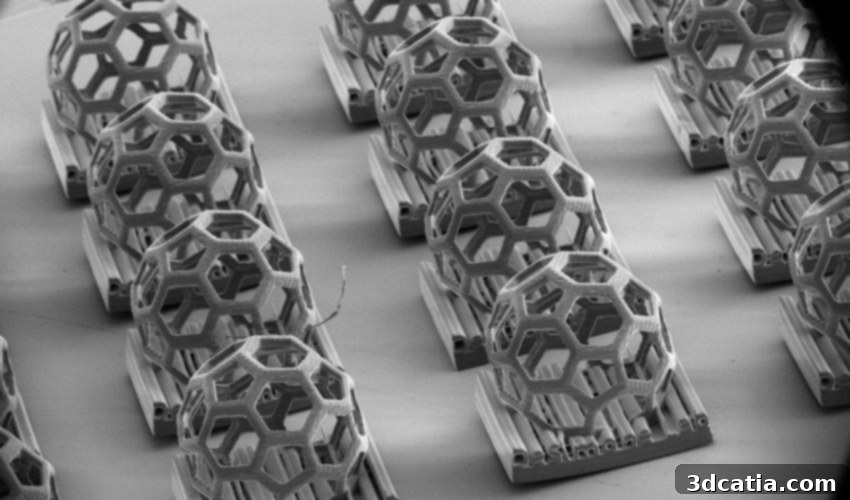
Over the past year, the field of microscale 3D printing has witnessed a series of remarkable advancements, pushing the boundaries of what is possible in miniaturized manufacturing. This exciting trajectory continues with a groundbreaking development from researchers at Stanford University in California. They have successfully engineered a novel microscale 3D printing process capable of producing intricate particles in a vast array of shapes. The true marvel of this new technique lies in its unprecedented speed, boasting the capacity to generate up to one million highly detailed and fully customizable particles with remarkable efficiency, every single day.
This innovation marks a significant leap forward for additive manufacturing, particularly at the micro-level. The ability to rapidly fabricate microscopic components with precision opens doors to countless applications across various industries. According to a press release issued by Stanford, these sophisticated 3D-printed microscopic particles are poised to make a substantial impact in sectors such as manufacturing, medicine, and scientific research. Their potential uses are incredibly diverse, including specialized applications in advanced microelectronics, the intricate world of microfluidics, serving as high-precision abrasives for complex manufacturing processes, and even revolutionizing drug and vaccine delivery systems. This pivotal research was generously supported, in part, by critical funding from the Bill & Melinda Gates Foundation and the National Science Foundation Graduate Research Fellowship Program, highlighting its recognized global importance.
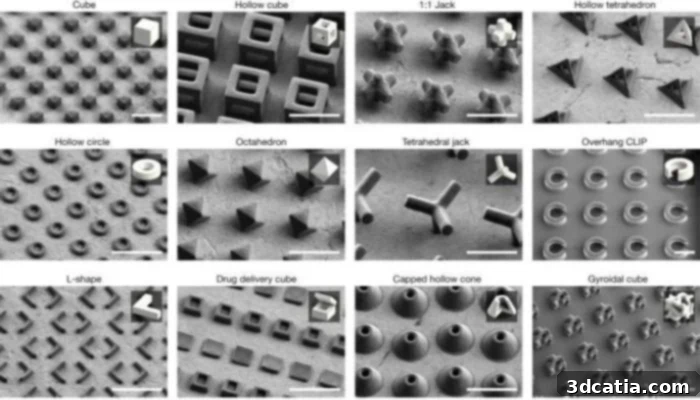
Geometries produced with r2rCLIP (image credits: Kronenfeld, Rother, Saccone, Dulay & DeSimone)
The Dawn of High-Speed Microscale Particle Manufacturing
For many years, the production of such microscale particles has presented formidable challenges to engineers and scientists alike. Achieving precise control over the minuscule dimensions and intricate geometries of these particles in a scalable manner has been exceptionally difficult. Traditional methods often involved painstaking manual labor, were severely limited in throughput, or lacked the necessary customization capabilities. Producing these minute structures required a very specific and delicate combination of meticulously controlled light exposure, finely tuned resin properties, and precise stage movement—parameters that were hard to maintain consistently for mass production. However, this newly developed photopolymerization process from Stanford offers a transformative solution, promising to overcome these historical hurdles and unlock unprecedented manufacturing capabilities.
The implications of being able to create millions of highly customized micro-particles daily are profound. This technology is not merely an incremental improvement; it represents a paradigm shift in how we approach the design and fabrication of micro-components, enabling innovation at scales previously deemed impractical or impossible.
Unlocking Diverse Applications with Micro-3D Printing
The versatility of these rapidly produced microscale particles means they can serve a multitude of functions across various high-tech industries. In microelectronics, for instance, these custom particles could be used to create highly specialized components for advanced sensors, miniature circuits, or even novel packaging solutions, pushing the boundaries of device miniaturization and performance. The field of microfluidics, which deals with the behavior, precise control, and manipulation of fluids at the sub-millimeter scale, stands to benefit immensely. Custom-designed micro-particles could be integrated into lab-on-a-chip devices, enhancing their diagnostic capabilities, or used to create more efficient and precise micro-pumps and valves.
Beyond electronics and fluidics, these particles could revolutionize complex manufacturing processes. Acting as precision abrasives, they could enable ultra-fine finishing of surfaces with unprecedented control, critical for industries requiring microscopic precision, such as optics or advanced materials. Perhaps one of the most exciting prospects lies in medicine. The ability to customize particles at the microscale is critical for advanced drug and vaccine delivery. These particles could be engineered to encapsulate active pharmaceutical ingredients, providing targeted delivery to specific cells or tissues, controlling drug release rates, and improving therapeutic efficacy while minimizing side effects. This could lead to a new generation of smart medicines and highly effective vaccines, especially beneficial for personalized medicine initiatives.
The Visionary Behind the Innovation: Professor Joseph DeSimone
Joseph DeSimone, the Sanjiv Sam Gambhir Professor in Translational Medicine at Stanford Medicine and a corresponding author of the pivotal paper, articulates the profound impact of this new technology. He explains, “Using light to fabricate objects without molds opens up a whole new horizon in the particle world. And we think doing it in a scalable manner leads to opportunities for using these particles to drive the industries of the future. We’re excited about where this can lead and where others can use these ideas to advance their own aspirations.” His statement underscores two critical aspects of this breakthrough: the inherent advantage of moldless fabrication, which allows for unparalleled design freedom and rapid iteration, and the crucial emphasis on scalability. The ability to produce these complex micro-objects not just in a lab setting, but at an industrial scale, transforms what was once a scientific curiosity into a powerful tool for commercial and medical innovation. This vision sets the stage for a future where micro-manufacturing is not just precise but also pervasive.
From CLIP to r2rCLIP: A Journey of Innovation
The foundation of this groundbreaking microscale particle process is built upon “Continuous Liquid Interface Production” (CLIP), a rapid resin 3D printing technology first introduced by DeSimone and his colleagues in 2015. Many in the additive manufacturing community may recognize CLIP as the core technology behind Carbon’s highly innovative 3D printing systems. CLIP revolutionized resin-based 3D printing by significantly boosting print speeds compared to traditional stereolithography (SLA) methods. This remarkable speed is achieved by an ingenious mechanism: sensitive structures can harden continuously without the need for the cured layer to be repeatedly torn away from the bottom of the resin vat, a process that slows down conventional SLA. This continuous printing is made possible by an oxygen-permeable window situated above the UV light source. This window creates a thin, persistent “dead zone” of uncured resin, preventing the liquid plastic from hardening directly onto the window and thus eliminating the problematic sticking and peeling steps that typically constrain print speeds.
Understanding Continuous Liquid Interface Production (CLIP)
At its heart, CLIP utilizes a digital light projector to selectively cure liquid photopolymer resin layer by layer, building an object from the bottom up. Unlike traditional SLA, which cures each layer and then peels it from the build plate or vat window, CLIP maintains a continuous liquid interface. The oxygen-permeable window allows a controlled amount of oxygen to diffuse into the resin, inhibiting polymerization in a very thin layer directly above the window. This “dead zone” acts as a non-stick surface, allowing the UV light to cure the resin just above this zone, while the newly formed solid part is continuously pulled upwards. This uninterrupted curing process dramatically accelerates print speeds, allowing for the rapid fabrication of complex geometries with excellent surface finishes and mechanical properties.
Introducing Roll-to-Roll CLIP (r2rCLIP): A Paradigm Shift in Scalability
While CLIP itself was a significant advancement, the Stanford researchers envisioned pushing its capabilities further to produce an even larger volume of particles, specifically aiming for up to one million highly detailed and customizable microscale particles per day. Achieving such volumes with the original CLIP setup would still involve substantial manual intervention and considerable time investment. To overcome this limitation and adapt the existing process for the true mass production of customized tiny particles, the team developed an ingenious extension called “roll-to-roll CLIP,” or r2rCLIP for short. The name itself hints at the process’s operational principle, which remarkably mimics a high-speed conveyor belt system.
The r2rCLIP system operates through a series of synchronized steps. First, a continuous film, acting as the substrate, is meticulously stretched and precisely transferred into the CLIP 3D printer’s active area. Instead of printing one large object or a few smaller ones, the modified CLIP engine then prints hundreds, if not thousands, of individual micro-structures onto this moving film simultaneously. This parallel processing capability is central to the system’s high throughput. After the printing phase, the film, now laden with countless micro-objects, moves along the “conveyor belt.” The newly printed structures undergo post-processing steps: they are first washed to remove any uncured resin and then subjected to a final curing stage to achieve their full material properties. Finally, the finished particles are carefully removed from the film, ready for collection and application, while the now-empty film seamlessly rolls up, preparing for the next printing cycle. This automated, continuous process fundamentally transforms microparticle production from a laborious, batch-oriented task into an efficient, high-volume manufacturing operation.
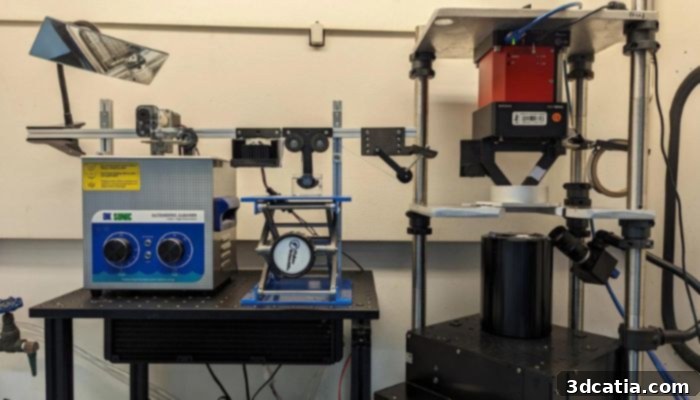
The r2rCLIP setup in the DeSimone lab (photo credits: DeSimone Research Group)
Achieving Unprecedented Speed and Resolution
Jason Kronenfeld, the lead author of the pivotal research paper, elegantly summarizes the core achievement of r2rCLIP: “We’re navigating a precise balance between speed and resolution. Our approach is distinctively capable of producing high-resolution outputs while preserving the fabrication pace required to meet the particle production volumes that experts consider essential for various applications. Techniques with potential for translational impact must be feasibly adaptable from the research lab scale to that of industrial production.” This statement highlights a crucial aspect of high-performance additive manufacturing: the ability to maintain fine detail and accuracy while simultaneously achieving rapid production rates. Often, these two factors are inversely related in 3D printing, making r2rCLIP’s success in balancing them a testament to its innovative design.
Kronenfeld’s emphasis on “translational impact” is particularly significant. It means that the technology isn’t just a fascinating laboratory experiment; it has been developed with the clear intention of being scaled up from academic research to practical industrial application. This focus on industrial viability ensures that r2rCLIP is not just a scientific curiosity but a genuine manufacturing solution capable of meeting the demands of high-volume production across various sectors. The potential for this technology to move beyond the lab and into factories and medical facilities means it could truly transform industries that rely on precise microscale components, making advanced additive manufacturing more accessible and economically feasible for a wider range of uses.
The Future Landscape of Additive Microfabrication
The development of r2rCLIP at Stanford represents more than just an engineering feat; it signals a new era for additive microfabrication. This high-throughput, high-resolution microscale 3D printing process has the potential to democratize the creation of custom micro-objects, enabling rapid prototyping and mass production of intricate designs that were previously too costly or time-consuming to realize. As industries continue to seek smaller, more efficient, and more integrated components, technologies like r2rCLIP will become indispensable. We can anticipate accelerated innovation in areas such as personalized medicine, advanced diagnostics, high-performance electronics, and novel material science, all driven by the ability to precisely engineer matter at the microscale with unprecedented speed and flexibility. This breakthrough not only addresses current manufacturing limitations but also inspires future generations of researchers and engineers to explore entirely new applications for microscopic additive manufacturing.
What are your thoughts on this revolutionary microscale resin 3D printing process for particles? How do you envision r2rCLIP impacting future industries and technological advancements? We would love to hear your insights! Let us know in a comment below or connect with us on our LinkedIn, Facebook, and Twitter pages! Don’t forget to sign up for our free weekly newsletter here to receive the latest 3D printing news straight to your inbox! You can also find all our compelling videos and tutorials on our YouTube channel.
*Cover Photo Credits: DeSimone Research Group, SEM courtesy of Stanford Nano Shared Facilities