
Unlocking the Full Potential: The Cumulative Value of Additive Manufacturing Across the Product Lifecycle
In an insightful analysis of trends in additive manufacturing, Jabil, a prominent manufacturing solutions provider, recently presented a comprehensive overview of how over 300 industry professionals leverage 3D printing technologies. This deep dive explored the diverse applications and evolving practices within the sector, prompting a crucial question: What is the true value of additive manufacturing? Is its impact primarily confined to rapid prototyping, or does its significance extend to tooling applications and beyond? How can we accurately measure its far-reaching influence across the entire value chain?
While many initially perceive the primary benefits of additive manufacturing to be concentrated in the product development phase—specifically, through cost reduction and accelerated timelines—Jabil’s report encourages a broader perspective. The study underscores that the real power of additive manufacturing lies in its ongoing, cumulative, and downstream benefits, which unfold regardless of the specific application. This holistic view emphasizes that the initial advantages are merely the beginning of a much larger, strategic impact.
The Shift Towards Industrialization: Producing Finished Parts
A significant trend highlighted in Jabil’s findings is the undeniable push towards the industrialization of additive manufacturing. The focus is increasingly shifting from mere concept validation to the actual production of small and medium-sized batches of finished, ready-to-use parts. This evolution signifies a maturing market where users are no longer content with just prototypes; they demand sophisticated, reliable manufacturing solutions.
The drive for industrialization is largely fueled by a critical need for repeatability and automation within 3D printing processes. Businesses are striving to integrate additive manufacturing seamlessly into their production workflows, aiming to achieve consistent quality and efficiency at scale. This pursuit of industrial-grade reliability is transforming how companies approach manufacturing. The numbers speak volumes: an impressive 81% of participants in Jabil’s study anticipate that their use of 3D printing for full-scale production will at least double within the next three to five years. This projection alone signals a monumental shift in manufacturing paradigms.
While rapid prototyping undeniably remains a foundational application and currently holds the largest market share when evaluating different uses, its growth rate has begun to stabilize. This plateau suggests that while prototyping continues to be vital, the next frontier of value creation in additive manufacturing lies in its broader integration into industrial production, leveraging its unique capabilities for direct manufacturing.
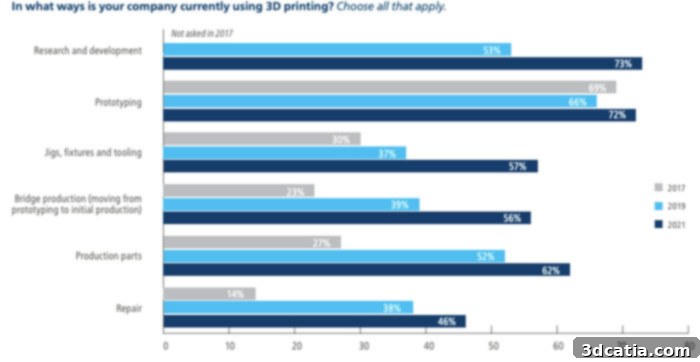
How is 3D printing used in businesses? Prototyping is often the first application (photo credits: Jabil)
Beyond Initial Savings: The Added Value of 3D Printing in Prototyping
The immediate advantages of employing 3D printing in rapid prototyping are widely recognized and profoundly beneficial. Teams can dramatically accelerate design iterations, effortlessly test and evaluate a multitude of concepts, and identify and correct potential defects in record time. These efficiencies translate directly into significant cost savings and reduced time-to-market, which have historically been key drivers for the widespread adoption of in-house additive manufacturing capabilities across numerous companies. However, to fully grasp its value, we must transcend these initial, tangible benefits and consider its impact across the entire product lifecycle and value chain.
According to Jabil, the true, compounding value of additive manufacturing in rapid prototyping extends far beyond the development phase itself, manifesting most profoundly after the finished product has successfully entered the market. By reducing and improving the design cycle, companies can bring superior, more competitive products to market faster. This leads to a strengthened brand image, directly enhanced by higher customer satisfaction resulting from innovative, well-engineered offerings. Consequently, revenues and profit margins increase, initiating what Jabil describes as a “virtuous circle.” This cycle demonstrates how early-stage investments in efficient prototyping translate into sustained market advantage and financial growth, proving that the influence of 3D printing is not just transactional, but transformative.
Revolutionizing Tooling and End-Part Production
Optimizing Production Lines with 3D Printed Tooling
The Jabil study from 2021 revealed a remarkable surge in the use of additive manufacturing for tooling applications, marking a significant 20% increase compared to 2019. This growth highlights a growing recognition of 3D printing’s strategic importance in manufacturing operations. Furthermore, 33% of participants affirmed that additive manufacturing has a decidedly positive impact on the design and production of various tools, jigs, and fixtures. The core value proposition of 3D printing in this context lies predominantly in its ability to enhance production lines. By enabling the rapid, on-demand creation of custom tools, businesses can effectively prevent costly slowdowns and minimize downtime, thereby averting significant financial losses.
Bringing tooling production in-house through additive manufacturing offers several profound benefits. It dramatically shortens or entirely eliminates reliance on protracted external supply chains, reduces the need for extensive physical stock, and drastically cuts lead times. This agility ensures that production lines remain operational and efficient, responding swiftly to changing needs or unexpected requirements. Ultimately, additive manufacturing delivers an immediate, tangible positive impact on operational efficiency, directly contributing to more robust and responsive manufacturing processes.
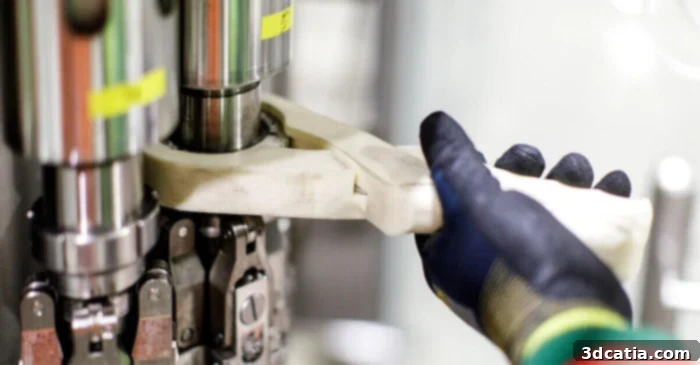
By 3D printing their tools, companies reduce downtime on their production lines (photo credits: Ultimaker)
The Ascendancy of Additive Manufacturing for Finished Parts
The trajectory for producing finished parts via additive manufacturing mirrors the success seen in tooling applications; it is an area that has experienced substantial growth in recent years. John Dulchinos, Vice President of Digital Manufacturing at Jabil, succinctly summarized this evolution, stating, “3D printing technology is getting better and more cost-effective every year. The break-even points this year are 10, 20, 30% better than last year. We’re going to continue to see that kind of compounded annual growth rate.” This continuous improvement in technology, materials, and processes is enabling businesses to achieve better returns on investment, compelling them to extend 3D printing’s utility far beyond initial prototyping stages.
As a result, more companies are confidently employing additive manufacturing for direct part production, moving significant volumes through these advanced processes. Jabil’s study reveals that over 50% of participants now utilize additive manufacturing to produce more than 50,000 parts annually, with an impressive 20% reporting volumes exceeding 100,000 parts per year. This clearly indicates a transition from niche application to a scalable manufacturing method.
Similar to its impact on rapid prototyping, the profound value of additive manufacturing in producing finished parts lies in its capacity to deliver more competitive products. These products often boast improved performance, enhanced functionality, and unique features that would be challenging or impossible to achieve with traditional manufacturing methods. This capability directly contributes to building a stronger brand image and fostering greater customer loyalty. Crucially, this competitive edge is intimately linked to the design phase: the principles of Design for Additive Manufacturing (DfAM) are arguably one of the most significant contributors to the technology’s overall added value, allowing for innovation that directly translates into market success.
Design for Additive Manufacturing (DfAM): The Core of Innovation
The design aspect within additive manufacturing, often encapsulated by the term Design for Additive Manufacturing (DfAM), exerts profound positive impacts across the entire value chain. Whether it pertains to production, maintenance, or sales, DfAM introduces fundamental differences when compared to conventional manufacturing processes. It is here, arguably, that the most significant and transformative value of additive manufacturing truly resides. DfAM liberates designers from the constraints of traditional manufacturing, enabling entirely new approaches to product development.
When considering the capabilities unlocked by DfAM, the advantages become clear. Different design techniques inherent to 3D printing allow for the creation of far more complex geometries without compromising functionality or structural integrity. This includes the implementation of intricate internal lattice structures or the application of topology optimization algorithms, which remove unnecessary material while maintaining or even enhancing part strength. Such innovations lead to significant material savings, reduced weight (lightweighting), and improved performance characteristics that are often unattainable with subtractive or formative manufacturing methods.
Furthermore, strategic design in additive manufacturing enables profound part consolidation. Multiple components that would traditionally be manufactured separately and then assembled can now be designed as a single, integrated print. This capability directly reduces the number of assembly steps, simplifies supply chains for spare parts, and consequently slashes overall manufacturing time and labor costs. DfAM is therefore not just about making things differently; it’s about making fundamentally better products in a more efficient and innovative manner, unlocking unprecedented levels of customization and performance.
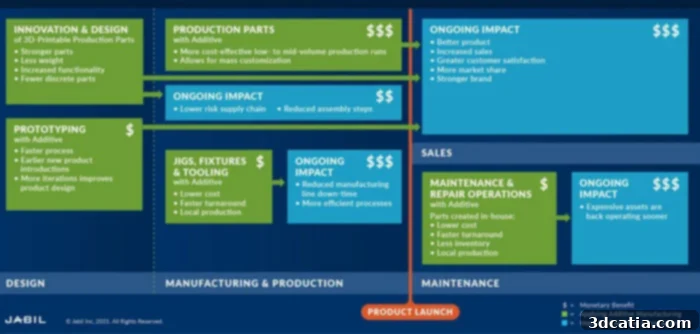
The cumulative benefits of additive manufacturing (photo credits: Jabil)
The Enduring Impact: Cumulative and Downstream Benefits
Jabil’s conclusion powerfully articulates this expanded perspective: “While additive manufacturing provides both clear cost and timing advantages in multiple, discrete stages in the product lifecycle, the cumulative benefits that have a multiplying affect over the total life of a product are far more meaningful. We expect these benefits to grow as new metal additive manufacturing materials or engineered additive manufacturing materials with custom mechanical properties are introduced.” This statement crystallizes the core message: the initial, measurable benefits are foundational, but the long-term, compounding advantages are what truly redefine manufacturing strategies.
These cumulative benefits encompass everything from faster time-to-market and enhanced product performance leading to increased market share, to streamlined supply chains and reduced inventory costs due to on-demand production. The ability to iterate rapidly, design for optimal functionality, and produce custom parts locally creates an ecosystem of innovation and efficiency that reverberates throughout a product’s entire lifespan. As material science continues to advance, introducing novel metal alloys and engineered polymers with tailored mechanical and thermal properties, the scope and scale of these benefits will only intensify. Additive manufacturing is not merely a tool for discrete tasks; it is a strategic enabler for comprehensive, sustainable competitive advantage.
You can download the entire illuminating Jabil study HERE for a deeper dive into their findings and insights.
In your opinion, where do you believe the most significant added value of 3D technologies truly lies? We encourage you to share your thoughts in a comment below or engage with us on our LinkedIn, Facebook, and Twitter pages! Don’t forget to sign up for our free weekly Newsletter here to receive the latest 3D printing news directly in your inbox! You can also explore all our informative videos on our dedicated YouTube channel.
*Cover Photo Credits: Trumpf