
Weekly 3D Printing Innovations: Advanced Post-Processing, Sustainable Construction, and Smart Scanning
This week marks another exciting dive into the rapidly evolving world of 3D printing and additive manufacturing. We bring you a curated selection of the most impactful developments, showcasing how innovative technologies are continually pushing the boundaries of what’s possible. From automating critical post-processing steps to constructing multi-story sustainable homes and enhancing design workflows with intelligent scanning solutions, the advancements highlighted here underscore the industry’s dynamic growth. Our roundup begins with DyeMansion’s groundbreaking new post-processing solutions, followed by an intriguing look at how Formlabs leverages its own SLS technology for production. We then explore an architecturally stunning two-story 3D printed house, introduce a cutting-edge scanning device from Capture 3D, and conclude with a pioneering community of 3D-printed zero net energy homes. Prepare to be inspired by the ingenuity and progress shaping the future of manufacturing.
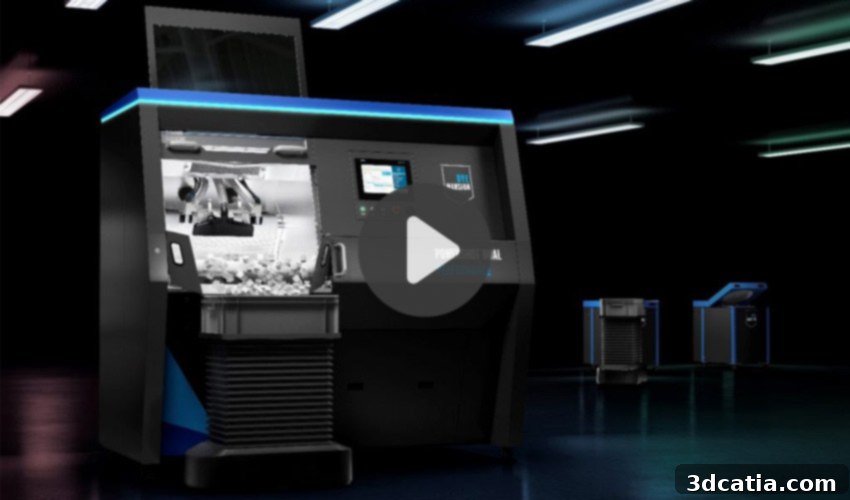
1. DyeMansion’s PowerShot Performance Series: Elevating Post-Processing Automation
Leading German manufacturer DyeMansion, renowned for its expertise in industrial post-processing solutions for 3D printed parts, has once again raised the bar with the introduction of its new PowerShot Performance series. This latest range of industrial machines is engineered to revolutionize the cleaning and coating of additive manufactured components, offering unprecedented speed and efficiency regardless of production volume. Effective post-processing is a critical yet often overlooked stage in the 3D printing workflow, essential for transforming raw printed parts into finished, functional products with desired aesthetic and mechanical properties. DyeMansion’s new systems address this challenge head-on, delivering solutions that are not only faster but also more automated.
The PowerShot Performance series comprises three distinct machines tailored to various post-processing needs: the PowerShot C, designed for efficient cleaning of printed parts; the PowerShot S, dedicated to precise surface finishing and coating applications; and the PowerShot Dual, an innovative integrated solution that combines both cleaning and coating steps into a single, streamlined process. This versatile portfolio provides manufacturers with the flexibility to choose the ideal system for their specific requirements, facilitating seamless integration into existing production lines. By automating these labor-intensive tasks, DyeMansion empowers companies to process large volumes of parts simultaneously, significantly enhancing throughput, reducing manual labor costs, and ensuring consistent, high-quality results. This advancement is particularly impactful for industries scaling up their additive manufacturing operations, where efficient post-processing is paramount for both economic viability and product excellence.
2. Formlabs’ Fuse 1 SLS Printer: Printing Parts for Its Own Success
Formlabs, a company widely recognized for making SLA (Stereolithography) 3D printing accessible, made significant waves in January with the official release of its first Selective Laser Sintering (SLS) 3D printing solution, the Fuse 1. This move marked Formlabs’ ambitious entry into a new segment of additive manufacturing, bringing the power of industrial-grade nylon powder bed fusion to a broader market. What makes this story even more compelling is the ingenious way Formlabs is utilizing its own technology: each Fuse 1 machine incorporates critical parts that were themselves 3D printed on another Fuse 1. This “eating your own dog food” approach serves as a powerful testament to the reliability, precision, and production-readiness of their new SLS platform.
Currently, a dedicated fleet of approximately fifty Fuse 1 printers is actively engaged in producing components for future Formlabs machines. These include essential elements such as the robust chamber door handle, designed for ergonomic and repeated use, and the intricate infrared purge sensor, vital for meticulously regulating the internal heat and ensuring optimal printing conditions within the machine. This internal production strategy offers numerous advantages. It grants Formlabs teams unparalleled agility, enabling rapid iteration and design improvements, as they can quickly print and test new versions of parts. Furthermore, it ensures exceptional quality control over critical components, guaranteeing that every Fuse 1 unit shipped meets stringent performance standards. By leveraging their own technology, Formlabs not only streamlines its supply chain but also demonstrates the immense potential of distributed manufacturing and additive manufacturing for end-use part production, bringing component fabrication closer to user needs and showcasing the Fuse 1’s capabilities in a real-world, high-stakes application.
3. Mense-Korte & Cobod BOD 2: A Landmark Two-Story 3D Printed House
The realm of construction 3D printing continues to expand its horizons, demonstrating not only the feasibility but also the architectural grandeur achievable with additive manufacturing. Renowned German architecture firm Mense-Korte has made significant strides in this domain, collaborating with Cobod to construct one of the most innovative and intricate 3D printed houses to date. Utilizing the advanced Cobod BOD 2 concrete 3D printer, they have successfully completed an impressive two-story building, pushing the boundaries of what was previously thought possible in large-scale additive construction.
The BOD 2, a state-of-the-art gantry-style concrete 3D printer, operates on the principle of material extrusion across its x, y, and z axes. This sophisticated system allows for the precise deposition of concrete layers, building structures from the ground up with remarkable speed and efficiency. Mense-Korte’s project showcased the BOD 2’s capability to operate continuously, day and night, erecting the multi-story structure with minimal human intervention and significantly reduced construction timelines compared to traditional methods. Furthermore, the inherent design freedom offered by 3D printing was fully embraced in the building’s aesthetic. Mense-Korte capitalized on the technology’s ability to create complex geometries and unique architectural features, resulting in a visually striking and highly customized residence. This project stands as a monumental achievement, not only for its two-story height but also for demonstrating the growing maturity and immense potential of concrete 3D printing to deliver sustainable, efficient, and architecturally expressive housing solutions for the future.
4. Capture 3D’s GOM ScanCobot: Automated Precision Scanning Made Easy
In the dynamic landscape of product development and quality control, 3D scanning plays a pivotal role in capturing precise digital representations of physical objects. Capture 3D, a company at the forefront of 3D software and scanning solutions, has long been recognized within the maker community for its accessible 3D scanning applications, such as their popular 3D scanning app compatible with smartphones equipped with a TruDepth camera. Building on this legacy of user-centric innovation, Capture 3D has now unveiled an advanced industrial solution: the GOM ScanCobot.
The GOM ScanCobot is a testament to the company’s commitment to making high-precision automation more approachable. It represents a mobile, integrated system that seamlessly combines several cutting-edge technologies: a high-precision optical ATOS 3D scanner, a collaborative robot (cobot), and a motorized rotation table. This powerful synergy is designed to significantly accelerate pre-production stages such such as rapid prototyping, reverse engineering, and quality inspection. The ATOS 3D scanner ensures exceptionally accurate data capture, critical for intricate designs and tight tolerances. The collaborative robot facilitates automated, repeatable scanning sequences, minimizing human error and maximizing efficiency. Meanwhile, the motorized rotation table allows for comprehensive 360-degree scans of parts, ensuring no detail is missed. The GOM ScanCobot’s standout feature is its user-friendliness, offering an intuitive entry point into the world of automated optical metrology even for those without extensive robotics experience. By streamlining the scanning process, it enables faster design iterations, quicker product launches, and more robust quality assurance, making it an invaluable tool for manufacturing across various sectors, from automotive to consumer electronics.
5. Mighty Buildings & Palari Group: The World’s First 3D Printed Zero Net Energy Home Community
As the global demand for sustainable living solutions intensifies, 3D printing in construction is emerging as a powerful technology to address environmental concerns and housing shortages simultaneously. In a landmark collaboration, Mighty Buildings, a leader in prefabricated 3D printed housing technology, has partnered with the Palari Group to announce their ambitious plan to construct the world’s first community of 3D-printed zero net energy homes. This pioneering development is slated for the upscale city of Rancho Mirage, nestled within California’s picturesque Coachella Valley, setting a new benchmark for eco-friendly and technologically advanced residential living.
A “zero net energy” home is designed to produce as much renewable energy as it consumes over the course of a year, effectively minimizing its carbon footprint and significantly reducing utility costs for homeowners. This sustainable vision is perfectly complemented by the inherent advantages of 3D printing technology in construction. Beyond being inherently more sustainable than traditional building methods—through reduced material waste and optimized resource utilization—3D printing offers several other compelling benefits. These include enhanced price stability, as fabrication processes are more controlled and less susceptible to labor and material fluctuations. The speed of construction is dramatically increased, allowing for quicker project completion and faster occupancy. Furthermore, 3D printing facilitates the creation of higher-quality components with superior insulation and structural integrity, contributing directly to the energy efficiency goals of zero net energy homes. The ability to rapidly and precisely fabricate entire structural modules off-site means homes can be assembled on-site with unprecedented speed and consistency. This innovative partnership between Mighty Buildings and Palari Group not only showcases the transformative potential of additive manufacturing in real estate but also paves the way for a new era of environmentally responsible and economically viable housing solutions.
We hope you enjoyed this week’s exploration into the cutting-edge innovations driving the 3D printing industry forward. From automating complex post-processing tasks to creating sustainable housing solutions and streamlining industrial scanning workflows, the advancements continue to reshape our world. Which of these groundbreaking developments resonated most with you, or which project do you find most impactful for the future? We’d love to hear your thoughts! Please share your insights and comments below, or engage with us on our Facebook, Twitter and LinkedIn pages! For those keen to stay at the forefront of additive manufacturing news, don’t miss out – sign up for our free weekly Newsletter to receive all the latest updates and exclusive content directly in your inbox!