
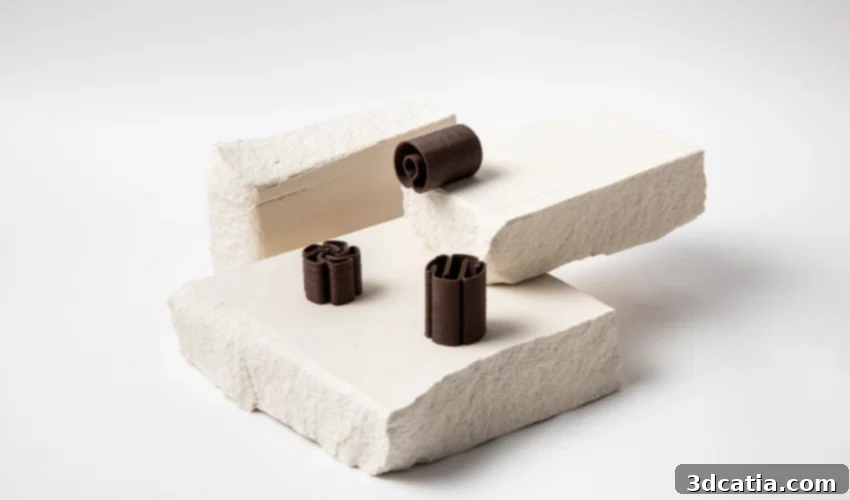
More Than Shape: Crafting Unforgettable Gastronomic Journeys with 3D Printed Chocolate
The intersection of 3D printing and the culinary world is rapidly expanding, paving the way for unprecedented innovation in food design and taste experiences. This exciting trend sees a growing number of projects pushing the boundaries of what’s possible in gastronomy. Earlier this year, we highlighted Revo Foods, a pioneering startup leveraging 3D printing to create plant-based salmon fillets from ingredients like pea proteins, citrus fibers, vegetable oils, and seaweed extracts. Similarly, the acclaimed French startup La Pâtisserie Numérique has been making waves with its digital confectionery. These initiatives signify a widespread movement toward integrating additive manufacturing into our kitchens.
At the forefront of this culinary revolution is Thibault Baes, a visionary designer based in Brussels. His project, “More Than Shape,” exemplifies the potential of 3D printing to redefine how we perceive and experience food. Collaborating with a Michelin-starred chef and a master chocolatier, Baes uses 3D printing to craft intricate chocolate forms, aiming to unlock entirely new sensory dimensions through additive manufacturing. We recently had the opportunity to speak with Thibault to delve deeper into his fascinating work and the philosophy behind More Than Shape.
Introducing Thibault Baes and the Vision Behind More Than Shape
“My name is Thibault Baes, and I am a designer based in Brussels,” he begins. “More Than Shape is the culmination of my graduation project at ENSAV LaCambre. It represents a journey of formal research, dedicated to creating novel taste experiences in the mouth, all made possible through the precise application of 3D printed chocolate.” Baes’ extensive research into this innovative field is structured around four distinct yet interconnected pillars: Compartmentalize, Fold, Support, and Break. Each of these phases explores a unique aspect of how form influences flavor, texture, and the overall gastronomic experience, pushing the boundaries of traditional chocolate making.
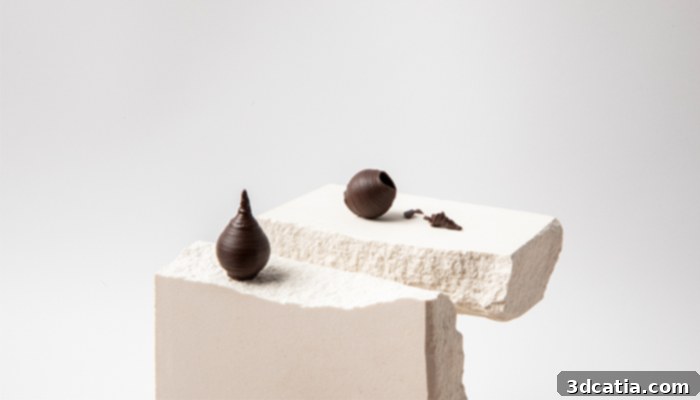
“Break” (photo credits: Thibault Baes)
The Genesis of a Dual Passion: Why Food 3D Printing and Chocolate?
Thibault’s decision to venture into food 3D printing, particularly focusing on chocolate, stemmed from a desire to merge his two profound passions: 3D printing technology and the art of cooking. “My interest in 3D printing ignited around the same time I commenced my design studies,” he explains. “Since then, I’ve acquired multiple printers, gained valuable experience working in a fablab, and immersed myself in the world of additive manufacturing.” When the time came to select a topic for his final graduation project, he was resolute that it had to be intertwined with 3D printing. The notion of applying 3D printing within the gastronomy sector quickly emerged as a compelling and, for him, entirely natural choice. “Initially, it wasn’t an easy path to forge, but I felt immense pride because it perfectly encapsulated my identity and interests,” he adds.
His early explorations involved experimenting with various food “materials.” However, as a designer, Thibault recognized the critical importance of focusing on form and functional application. This realization led him to make a strategic decision: to concentrate exclusively on chocolate. “Chocolate was an ideal choice because, even at that time, it was a material already relatively well-documented and understood within the nascent field of food 3D printing,” he notes. This focused approach allowed him to delve deeply into the interplay of design, texture, and taste, laying the groundwork for More Than Shape’s innovative creations.
The Synergy of Expertise: Collaborating with a Michelin-Starred Chef and Chocolatier
A cornerstone of the More Than Shape project is its unique collaborative model, bringing together Thibault’s design expertise with the profound culinary knowledge of a Michelin-starred chef and the artisanal skill of a chocolatier. “The immense advantage of working alongside food artisans is that each individual contributes their distinct vision and specialized training to the project,” Thibault emphasizes. This multidisciplinary approach ensures that every creation is not only aesthetically groundbreaking but also gastronomically impeccable.
Within the framework of More Than Shape, the chef’s role is pivotal. “The chef was involved primarily because of his intimate understanding of the ‘field’ – the restaurant environment, diner expectations, and current culinary trends,” Baes explains. “He possesses an innate sense of what could be truly interesting and impactful to develop in terms of new taste experiences.” This initial insight forms the bedrock of their creative process. From there, their collaboration unfolds as a dynamic “ping-pong” process. Thibault develops an initial idea or design concept, which he then presents to the chef. The chef, drawing from his vast experience, provides invaluable feedback, suggesting modifications, and guiding Thibault in the most promising directions for further exploration. This iterative cycle of design, feedback, and refinement ensures that the 3D printed chocolate forms are not merely novelties but integral components of sophisticated culinary creations. Ultimately, the chef skillfully integrates these uniquely printed pieces into complete, harmonious dishes, transforming them into unforgettable gastronomic moments. This blend of cutting-edge technology and profound culinary artistry is what truly sets More Than Shape apart.
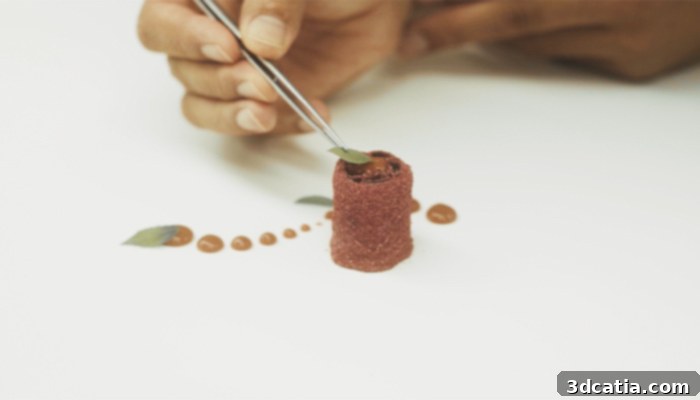
Dessert made by chef Sang Hoon Degeimbre where the 3D printed shape is surrounded by cheese and rolled in a fruit powder (photo credits: Thibault Baes)
The Technology Behind the Delicacy: 3D Printers for Chocolate
Delving into the technical aspects, Thibault details the specific 3D printing technology empowering More Than Shape’s creations. “I primarily utilize Print2Taste printers, which are designed for wire-deposited chocolate,” he states. These specialized food 3D printers operate on a principle similar to Fused Deposition Modeling (FDM), but adapted for edible materials. “They function with a piston mechanism that precisely presses melted chocolate through a nozzle, depositing it in successive layers to build up the desired three-dimensional form.”
His journey began with the Mycusini, the brand’s home-version printer, allowing him to familiarize himself with the basics of chocolate 3D printing. However, for more advanced and customized work, he transitioned to the Procusini. “The Procusini offers a larger build volume and, crucially, allows me the flexibility to use my own custom ingredients and chocolate formulations, unlike the Mycusini which is tied to the brand’s proprietary cartridges,” Thibault explains. While acknowledging the limited options in the market for dedicated chocolate 3D printers, he confirms that the Print2Taste machines have served his needs effectively. “To be honest, that’s about all I’ve found on the market, but they work well for what I need,” he says.
Looking to the future and continuous improvement, Thibault has also invested in the new Choc Mate 2, which recently emerged from a successful Kickstarter campaign. “For me, the Choc Mate 2 represents the best chocolate printer currently available on the market,” he asserts, indicating a commitment to leveraging the most advanced tools for his innovative projects. This continuous exploration of technology ensures More Than Shape remains at the cutting edge of food 3D printing.
Understanding the Chocolate 3D Printing Process
The actual printing process for chocolate, while specialized, is surprisingly intuitive for anyone familiar with consumer-grade 3D printers. “It’s quite straightforward and shares many similarities with a plastic FDM printer,” Thibault clarifies. “The key difference is that instead of loading plastic filament, you insert pre-filled chocolate cartridges into the machine.” The process begins with placing a chocolate cartridge into a specialized syringe-like mechanism. The printer then gently heats the chocolate to its optimal melting temperature, ensuring a smooth, consistent flow for extrusion. Once the chocolate reaches the correct consistency, the machine is ready to commence printing, meticulously building the desired shape layer by layer.
However, Thibault stresses one critical factor unique to chocolate printing: ambient temperature. “The ambient temperature of the printing environment is absolutely paramount for successful chocolate 3D printing,” he explains. “If the room is too warm, the extruded chocolate may melt prematurely or lose its structural integrity, causing the printed piece to collapse. Conversely, if the environment is too cold, the chocolate can solidify too quickly, leading to inconsistent extrusion, blockages in the nozzle, and ultimately a non-continuous print.” Achieving the perfect balance of temperature ensures precise deposition, rapid solidification for structural support, and ultimately, a perfectly formed and textured chocolate creation. This delicate control over environmental conditions is a testament to the blend of art and science inherent in food additive manufacturing.
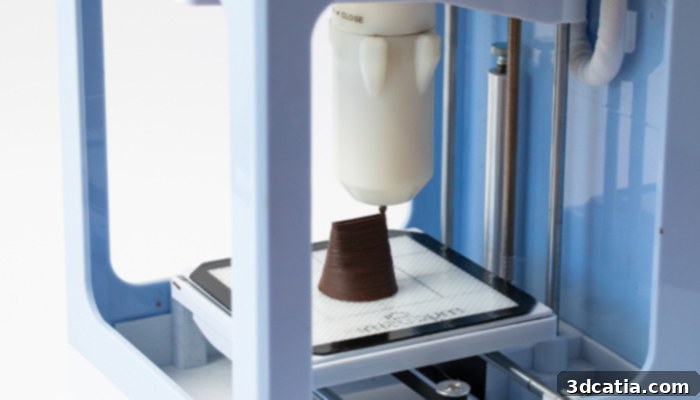
3D printing chocolate (photo credits: Thibault Baes)
Beyond Printing: The Synergistic Role of Other Digital Technologies Like Laser Cutting
While 3D printing is central to More Than Shape, Thibault’s approach is not confined to a single technology. He strategically incorporates other digital fabrication methods, such as laser cutting, to expand the creative possibilities. “My overarching goal is to harness digital technologies for their inherent, intrinsic properties,” he clarifies. For chocolate 3D printing, his philosophy is to transcend mere decoration. “I consistently strive to engineer shapes that are exclusively achievable through additive manufacturing, forms that serve a tangible function, whether that’s enhancing the experience in the mouth or contributing meaningfully to the presentation on the plate, rather than simply being ornamental.”
3D printing, for example, offers unparalleled control over internal geometries. “It allows us to meticulously work on the inside of a shape, creating intricate cavities, hidden chambers, and complex, interwoven folds that would be utterly inaccessible or impossible to achieve through traditional molding or sculpting techniques,” he details. These internal structures are crucial for modulating texture and flavor release. For laser cutting, the benefits manifest differently. “Laser cutting is more about achieving delicate, lace-like precision, cutting extremely small details, or creating precise notches and interlocking elements,” Thibault explains. This technology can be used to craft wafer-thin components, decorative overlays, or structural elements that complement the bolder, more volumetric forms created by 3D printing, creating a harmonious blend of textures and visual complexity in a single culinary creation. This multi-technological approach unlocks a broader spectrum of design possibilities, pushing the boundaries of edible artistry.
The Sensory Impact: Traditional vs. 3D Printed Chocolate
A common question Thibault encounters concerns the fundamental nature of his creations: “Am I often asked if there’s plastic in my chocolate?” he recounts with a slight smile. “But it’s crucial to understand that it is, in fact, classic chocolate – the same high-quality chocolate you know and love.” The transformative difference, however, lies not in the ingredients, but in the method of shaping and its profound impact on the sensory experience.
“The divergence occurs precisely when we impart form through 3D printing,” he elaborates. “When we are able to print chocolate into extremely thin walls and delicate, intricate structures, it fundamentally alters the texture, imparting a distinctly crunchier mouthfeel.” This textural modification, in turn, subtly yet significantly influences the taste perception. The precise layering and often hollow or porous structures created by 3D printing tend to make the chocolate feel “less heavy” on the palate when tasted. This sensation can be attributed to increased aeration within the chocolate’s structure and the way it dissolves in the mouth. It’s not just a visual novelty; it’s an engineered experience where the physical form directly dictates the perceived lightness, crispness, and flavor release, offering a truly innovative take on a timeless treat.
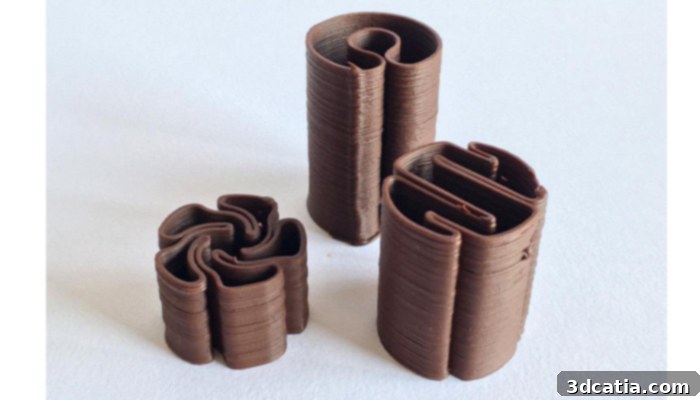
3D printed chocolate tubes (photo credits: Thibault Baes)
3D Printing’s Transformative Role in the Food Sector
Beyond the specific applications in chocolate, Thibault offers a broader perspective on the profound impact of 3D printing on the entire food sector. “It unlocks numerous possibilities that have already been explored in various articles, such as dietary applications – allowing for customized nutritional profiles – and optimizing logistics within the food supply chain,” he acknowledges. These aspects represent significant advancements for efficiency and personalization.
However, for Thibault, whose expertise lies in design, the most compelling contribution of food 3D printing is its revolutionary capacity to introduce novel shapes and entirely new methodologies for creating and plating dishes. “I genuinely perceive 3D printing as an advanced mixer, a full-fledged, indispensable kitchen tool,” he states. “It enables chefs and designers to achieve very specific outcomes that would otherwise be utterly impossible to replicate through traditional culinary techniques, or at the very least, would demand an exorbitant amount of labor and time.” This technology empowers unparalleled precision in form, texture, and structural integrity, allowing for an unprecedented level of creative control that fundamentally alters the landscape of culinary artistry and innovation.
More Than Shape’s Future Horizons
Looking ahead, Thibault Baes and More Than Shape are committed to further democratizing and advancing the art of food 3D printing. “I am currently engaged in conducting various cooking workshops,” he reveals. “These sessions are designed to introduce participants to the fascinating world of food 3D printing, allowing them to get hands-on experience and understand its potential firsthand.” Beyond educational outreach, Thibault is keen to expand the collaborative spirit that underpins More Than Shape’s success. “I am also actively seeking to continue and deepen my work with chefs, culinary innovators, and other key stakeholders within the food industry,” he adds. These future collaborations promise to push the boundaries even further, exploring new ingredients, new forms, and new gastronomic experiences, cementing More Than Shape’s position at the vanguard of culinary technology.
A Final Invitation to Our Readers
Thibault extends a warm invitation to anyone intrigued by his work: “Please feel free to contact me; I am always very open and enthusiastic about discussing my projects and the potential of food 3D printing!” He encourages readers to connect and learn more. “You can also follow my Instagram account @thibaultbaes for the latest updates, or visit my website HERE for comprehensive information about More Than Shape. Thank you!”
What are your thoughts on the groundbreaking innovations coming from More Than Shape and the broader implications of 3D printing in the culinary arts? We invite you to share your perspectives in a comment below, or engage with us on our Facebook and Twitter pages. And for those eager to stay abreast of all the latest developments and breaking news in the exciting world of 3D printing, don’t forget to sign up for our free weekly newsletter, delivered directly to your inbox!