Unlocking Advanced FDM/FFF: The Power of Dual Extrusion 3D Printing with 3DGence DOUBLE
The landscape of Fused Deposition Modeling (FDM) and Fused Filament Fabrication (FFF) 3D printing has revolutionized rapid prototyping and manufacturing. However, these popular additive manufacturing technologies have traditionally faced certain limitations, particularly when it comes to producing multi-color or multi-material parts in a single print job. A common workaround involves pausing a print midway to manually change the filament, a process that is not only time-consuming but also introduces potential points of failure, affecting print quality and efficiency. Fortunately, advancements in 3D printer design have introduced more sophisticated solutions, with dual extrusion 3D printing emerging as a leading method for overcoming these challenges and significantly expanding the capabilities of FDM/FFF.
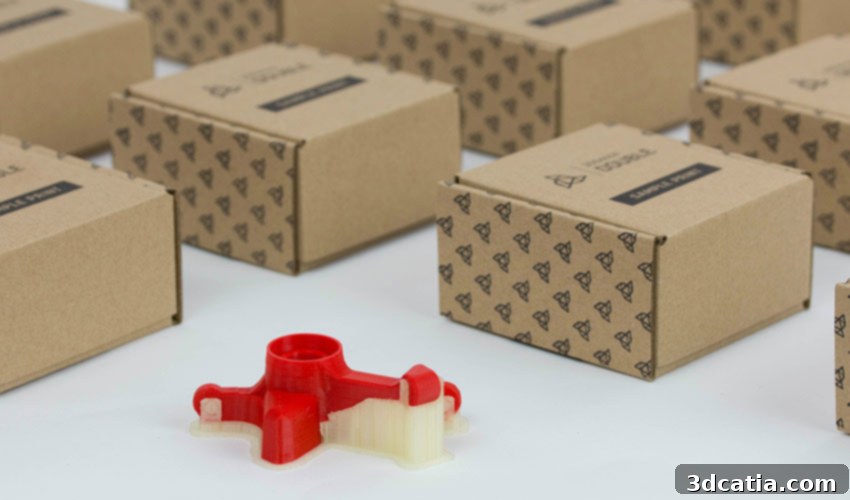
Recognizing the growing demand for more versatile and efficient 3D printing solutions, the innovative Polish company 3DGence has made significant strides in this area. With a strong commitment to pushing the boundaries of additive manufacturing, 3DGence has integrated dual extrusion technology across its line of industrial-grade 3D printers. To emphatically demonstrate the robust capabilities and seamless functionality of their latest machine, the 3DGence DOUBLE, the company has launched a unique initiative: sending out free 3D printing samples. This campaign is specifically designed to showcase how effectively the 3DGence DOUBLE handles soluble support materials, thereby enabling the creation of complex geometries that were previously impossible or highly challenging with single-extruder setups. This proactive approach underscores their confidence in the machine’s performance and its potential to transform various industrial applications.
The Evolution of FDM/FFF: Addressing Core Limitations
Traditional FDM/FFF 3D printers, typically equipped with a single extrusion head, excel at producing robust parts from a single material and color. However, this simplicity comes with inherent limitations. For designs requiring multiple colors, users are forced into labor-intensive filament swaps, risking layer misalignment or print failures. More critically, when fabricating parts with complex geometries, overhangs, or intricate internal structures, support materials become indispensable. Single-extruder machines often use the same primary build material for supports, which necessitates painstaking manual removal post-print. This process can be destructive, leaving rough surfaces, damaging delicate features, and significantly increasing post-processing time and labor costs. The inability to print with different materials simultaneously also restricts the creation of parts with varying mechanical properties, such as a rigid core with a flexible exterior, or parts requiring distinct functional zones.
These limitations have long been a bottleneck for designers and engineers aiming to leverage 3D printing for truly innovative and functional applications. Industries demanding high precision, complex internal channels (like in heat exchangers or fluidic devices), or intricate assemblies have often found single-extruder FDM/FFF insufficient. The need for supports often dictated design choices, compelling engineers to simplify models to avoid excessive, difficult-to-remove structures. This compromised the very essence of additive manufacturing’s promise: design freedom. Therefore, the advent of dual extrusion 3D printing technology marks a pivotal moment, providing a sophisticated solution that directly addresses these long-standing challenges by offering unprecedented flexibility in material usage and design complexity.
Dual Extrusion 3D Printing: A Paradigm Shift in FDM/FFF
Dual extrusion 3D printing represents a significant leap forward in FDM/FFF capabilities. By incorporating two independent extrusion heads, these machines can simultaneously print with two different filaments. This opens up a myriad of possibilities, vastly expanding the creative and functional scope of 3D printing. The most immediate benefit is the ability to produce multi-color parts, allowing for aesthetic enhancements or functional color-coding within a single object, without interruption. Beyond aesthetics, the true power of dual extrusion lies in its capacity for multi-material printing. Engineers can now combine materials with distinct properties, such as a tough, impact-resistant polymer for the main structure and a flexible elastomer for gaskets or dampeners, all within the same print job. This enables the production of highly integrated, functionally optimized components that would otherwise require complex assembly from individually printed or manufactured parts.
However, perhaps the most impactful application of dual extrusion is its synergy with soluble support materials. Unlike traditional supports made from the same build material, soluble supports are specifically designed to dissolve away after printing, typically in water or a specialized solvent. This eliminates the need for manual removal, drastically reducing post-processing time and effort. More importantly, it allows for the creation of parts with exceptionally complex geometries, internal cavities, intricate lattice structures, and delicate overhangs that would be impossible to support and clean effectively with traditional methods. The soluble material can reach areas inaccessible to tools, ensuring a clean and smooth finish on all surfaces, significantly enhancing the quality and functional performance of the final printed object. This capability empowers designers to fully realize the potential of additive manufacturing, moving beyond simplified designs constrained by traditional support removal challenges.
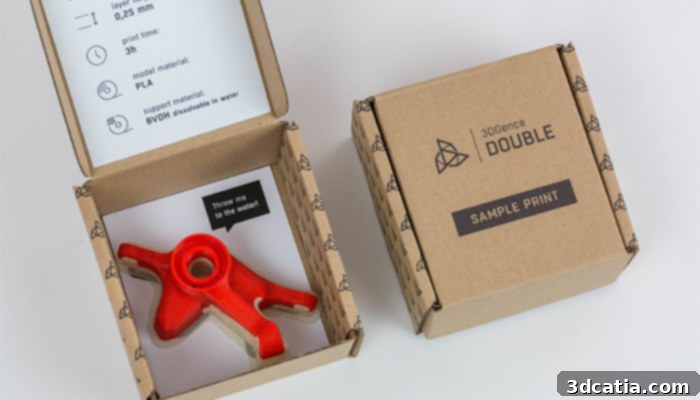
3D printed mountain bike brake model showcasing soluble support capabilities from 3DGence.
3DGence DOUBLE: Pioneering Industrial Dual Extrusion with BVOH
3DGence’s main objective with the DOUBLE is to demonstrate not just the utility, but also the remarkable ease of use of their dual extrusion 3D printer, particularly when utilizing advanced soluble support materials. The company’s choice of material for its soluble supports, BVOH (Butenediol Vinyl Alcohol Copolymer), is a testament to its commitment to superior print quality and user experience. Unlike some other water-soluble support materials such as PVA, BVOH offers enhanced stability and printability, making it more reliable for complex prints while retaining its excellent solubility. This material allows for the supports to be removed with unprecedented simplicity: by merely submerging the printed model in warm water. BVOH efficiently dissolves in water at a temperature of around 50ºC (122ºF), typically leaving no residue and ensuring a pristine surface finish on the primary build material. This process is not only clean and environmentally friendly but also drastically reduces the labor and time associated with post-processing.
The integration of BVOH as a soluble support material is particularly crucial for unlocking new design possibilities. It empowers engineers and designers to create models with extremely complex geometries, intricate internal channels, and delicate features that would be impossible to fabricate cleanly with traditional break-away supports. Furthermore, the ability to print robust support structures that disappear without a trace facilitates advanced developments such as topological optimization in 3D models. Topological optimization generates highly efficient, organic shapes by removing unnecessary material, often resulting in complex internal structures and external forms. With BVOH, these optimized designs can be realized in physical form, pushing the boundaries of lightweighting, material efficiency, and performance in industrial applications. The elimination of manual support removal minimizes the risk of damaging intricate details, ensuring the integrity and precision of the topologically optimized parts, making 3DGence DOUBLE an invaluable tool for cutting-edge engineering and design.
The Mountain Bike Brake: A Perfect Demonstration
To vividly illustrate the advantages of their dual extrusion technology and the power of soluble supports, 3DGence selected a mountain bike brake as their sample model. This choice was strategic, as a brake component often features intricate details, mounting points, and internal channels that would pose significant challenges for a single-extruder 3D printer using conventional supports. The sample was printed using durable PLA (Polylactic Acid) for the functional part and BVOH for the support structures. This combination perfectly showcased the 3DGence DOUBLE’s ability to seamlessly integrate two different materials into a single, high-quality print.
The brake model, printed with a layer height of 0.25mm, takes approximately 3 hours to complete. This relatively short print time for a complex part highlights the efficiency of the 3DGence DOUBLE. After printing, the model is simply submerged in warm water, allowing the BVOH supports to dissolve completely, leaving behind a perfectly formed PLA brake with smooth surfaces and all intricate details intact. This process eliminates the risk of breakage or damage often associated with mechanical support removal, ensuring the structural integrity and aesthetic quality of the final product. The mountain bike brake sample serves as a compelling real-world example of how dual extrusion with soluble supports empowers manufacturers to create previously unachievable designs, offering superior functionality and finish, and significantly streamlining the post-processing workflow.
“3DGence DOUBLE” and its Industrial Dual Extrusion 3D Printing Prowess
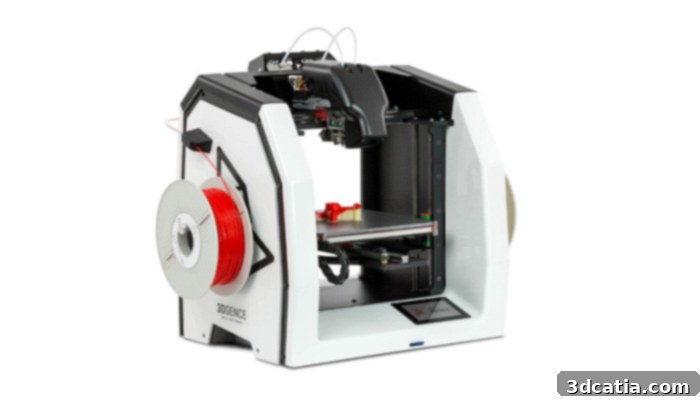
The 3DGence DOUBLE printer made its highly anticipated market debut on March 15th, quickly positioning itself as a formidable contender in the industrial FDM/FFF segment. Equipped with a robust double extruder system, it proudly follows in the footsteps of the brand’s first successful industrial machine, the 3DGence INDUSTRY, which was launched in 2014. This legacy solidifies 3DGence’s tradition of designing and manufacturing machines with a distinct industrial character, focusing on reliability, precision, and performance suitable for demanding professional environments. As highlighted in our ranking of the best dual machines, the 3DGence DOUBLE stands out for its engineering quality and its commitment to solving complex manufacturing challenges, making it an ideal choice for businesses looking to integrate advanced additive manufacturing into their operations.
The core philosophy behind the 3DGence DOUBLE is to elevate dual extrusion 3D printing to a much simpler, yet more powerful level, making it accessible and efficient for industrial adoption. This is achieved through a suite of advanced features designed for seamless operation and consistent, high-quality results. Key among these innovations is sophisticated material flow control, which precisely manages filament deposition from both extruders, ensuring optimal layer adhesion and surface finish, even during multi-material prints. The printer also boasts an advanced autocalibration system, drastically reducing setup time and eliminating the common frustrations associated with bed leveling and extruder alignment. This intelligent feature ensures that every print starts with perfect calibration, minimizing errors and maximizing print success rates.
With a generous print volume of 190 x 255 x 195 mm, the 3DGence DOUBLE can accommodate a wide range of part sizes, from intricate prototypes to functional end-use components. The user experience is further enhanced by a large, intuitive 4.3-inch touchscreen interface, which provides easy access to all printer settings, print monitoring, and job management. These combined features—precision engineering, intelligent automation, and user-friendly controls—make the 3DGence DOUBLE an exceptionally attractive proposition for companies seeking to adopt advanced 3D printing into their production chain. It offers a reliable, efficient, and versatile tool that can significantly accelerate product development cycles, reduce manufacturing costs, and enable the creation of innovative products previously constrained by traditional manufacturing methods. The 3DGence DOUBLE truly embodies the future of industrial FDM/FFF, bringing unparalleled flexibility and performance to the workshop floor.